In a residential bushfire protection system, the controllers are the decision-makers that tie the whole arrangement together. They do not just switch devices on and off. They monitor conditions, compare information, manage pumps and valves, and help the system keep working when conditions become difficult. Part 11 of this series looks at automatic control and redundancy, with a simple rule at its centre: if one controller fails, the other must be able to keep protecting the property without relying on the same weak point.
Why controller redundancy matters
Many homeowners think of redundancy as having a spare part sitting nearby. In a bushfire protection system, that is not enough. True redundancy means the backup is genuinely capable of taking over the complete job by itself. If both controllers depend on the same power feed, the same cable, the same network switch, or the same exposed equipment, a single fault can still disable the whole system.
That is the risk this part of the series addresses. The controllers are the system’s brain. They receive information from sensors, decide what action is needed, and coordinate pumps, sprinkler zones, water management, ventilation and other connected functions. If the brain is unreliable, the rest of the system can be excellent and still fail at the wrong time.
The protection contribution for this part is part of the overall readiness model. That weighting reflects how important automatic control and redundancy are to the system as a whole. It does not mean any percentage chance that a house will survive a fire. Survival depends on many factors, including the fire behaviour, the property layout, maintenance, water supply, ember attack, and the way the entire system has been designed and commissioned.
What the two controllers should do
The core idea is straightforward. Two independent controllers should be installed so that either one can run the entire bushfire protection system if the other fails. In practice, each controller should be capable of making the key decisions and sending the necessary commands to the critical equipment.
That means each controller should understand the active sprinkler zones, the pump status, the water level, the available power, and the condition of the main sensors. It should also be able to respond to changing conditions without waiting for a remote cloud service or a second device that may already be unavailable.
The controllers should not be arranged like a simple master and follower setup where one unit is useless without the other. That can create a hidden single point of failure. Instead, the architecture should allow either controller to stand alone if needed.
What “independent” really means
Independence is not just a label. It means the controllers should be separated in ways that reduce the chance of one event affecting both at once. Where practical, they should be installed in separate protected locations. They should also have separate communication paths to critical equipment and separate electrical supply arrangements where practical.
This does not mean every cable must be completely unique in every property. It means the design should avoid unnecessary common failure points. If a single damaged cable, switchboard issue or network device can take out both controllers, the redundancy has been weakened too much.
Continuous cross-checking between controllers
A strong bushfire control system should not only have two controllers. The controllers should also continuously compare what they are seeing and what they are doing. This cross-checking helps detect faults early and reduces the chance that one controller silently drifts out of step with the other.
Both controllers should compare the same important information, including sensor readings, water level, pump status, power availability, active sprinkler zones, system faults and their own decisions. If one controller sees a hot zone while the other does not, or one believes the pump is running while the other says it is not, the disagreement should be treated seriously.
The aim is not to create an argument between controllers. The aim is to make the system notice when its information is inconsistent and then respond in the safest practical way.
What happens if the controllers disagree
If the controllers disagree, the system should default towards the safer protective action, continue operating where possible, and alert the resident. In many cases, the safer choice will be to maintain or increase protective activity rather than reduce it.
For example, if one controller reports a sensor fault and the other reports rising temperature or ember exposure, the system should not simply shut down because the data is messy. It should treat the uncertainty as a reason to become more cautious. A fault warning is useful, but a total loss of protection can be worse than continued conservative operation.
Independent power and communications
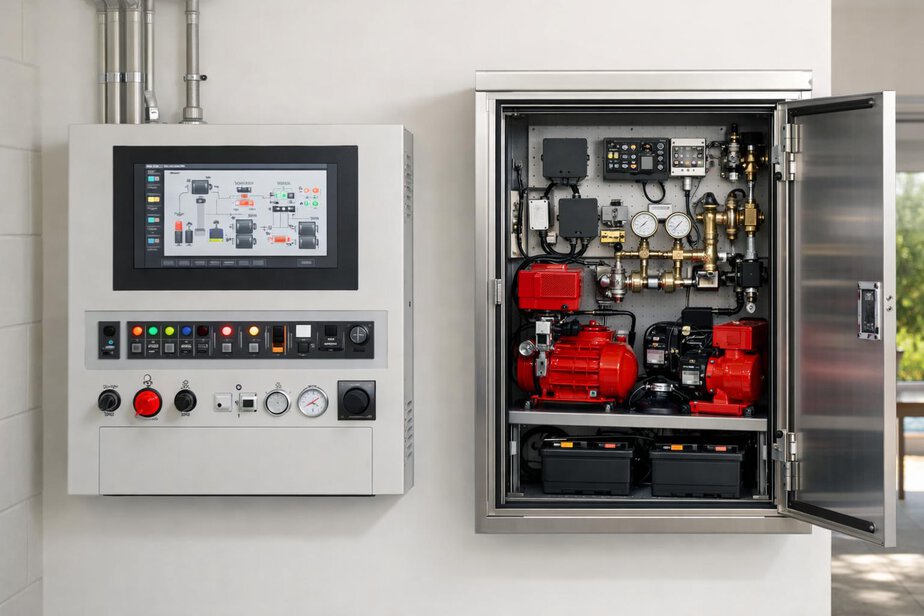
For redundancy to be meaningful, each controller should have its own protected electrical circuit, battery backup and independent power path where practical. Redundant controllers should not depend on one vulnerable power supply. A single switchboard problem, damaged cable or local fault should not be able to take out both controllers at once.
This principle matters even more in a bushfire environment, where power failures are common and external infrastructure may be under strain. A controller that loses its backup battery or depends on the same fragile circuit as the other controller is not truly independent.
Separate communication paths where practical
The same logic applies to communications. Critical equipment such as fire pumps, critical valves, smoke and heat sensors, and firefighter controls should not all depend on one cable, one network device or one communications path if that can be avoided. If practical, separate pathways should be used so that one failure does not isolate both controllers from essential equipment.
Local direct control is especially important. Internet access and mobile coverage are useful for alerts, remote monitoring and record transfer, but they must never be required for the system to protect the property. Loss of cloud access must not stop automatic operation.
It is also wise to avoid designs where both controllers depend on the same shared smart hub or home automation device for critical actions. A single consumer device can become a common point of failure if it hangs, loses power, or stops communicating under heat or smoke exposure.
| Function | Preferred approach | Why it matters |
|---|---|---|
| Controller power | Separate protected circuits with battery backup | Reduces common power failure risk |
| Critical communication | Independent paths where practical | Prevents one link failure disabling both controllers |
| Cloud connection | Optional only | Automatic protection must continue without internet |
| Local equipment control | Direct local control where possible | Maintains operation when remote systems fail |
Fallback mode when information is lost
In a bushfire event, the system may lose one sensor, several sensor links, or part of its communications network. That should not automatically mean the whole system stops. Instead, the control logic should move into a conservative fallback mode.
Fallback mode is a deliberate way of saying, “We do not have complete confidence in the information, so we will act more cautiously.” In practice, that may mean keeping sprinkler zones active longer, maintaining pump operation, preserving water for critical areas, or avoiding non-essential changes until the system has better information.
This is a crucial design principle. Loss of information should generally result in more cautious protection, not reduced protection. A system that becomes less protective the moment a sensor signal drops out can fail exactly when it is needed most.
Examples of conservative behaviour
- Keeping essential zones active if the fire status is uncertain.
- Continuing pump operation while a fault is investigated.
- Alerting the resident that the system is in fallback mode.
- Holding the last known safe configuration instead of making risky assumptions.
- Limiting automatic changes until the controller regains confidence in the inputs.
Fallback mode should be planned and tested, not treated as an afterthought. The homeowner should understand that the system may keep protecting aggressively if it loses confidence in its data. That is usually preferable to an overconfident shutdown.
Manual override with safety interlocks
Automation is valuable, but it should not remove the ability for authorised people to take direct control when needed. Authorised residents, firefighters and service personnel should have manual override capability. This is especially important if a controller faults, a sensor behaves unexpectedly, or an incident demands a different response.
At the same time, critical controls must be protected from accidental or unauthorised changes. Normal household users should not be able to casually shut down the only operating pump during a confirmed fire event. That would be unsafe. Safety interlocks should prevent obviously dangerous actions unless the system recognises that a properly authorised override is being applied.
In practical terms, this means the system should support tiered access. A resident may be able to acknowledge alarms, start or stop selected non-critical functions, or switch to a pre-approved emergency mode. Firefighters or appropriately authorised technicians may need higher-level override capability to change protected settings, isolate equipment, or place the system into a fireground-friendly configuration.
These controls should be simple enough to use under stress, but not so simple that anyone can change life-safety functions by accident. The goal is controlled flexibility, not unrestricted access.
Local logging and event records
Good systems keep a record of what happened. Local event logging is standard practice for the controller architecture because internet and mobile services may fail at the very time the record is most needed. The system should store important information locally so the event history remains available even if cloud communications are unavailable.
The controller should record sensor activations, pump operation, zone changes, water-level changes, power failures, controller decisions, faults and manual overrides. These logs help with troubleshooting, maintenance, post-event review and verification that the system behaved as intended.
Local logging does not need to be complicated for the homeowner, but it should be dependable. The record should survive routine outages, temporary communications failures and controller switchover events. If the system uses remote reporting as well, that is useful, but it should be treated as an extra layer rather than the only record.
For ordinary homeowners, the main value is clarity. If the system enters fallback mode, loses power, or changes zones during a high-risk day, the log can show what happened and when. That can help qualified technicians understand whether the issue was a sensor fault, a power event, a pump problem or a control decision.
Automatic self-testing and fault detection
Controllers should not wait for a crisis before proving that they are healthy. Automatic self-testing should occur at startup and at scheduled intervals. These tests should check processor and memory health, inputs, outputs, communications, power supply, backup controller status and fault reporting.
The self-test should be broad enough to detect obvious internal failures, but it should also be practical. A self-test that is too weak may miss serious faults. A self-test that is too aggressive may interrupt normal protection. The design should be balanced so that the system checks itself without creating unnecessary downtime.
Why self-testing matters
A control fault can be invisible from the outside. A unit may still look powered and connected while an internal error prevents it from making correct decisions. Regular self-testing helps catch that kind of hidden problem before a bushfire arrives.
When a fault is detected, the system should reflect that in the readiness indicator where appropriate. If the system uses Green, Amber and Red style readiness states, a controller fault should influence that status honestly. The homeowner needs a clear picture of whether the system is fully ready, partly degraded, or in a significant fault condition.
Self-testing should also include the backup controller. If the backup is never checked, it may appear available when it is not. That defeats the whole point of redundancy.
Software updates and maintenance without losing protection
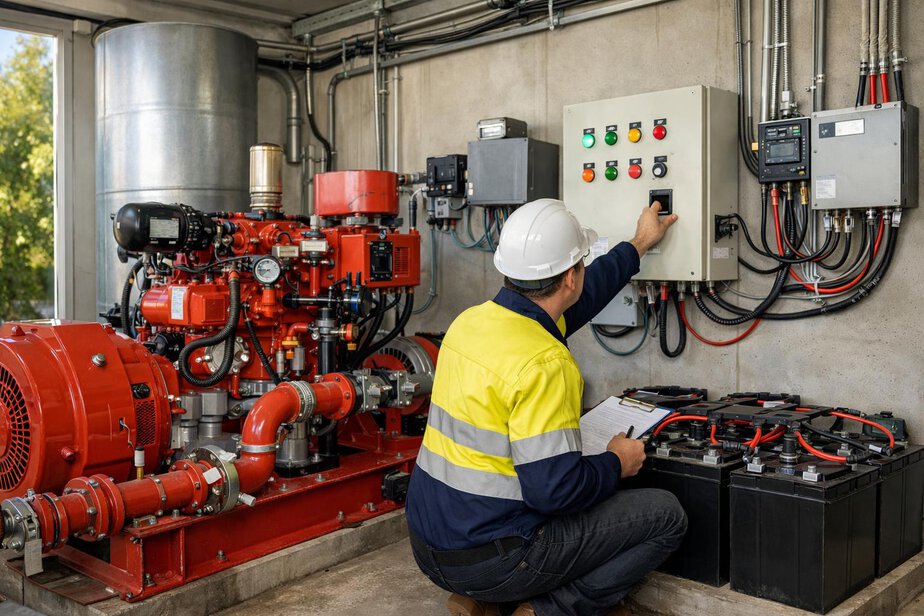
Software and firmware updates are part of modern control systems, but they must be handled carefully. The basic rule is simple: never update both controllers at the same time. Update one controller while the other remains fully operational. Confirm correct operation before updating the second controller.
This approach reduces the chance that an update error, configuration mistake or failed installation disables the whole system. It also gives the resident and technician a chance to verify that the updated controller is behaving correctly before the second unit is touched.
Maintenance planning should extend beyond software. Any work on wiring, communication devices, power circuits or exposed equipment should be done in a way that preserves protective function as much as possible. In a bushfire-ready system, maintenance should not quietly remove the very resilience it was meant to support.
Practical update discipline
- Update one controller only.
- Confirm the updated unit starts correctly and cross-checks with the other controller.
- Verify the system still controls critical equipment as intended.
- Keep the second controller untouched and fully available during the first update.
- Only then update the remaining controller.
This staged approach may seem cautious, but cautious is exactly the right mindset for life-safety automation.
How the controllers fit with the rest of the system
The controllers do not exist in isolation. They need to coordinate with smoke and heat detection, weather sensors, pumps, sprinkler zones, water management, generator control, load shedding, positive-pressure ventilation and firefighter controls. They may also coordinate with manual local controls if higher-level automation fails.
That is why separate power and communications are so important. The more critical functions the controller manages, the more damaging a common fault can become. If one controller can fail completely and the other can still operate pumps, valves, alarms and protective zones, the property has a much better chance of maintaining useful defence under stress.
At the same time, the whole arrangement should fail toward a safe state wherever practical. That does not mean the system should constantly shut itself down. It means that when the system is forced to choose between uncertain and protective behaviour, it should favour protection.
Equipment, controls and cabling located in exposed areas should receive suitable bushfire protection as part of the wider design. Redundancy is not a substitute for shielding, routing and placement. It is one layer in a larger risk-reduction strategy.
What homeowners should understand before installation
For ordinary homeowners, the most important lesson is simple. A redundant control system is only useful if the backup is truly independent and can run the complete system by itself. Ask how the controllers are powered, how they communicate, where they are located, and what happens if one of them fails during a fire event.
It is also sensible to ask how the system behaves when sensors are missing, power is unstable, or communications are interrupted. A good answer will sound conservative and practical. The system should keep protecting, cross-check what it can, log what happened, and alert the resident if anything is wrong.
Homeowners should avoid assuming that automation removes the need for planning or maintenance. A complex controller arrangement still needs commissioning, periodic testing and service by appropriately qualified professionals. The final architecture should be designed and commissioned by qualified control, electrical and fire-system professionals who understand the site and the intended operating sequence.
Redundancy is not about having a second controller somewhere in the system. It is about having a second controller that can genuinely carry the full load if the first one fails.
Conclusion: redundancy must be real, not cosmetic
Automatic control and redundancy can greatly improve a residential bushfire protection system, but only when they are designed properly. Two controllers are only true redundancy if one can fail completely and the other can continue protecting the property without depending on the same failed equipment. Separate power, separate communications where practical, continuous cross-checking, conservative fallback mode, protected manual override, local event logging and staged software updates all help make that possible.
For homeowners, the practical lesson is to look past labels and ask how independence is actually achieved. If the controller arrangement is vulnerable to one common fault, it is not robust enough for a bushfire environment. If it can keep working through loss of sensors, power issues or one controller failure, it is much closer to the level of resilience this series is building toward.
Before publication or installation, verify the facts, system details and local procedures with appropriately qualified professionals, and confirm any site-specific requirements before final design or commissioning.
FireRescue Training Hub
Access practical fire and emergency study support resources, downloads, checklists, audio guides, and member-only course content.
- Course library
- PDF downloads
- Audio guides
- Checklists
Study support only. Not accredited training or a replacement for workplace procedures.
About the author and safety review
Ken Walker
Former Station Officer and fire service educator
Former career firefighter with extensive career and volunteer fire service experience.
Qualifications: Associate Diploma of Applied Science in Fire Technology; Institute of Fire Engineers studies.
Author profilehttps://www.firerescue.com.au/about-us/