Grassfire attack is never just about driving fast or putting water on flames. It is about disciplined people, clear leadership and tankers working as one team. When every firefighter, driver, crew leader and incident controller does their job properly, the crew can hold a line, protect each other and keep the fire from getting away.
Why discipline matters in grassfire attack
Grassfires can move quickly through continuous fuel, especially when winds are strong and dry. A fire that looks manageable at one moment can change shape, speed or direction with very little warning. In that environment, discipline is not a nice extra. It is a core safety tool.
Discipline means more than following orders. It means every person managing their own actions, staying alert and thinking about the people around them. It means the driver checking the vehicle position, the crew leader keeping the task clear, the firefighter watching the fire edge and the incident controller maintaining the big picture. When one person becomes distracted, rushed or careless, the risk spreads across the whole crew.
There are two sides to discipline on the fireground. The first is self-discipline. Each firefighter must know their task, wear the correct protective clothing and equipment, keep hydrated, secure loose gear and stay inside the agreed safety system. The second is team discipline. Crews must follow the same operating method, use the same radio channel, keep their spacing and respond quickly to changes in fire behaviour.
Firefighter safety always comes before property protection and fire suppression. That is not a weakness. It is how a professional crew stays effective for the whole shift, not just for the first few minutes.
First actions, control and the first briefing
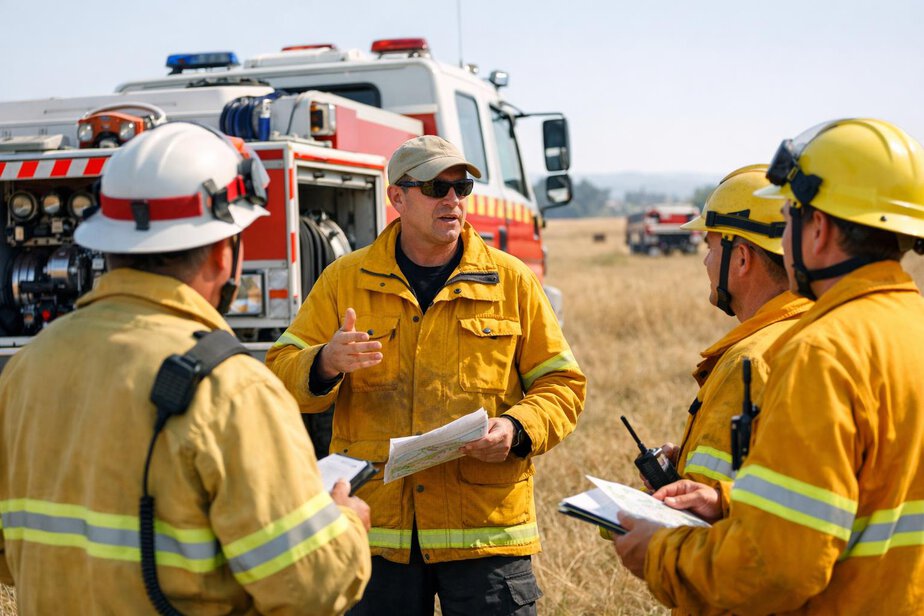
The first officer or crew leader arriving at a grassfire may initially act as incident controller until the incident is handed over or formally assigned. That person should establish control, assess the fire, identify obvious hazards and provide a clear situation report. Even a short early briefing can save time and prevent confusion later.
The first steps should focus on what matters most: where the fire is, how fast it is moving, what the wind is doing, what access exists and whether there is a safe place to begin work. The crew should also think about where the fire could go next if conditions change. Roads, tracks and burnt ground may provide useful anchor points, but they must be checked against the actual fire behaviour and access conditions.
Incoming crews need a proper briefing before they begin work. At minimum, they should know:
- their allocated task
- who they report to
- the radio channel
- the attack method
- known hazards
- safety arrangements
- escape routes and anchor points
A clear briefing is not bureaucratic delay. It is the foundation of disciplined work. It gives each tanker crew the information needed to operate without creating conflict or confusion on the fireground.
The chosen attack method must suit the conditions. Direct attack, parallel attack and indirect attack all have a place, but the decision should consider fuel, weather, topography, fire intensity, flame height, access and available resources. Direct attack involves working close to the burning edge. It is usually the best option only when flame height and intensity allow firefighters to work safely. If the fire is too hot, too fast or too unpredictable, a different method may be safer and more effective.
Anchor points, escape routes and the safe place to start
A disciplined attack starts from a secure anchor point. An anchor point is a safe or advantageous location from which firefighting work can begin. It helps prevent crews from being outflanked by the fire while they build control along the edge. A road, track or area of burnt ground may be a suitable anchor point, but only if it is genuinely safe and practical under the current conditions.
Working from an anchor point matters because grassfire edges can run around a crew faster than expected. If the fire gets behind the operation, the risk rises sharply. That is why the crew should understand where the fire is likely to move and how to retreat if needed. Every tanker line should have an agreed escape route that is realistic for the vehicles, the terrain and the wind direction.
Escape routes are not a last-minute idea. They should be identified before the first tanker fully commits. If the route involves turning a heavy vehicle, crossing soft ground or reversing under smoke, it may not be reliable enough. The safest route is one that can be used under stress, with limited visibility and changing fire behaviour.
The fireground also needs a sensible separation between the working edge and the rest of the operation. Crews should know where machinery is moving, where support vehicles are parked and where personnel are standing. Falling trees, branches, hidden hollows and other ground hazards can become more dangerous when crews are focused on the flame front.
In a busy grassfire, the strongest-looking path is not always the safest one. Discipline means checking the route, choosing a secure start point and being prepared to change the plan if the fire or the ground conditions make the original approach unsafe.
How a coordinated tanker line works
Tankers can be highly effective when they work in a coordinated line along a long grassfire edge. This is not simply a matter of sending several vehicles to the same spot. It requires a common operating method, careful spacing, good communication and a clear understanding of which tanker is doing what.
The first tanker carries the main initial attack. A firefighter directs water at the base of the flames to achieve maximum penetration and knockdown. The aim is to cool and suppress the fire where it is burning hardest, not just to wet the top of the flames. In many cases, a second firefighter may follow behind with an appropriate spray or fog pattern to complete the knockdown and provide emergency protection from rising radiant heat.
The second tanker follows the first tanker and helps extinguish fire that was missed or has reignited. That follow-up action matters because grassfires often leave thin strips of heat, small pockets of flame and smouldering patches along the edge. If these are ignored, they can flare again as wind shifts or as unburnt fuel is exposed.
The third, fourth and fifth tankers add further knockdown, backup and rotation capacity. They allow the line to keep moving while one tanker refills or repositions. They also provide resilience when the crew needs to pause for a hazard, a change in wind or a handover to another section of line.
Tankers in a line should not operate as isolated units. They should function as one disciplined team. The goal is not just to extinguish visible flame. It is to hold the edge, protect each other, stop missed fire and prevent relights that could break the line later.
The practical five-tanker model and why more is not always better
The operational model supplied for this article treats the tanker line as a teamwork system. One tanker provides the starting level of firefighting effectiveness. A second tanker may improve the combined effectiveness by approximately 25%. A third tanker may add another approximately 25%. A fourth tanker may add another approximately 25%. A fifth tanker may add another approximately 25%.
This is best understood as a practical teamwork model, not a universal scientific measurement. Actual effectiveness will depend on crew experience, fire behaviour, terrain, water supply, visibility, communications and vehicle capability. Even so, the model gives a useful way to think about how a disciplined line grows stronger as each tanker adds a genuine function rather than just another vehicle in the way.
For one coordinated attack line, five tankers should be treated as the practical maximum. Beyond that point, the line can become crowded. Crews may struggle to communicate clearly. Vehicles may block each other’s movement. Drivers may have less room to see the fire edge, the tanker ahead or a changing escape path. The result can be wasted effort rather than better control.
Additional tankers should not simply crowd into the same line. Extra resources may be more useful on another flank, protecting assets, supplying water, patrolling the blackened edge or providing crew relief. That choice is not a sign of weakness. It is a sign that the incident is being managed with discipline and resource awareness.
When tankers are used well, the line can advance in a steady and controlled way. When too many are squeezed into the same narrow attack path, they can get in each other’s way. A larger group is not automatically a stronger group. In grassfire work, disciplined organisation often beats raw numbers.
| Tankers in one attack line | Practical teamwork model | Main value on the fireground |
|---|---|---|
| 1 tanker | Starting effectiveness | Main initial attack and first knockdown |
| 2 tankers | About 25% more combined effectiveness | Follow-up knockdown and early backup |
| 3 tankers | About 25% more combined effectiveness | Greater continuity and rotation capacity |
| 4 tankers | About 25% more combined effectiveness | More backup and stronger line discipline |
| 5 tankers | About 25% more combined effectiveness | Practical maximum for one coordinated line |
The value of the model is simple: every additional tanker should improve the operation in a real way. If it does not, the resource is probably better used elsewhere.
Driver discipline, spacing and water management
Experienced drivers are a major part of a successful grassfire operation. The driver must monitor the water stream, fire behaviour, vehicle position, radiant heat and the distance from the tanker ahead. That monitoring is not passive. It is part of the tactical job. The driver may need to slow, hold, peel away, refill or reposition at short notice.
Safe spacing must be maintained between vehicles. Smoke, dust and poor visibility can quickly increase the risk of collision. In a working line, the gap between tankers needs to be big enough to allow reaction time, but not so large that the line breaks apart or leaves unprotected fire edge between vehicles. The right spacing will vary with terrain, speed, visibility and the shape of the fire edge.
Water levels must be monitored continuously. Every tanker should maintain an appropriate safety reserve. Running a tank completely dry at the wrong moment can leave the crew exposed, create confusion and force a dangerous withdrawal. The first tanker should peel away safely to refill before the reserve becomes too low. The next tanker then moves forward and takes over the primary attack role.
Reliable refill points should be identified early. These may include tanks, dams, channels or other approved water sources. Crews need to know not only where the water is, but whether the access is suitable for the vehicle, whether other traffic is using the point and whether the refill method is safe under current conditions.
Seatbelts must be worn while travelling. Helmets and loose equipment must be safely secured inside the vehicle. This sounds basic, but it is exactly the sort of basic discipline that prevents injuries when vehicles move suddenly, hit uneven ground or have to brake hard in smoke.
Crews should also avoid directing burning material into unburnt grass. That may seem obvious, yet in the pressure of a fast-moving operation it can happen if streams are used carelessly or if the tanker is positioned poorly. A disciplined driver and nozzle operator work together to put water where it helps, not where it creates a new problem.
Crew roles, communication and protecting each other
Grassfire suppression is a team activity, and every person has a role in protecting the crew as well as attacking the fire. The person on the nozzle, the person supporting the nozzle, the driver, the crew leader and the incident controller all need to understand how their actions affect the others.
Communication must be clear and brief. On a noisy fireground, long messages and vague directions are easy to miss. Crews should use the agreed radio channel and the same terminology throughout the incident. If the task changes, the crew needs to know immediately. If a hazard appears, it should be reported immediately. If the wind shifts or the fire edge starts to run, the line must respond as one unit.
Every firefighter is responsible for their own safety and for watching the safety of nearby crew members. That means looking out for signs of fatigue, heat stress, smoke exposure and poor decision-making. It also means noticing when another crew member is in a risky position near the vehicle, the fire edge or a piece of machinery.
Approved personal protective clothing and equipment must be worn. This may include protective trousers and coat or overalls, helmet, boots, gloves, goggles and respiratory protection where required. The point is not to make work harder. The point is to reduce the impact of heat, embers, smoke and flying material while the crew does the job.
Hydration is another area where discipline matters. Firefighters should begin drinking fluids before strenuous work and continue drinking water and suitable electrolyte replacement drinks during operations. Waiting until someone feels thirsty is usually too late. Crews work better when hydration is planned, not improvised.
Working together is the key to a safe and successful firefight. A disciplined crew can do more with fewer mistakes, fewer delays and better protection for everyone on the line.
Watching the weather, reading the ground and knowing when to change the plan
Grassfires are strongly affected by wind, fuel and terrain. Strong, dry winds can cause a fire to increase speed or change direction with little warning. A crew that is doing everything right can still be in danger if it ignores a wind change or underestimates the way slope and fuel continuity influence the fire edge.
That is why incident management on a grassfire must remain active, not fixed. The line that was working well a few minutes ago may need to adjust if the fire intensifies, the wind changes or the access becomes unsafe. A disciplined crew does not wait until the plan has clearly failed. It keeps checking whether the conditions still support the chosen method.
Direct attack is most useful when flame height and fire intensity allow firefighters to work safely near the edge. If the flames get too high or the heat becomes too intense, the crew may need to move to a parallel or indirect method, or shift to holding a safer line while resources are repositioned. The right choice depends on what the crew can safely control, not on stubbornness or pressure to keep moving forward.
Heavy machinery may be involved in some operations, but crews should stay clear of machinery movement and keep awareness of blind spots, turning circles and changing ground conditions. A grassfire scene can become cluttered very quickly when engines, tankers, support vehicles, earthmoving equipment and foot crews all share the same edge.
There is also the risk of falling trees and branches, particularly where heat, wind or previous fire damage has weakened vegetation. Crew discipline includes noticing those hazards before they become an incident within the incident. Reporting hazards early helps everyone stay alive and keeps the operation moving.
Aerial support, foam and coordinated suppression
Aircraft can add real value on some grassfires. They may assist by attacking running fire edges, targeting hot spots and reporting fire activity. In the right conditions, aerial support can slow the fire enough for ground crews to get into a better position or help identify changes that are hard to see from the ground.
Ground crews must listen for warnings and move clear of planned water or foam drops. Aerial support is only effective when everyone understands where the aircraft is working and what the ground crews are expected to do. Good air-ground coordination is part of the same discipline that keeps tanker lines safe.
Class A foam may improve water penetration and wetting of grass fuels when it is authorised, correctly proportioned and environmentally appropriate. Crews must consider environmental restrictions near waterways, dams, catchments and organic farms. If foam use is not suitable for the location or the incident plan, water alone may be the better choice.
Aircraft should not be treated as a substitute for ground discipline. They are a support tool, not a solution on their own. The best results usually come when air support, tanker attack and incident control are all aimed at the same tactical problem.
When aircraft and tankers work together, communication matters even more. Ground crews need to know where the aircraft is operating, where the active edge is and whether the drop pattern will affect an escape route or a repositioning plan. A disciplined team makes room for aerial support instead of being surprised by it.
Mop-up, patrol and stopping relights
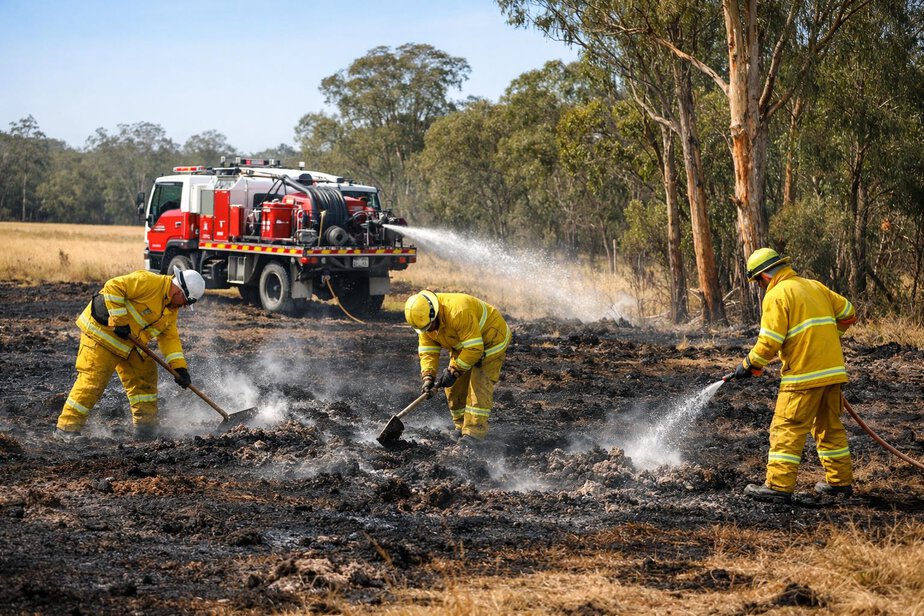
Putting out the visible flame is only part of grassfire suppression. After the flames are knocked down, crews must complete thorough mop-up and blacking out. This stage is often less dramatic, but it is where a lot of real protection is won or lost.
Mop-up should begin from a secure anchor point and continue systematically around the fire perimeter. That method helps the crew stay oriented and makes it less likely that a hot section will be missed. Hot grass, roots, stumps, logs, animal dung and other burning material near the edge must be cooled, broken apart or turned over. Hand tools and water should be used together where required.
Crews should not assume that blackened ground is safe ground. Small heat sources can remain in concealed fuel, and wind can expose them again. This is why the second tanker and the following tankers matter even after the main flames are down. Their work helps catch fire that was missed or has reignited.
Patrols must continue until the fire is declared safe. That may include checking the perimeter again after wind changes, rechecking problem spots and making sure the edge remains cool. If resources are limited, patrol may be one of the best uses of additional tankers that are not needed in the main attack line.
A disciplined mop-up phase also protects the next shift. If the handover is rushed and the fire edge is left with hidden heat, another crew may inherit a problem that could have been prevented. Working together includes leaving the fire in a better condition than it was found.
Putting the whole operation together
The strongest grassfire operations are built on simple ideas applied well. Start from a secure anchor point. Brief every incoming crew. Match the attack method to the fire and the conditions. Keep the tanker line disciplined. Protect each other. Monitor water. Adjust to the wind. Use aircraft carefully. Finish with thorough mop-up and patrol.
In a coordinated line, the first tanker does the initial attack, the next tanker closes gaps and catches relights, and later tankers provide backup, knockdown and rotation. The five-tanker model gives a practical limit for one line, because a bigger group can create congestion, communication problems and wasted resources. Extra tankers are often more valuable on another flank, on asset protection, on water supply, on black-edge patrol or as relief for crews that have been working hard.
That is the central lesson: a larger number of vehicles is not automatically a better firefighting force. A smaller number of disciplined tankers, each doing the right job at the right time, can be more effective than a bigger group that is crowded, unclear and poorly coordinated. The fireground rewards teamwork, patience and a clear chain of command.
Practical conclusion: Grassfire tanker tactics succeed when discipline and teamwork stay ahead of speed and pressure. Keep the line safe, keep the communication clear and keep the task simple enough for every crew member to do well. Before publication or operational use, verify facts, local procedures and agency instructions, because fire conditions, equipment and requirements can change from one area to another.
FireRescue Training Hub
Access practical fire and emergency study support resources, downloads, checklists, audio guides, and member-only course content.
- Course library
- PDF downloads
- Audio guides
- Checklists
Study support only. Not accredited training or a replacement for workplace procedures.
About the author and safety review
Ken Walker
Former Station Officer and fire service educator
Former career firefighter with extensive career and volunteer fire service experience.
Qualifications: Associate Diploma of Applied Science in Fire Technology; Institute of Fire Engineers studies.
Author profilehttps://www.firerescue.com.au/about-us/