Fire Rescue Update
Long-Term Cancer Risk in Firefighters
Firefighting remains one of the most respected yet hazardous occupations in Australia. While the immediate dangers of flames and structural collapse are widely understood, the long-term health risks, particularly the risk of cancer, are less visible but equally important to acknowledge and address.
Key takeaways
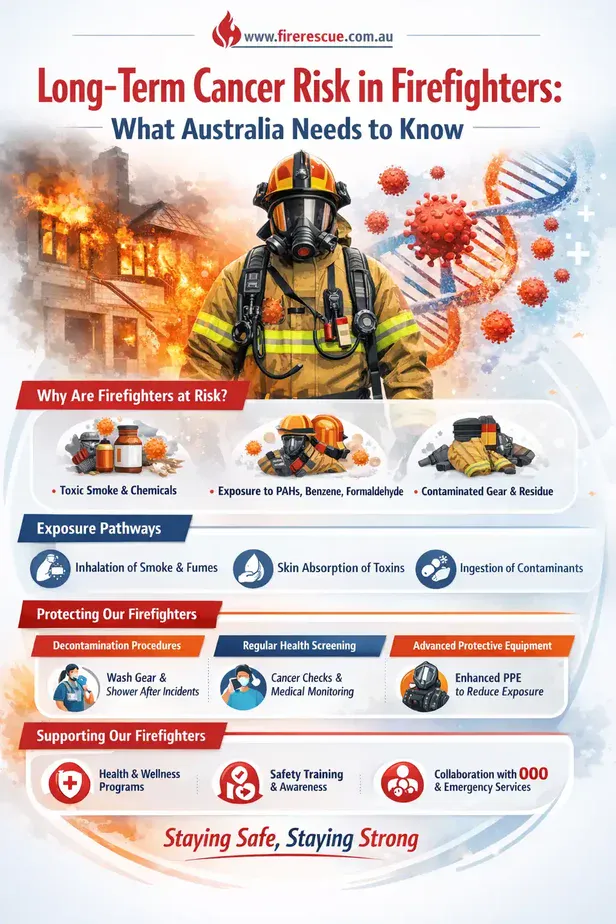
Firefighters face an elevated long-term cancer risk due to repeated exposure to carcinogenic substances during firefighting operations. These include smoke, toxic chemicals, and combustion by-products that can penetrate protective gear and remain on equipment and skin.
Understanding this risk has led to improved decontamination procedures, health monitoring, and changes in training to reduce exposure. However, ongoing vigilance and adherence to safety protocols remain critical to protecting firefighter health.
The collaboration between Fire/Rescue services, emergency medical teams, and other agencies is vital in ensuring early intervention, effective response, and long-term health support for firefighters.
Long-Term Cancer Risk in Firefighters
Clear, practical Australian-focused information on exposure risks, protection steps, decontamination habits, and why long-term health monitoring matters.
Background and context
The occupational hazards of firefighting extend far beyond the immediate scene of an emergency. While the public and emergency services often focus on fire suppression and rescue during active incidents, the latent health risks that emerge over years or decades are less visible but no less serious.
One of the most concerning long-term risks is the increased incidence of various cancers among firefighters. This risk arises primarily from the exposure to carcinogens found in smoke, soot, and chemical residues encountered when fighting fires. These substances include polycyclic aromatic hydrocarbons (PAHs), benzene, formaldehyde, and other toxic compounds released during combustion of building materials, plastics, and household chemicals.
Despite advances in personal protective equipment (PPE), such as improved breathing apparatus and flame-retardant clothing, contaminants can still permeate gear or adhere to skin, clothing, and equipment surfaces. Over time, cumulative exposure can increase the likelihood of developing certain cancers, including those of the respiratory system, urinary tract, skin, and blood.
Scientific insights into cancer risk for firefighters
Research both internationally and within Australia has highlighted that firefighters are at a statistically significant higher risk of developing several types of cancer compared to the general population. While exact figures vary due to differing study designs and populations, trends consistently show elevated risks for cancers such as mesothelioma, non-Hodgkin lymphoma, multiple myeloma, and prostate cancer.
These findings have prompted health authorities and fire services to develop targeted programs aimed at early detection and prevention. Regular health screenings, cancer awareness training, and protocols to minimise exposure during and after fire incidents form the core of these efforts.
Exposure pathways
Firefighters encounter carcinogens primarily through inhalation of smoke and toxic gases, dermal absorption through contaminated skin, and inadvertent ingestion of particles. Even after active firefighting, soot and chemical residues can linger on clothing, helmets, and equipment, posing ongoing risks if not properly cleaned.
This understanding has led to recommendations that firefighters shower and change clothes immediately after fire responses and that contaminated gear be cleaned or replaced regularly to prevent prolonged exposure.
Practical implications for Australian fire services
The recognition of long-term cancer risk has brought changes to operational procedures, training, and health monitoring within Australian fire services. Firefighters are now encouraged to adopt rigorous decontamination routines, including washing gear and skin promptly after incidents and using specialised cleaning facilities where available.
Training programs increasingly emphasise awareness of carcinogen exposure and personal responsibility for hygiene and safety. Fire services also promote the use of advanced PPE designed to reduce permeation of harmful substances.
Health monitoring initiatives have been introduced in some jurisdictions, offering regular medical check-ups, cancer screening, and support services tailored to firefighters’ unique risks. These programs aim to detect health issues early and provide timely interventions.
Collaboration with emergency medical and support services
In Australia, the emergency response system involves multiple agencies working in concert. Fire/Rescue services focus on fire suppression, rescue, and immediate hazard mitigation. Ambulance services provide urgent medical care and transport, while Police handle scene security and investigation. The State Emergency Service (SES) supports with additional resources during larger-scale emergencies or natural disasters.
When firefighters suffer acute injury or illness related to exposure during incidents, calling triple zero (000) ensures the fastest coordinated medical response. Beyond emergency care, ongoing health support is often provided through specialised occupational health services linked to fire agencies.
Supporting firefighter health for the long term
Addressing the long-term cancer risk requires a holistic approach that combines individual precautions, organisational policies, and community awareness. Firefighters must understand the risks and commit to safety practices, including proper use and maintenance of PPE and adherence to decontamination protocols.
Fire services should continue investing in research, health surveillance, and training to keep pace with emerging knowledge and technology. Ensuring access to mental health and medical support is equally important, given the psychological impact of both firefighting and chronic health concerns.
Ultimately, reducing cancer risk is about protecting those who protect the community. Through ongoing education, innovation, and collaboration, Australian fire services can better safeguard their crews’ health today and into the future.
Beyond the physical health challenges, it is crucial to recognise the emotional and psychological toll that prolonged exposure to hazardous environments can have on firefighters. The stress associated with the knowledge of increased cancer risk, combined with the trauma of emergency responses, underscores the need for comprehensive wellness programs that address both physical and mental health.
Moreover, advancements in technology are beginning to play a significant role in reducing exposure risks. Innovations such as real-time air quality monitors integrated into breathing apparatus, improved materials for protective clothing that better resist chemical penetration, and automated decontamination systems are becoming increasingly accessible to fire services. These technological tools not only help in minimizing carcinogen exposure but also contribute to better data collection for ongoing research and health monitoring.
Community engagement and awareness are additional components that support firefighter health. Educating the public about the risks firefighters face can bolster support for funding preventive measures and health programs. It also fosters a culture of respect and understanding that acknowledges the sacrifices firefighters make beyond the visible dangers of flames and smoke.
In conclusion, the long-term cancer risk faced by firefighters is a multifaceted challenge that demands continuous attention and action. By combining rigorous safety protocols, advanced technology, comprehensive health monitoring, and supportive community frameworks, Australian fire services can create a safer and healthier environment for those who risk their lives to protect others.
FireRescue Training Hub
Access practical fire and emergency study support resources, downloads, checklists, audio guides, and member-only course content.
- Course library
- PDF downloads
- Audio guides
- Checklists
Study support only. Not accredited training or a replacement for workplace procedures.
About the author and safety review
Ken Walker
Former Station Officer and fire service educator
Former career firefighter with extensive career and volunteer fire service experience.
Qualifications: Associate Diploma of Applied Science in Fire Technology; Institute of Fire Engineers studies.
Author profilehttps://www.firerescue.com.au/about-us/