
A fire indicator panel (FIP) provides information about a building’s installed fire alarm system. It is a system-status and response aid—not a public diagnosis of whether there is a fire, how severe it is or whether a building is safe.
Depending on the installation, a panel may indicate an alarm zone, identify a particular device or show a fault or isolation. Those indications need to be understood in the context of the building’s layout, system configuration and emergency procedures.
For occupants, the safe baseline is straightforward: follow the building’s emergency plan and warning instructions, evacuate when directed or when there is immediate danger, and do not operate, silence, reset or isolate the panel.
Key points at a glance
- A zone indication does not necessarily identify an individual detector or the exact location of a fire.
- A device address identifies a system input; it does not establish the cause or severity of an incident.
- The panel display, occupant warning system and alarm monitoring connection have different roles.
- An alarm sounding does not, by itself, confirm that the fire service has been notified.
- Occupants should not approach the panel or investigate an indicated area before responding to an evacuation instruction.
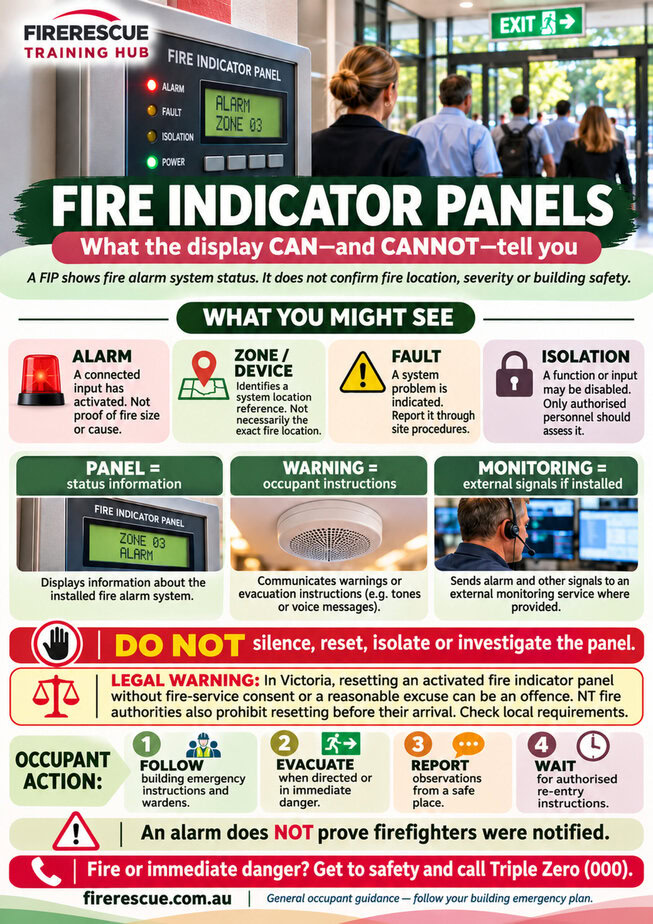
What is a fire indicator panel?
A FIP is an interface through which information about the fire alarm system can be displayed and, by authorised personnel, managed. You may see one near a building entrance or another designated location, but its position and arrangement vary.
Depending on the installation, information may appear through labelled indicator lights, a text display or a combination of both. Associated documentation can help trained personnel relate an indication to a part of the building.
There is no single display arrangement that occupants can safely assume applies everywhere. A familiar-looking panel in another building may have different labels, programming and connections.
What kinds of status might it show?
| Possible indication | What it may communicate | What occupants should not conclude |
|---|---|---|
| Alarm | The system has registered an alarm condition from a connected input. | That the display establishes the cause, size or precise location of a fire. |
| Zone or device information | A location reference associated with an alarm or other event. | That the indicated location is the only affected area or a safe place to investigate. |
| Fault | A problem detected within the system or a connected component. | That it is harmless, that there cannot also be a fire, or that the whole system has stopped working. |
| Isolation or disablement | A function, input or part of the system has been taken out of its normal operating arrangement. | That the scope or consequences can be determined from a brief glance. |
The exact meaning of an indication must be checked against the installed system’s documentation. This table is an explanation of broad categories, not a guide to operating a panel.
Does a zone identify the exact detector or fire location?
Not necessarily. A zone is a grouping used by the alarm system. Depending on the design, it may cover multiple devices and a substantial part of a building.
A zone label can help trained responders narrow their enquiries, but it is not a map of fire spread. Nor does it explain why an alarm activated.
Conventional and addressable systems
In broad terms, a conventional system may indicate the zone containing an activated device without identifying the individual detector. An addressable system can provide an individual device identity, where that capability is installed and configured.
More detailed location information is useful, but it has limits. A displayed detector address is not necessarily the point where a fire began. It also does not establish whether smoke or other hazards are affecting another area.
Site documentation matters: the usefulness of a label depends on how accurately it describes the building and how the system has been configured and maintained.
Three different roles: indication, warning and monitoring
These functions can be connected, but they are not interchangeable.
| Function | Main purpose | Important limit |
|---|---|---|
| Fire indicator panel | Displays information about the installed fire alarm system and provides controls for authorised use. | The display is not a complete set of instructions for occupants. |
| Occupant warning | Communicates warnings or instructions through the building’s installed arrangements, which may include tones, speakers or voice messages. | The warning sequence and required response depend on the building’s emergency arrangements. |
| Alarm monitoring | Communicates specified signals to an external monitoring service where that connection is provided. | A local alarm does not prove that a signal has reached a monitoring service or that firefighters are responding. |
Some buildings have an emergency warning and intercommunication system, often called EWIS. Its warning and communication functions should not be confused with the panel’s status display, even where the systems are connected.
Buildings can also have different evacuation arrangements. Do not apply a tone sequence, voice message or response procedure learnt at one workplace to every other building.
Does an alarm automatically call the fire service?
Do not assume so. Automatic notification depends on the building’s installed monitoring arrangements, their configuration and their operating condition.
A panel being present is not proof of a monitored connection. Neither is an audible alarm. The transmission of alarm, fault and other signals can also differ between installations.
Building management should know the site’s monitoring arrangements and explain the relevant emergency reporting responsibilities during induction.
If you discover a fire or there is an immediate threat to life, move to safety and call Triple Zero (000). Do not delay that call because you believe an automatic system must already have notified the fire service.
What should occupants do when an alarm sounds?
Your response should come from the building’s emergency plan, warning messages, wardens and immediate conditions—not from trying to interpret the panel.
- Respond to the warning. Follow the building’s emergency instructions and directions from wardens or emergency services. Do not wait for someone to prove there is a fire.
- Evacuate when directed or when there is immediate danger. Do not approach a panel first or enter smoke to investigate an indicated location.
- Use the designated evacuation arrangements where safe. Follow the site’s provisions for exits, lifts and assistance rather than assuming another building’s procedures apply.
- Report useful information from safety. Tell wardens or emergency services what you actually observed, including the location of smoke or anyone needing assistance. Do not return to gather more information.
- Follow instructions about assembly and re-entry. A quiet alarm or changed panel display is not, by itself, permission to return.
If you need assistance to evacuate, discuss the arrangements with building management before an emergency. Visitors and contractors also need clear instructions; familiarity with the building should not be assumed.
Why occupants should not silence, reset or isolate a panel
Panel controls can affect warning, detection or communication functions, depending on the installation. Operating them without the right authority and knowledge can interfere with the response and make the sequence of events harder to establish.
Silencing an alarm does not remove a hazard. Resetting a panel does not prove that conditions are safe. An isolation may affect only a particular function or may have wider consequences that are not obvious to an occupant.
Even where an activation seems to have an innocent explanation, leave the controls alone. Fire Rescue Victoria identifies cooking smoke, steam, aerosols and maintenance activities among possible causes of unwanted alarm activations. That does not make it safe to dismiss a new alarm based on previous events.
FRV also states that it determines an alarm to be false after attending and establishing its nature. Occupants should not substitute a guess about the cause for the building’s emergency response.
Who may operate a panel, and under what conditions, depends on the jurisdiction, installation and applicable procedures. A generic article cannot grant that authority.
Who should investigate an alarm or fault?
During a possible emergency, occupants should pass observations to wardens or emergency services from a safe location. They should not undertake a search of the panel-indicated area.
Trained wardens have duties defined by the building’s emergency plan. Being a warden does not automatically establish authority to operate every panel or investigate a hazardous area.
Building management should arrange for faults, recurring activations and maintenance concerns to be assessed by the appropriate fire alarm service provider or other competent specialist. FRV recommends contacting the alarm service provider about repeated false alarms and considering professional assessment of system design where needed.
A fault indication should therefore be reported promptly through the site’s procedures—not ignored and not treated as an invitation to attempt a reset. Management needs to establish what is affected and what response is required.
What to find out before an emergency
Ask your employer, tenancy representative or building manager where to find the current emergency plan and occupant instructions. The full plan and a displayed evacuation diagram are not necessarily the same document.
- Locate the relevant evacuation diagrams and identify the exits and assembly arrangements.
- Learn what the building’s warning messages mean and what action they require.
- Find out who the wardens are and how to report an emergency or a system fault.
- Confirm arrangements for anyone who may need assistance.
- Understand who is responsible for emergency calls without assuming automatic monitoring replaces that responsibility.
- Know who can authorise re-entry after an incident.
For managers, induction should focus on these occupant actions—not simply point out the panel and expect people to interpret it.
The bottom line
A fire indicator panel provides valuable system information, but its display has boundaries. A zone is not necessarily an exact location; a device address is not a diagnosis; and a local alarm is not confirmation of fire-service notification.
For occupants, the priority is to follow the building’s emergency arrangements and respond to danger—not investigate or operate the panel. Questions about labels, monitoring or recurring faults are best resolved with building management before the next alarm.
If you identify a technical error or a jurisdiction-specific difference in this article, please let the editorial team know so it can be reviewed.
Related FireRescue guides
- Do Aerial Water Drops Really Stop Bushfires? What Firefighting Aircraft Can and Cannot Do
- Integrated Residential Bushfire Protection System Part 20: What Could Go Wrong?
- Electrical Substation and Transformer Fires: What First Responders Need to Know
Sources and further reading
Source material was gathered for this draft on 17 November 2026. Confirm current official advice for your location. Readers can contact FireRescue with corrections or relevant field experience.
FireRescue Training Hub
Access practical fire and emergency study support resources, downloads, checklists, audio guides, and member-only course content.
- Course library
- PDF downloads
- Audio guides
- Checklists
Study support only. Not accredited training or a replacement for workplace procedures.
About the author and safety review
Ken Walker
Former Station Officer and fire service educator
Former career firefighter with extensive career and volunteer fire service experience.
Qualifications: Associate Diploma of Applied Science in Fire Technology; Institute of Fire Engineers studies.
Author profilehttps://www.firerescue.com.au/about-us/