Food truck fire safety in Australia is about much more than carrying an extinguisher. The real risk starts with poor site set-up, unsafe LPG and electrical work, hot oil, crowded events, limited escape paths and rushed shutdowns. If you operate a food truck, coffee van or market stall, the safest approach is simple: plan the site properly, install and maintain equipment through qualified professionals, train staff before trading, and know exactly what to do if gas, fire or smoke appear.
Immediate life-threatening emergencies in Australia require Triple Zero (000). If there is fire, smoke, a gas leak, serious injury or you are unsure whether the situation is escalating, call 000 first from a safe place and then follow your emergency plan.
Contents and quick summary
- Biggest fire risks in food trucks, coffee vans and market stalls
- Site planning before opening
- LPG cylinder safety, leaks and shutdown
- Cooking fires, hot oil and fryers
- Rangehoods, grease filters and duct cleaning
- Electrical safety and generators
- Fire extinguishers, blankets and access
- Daily checks, emergency action and staff training
- Australian compliance overview, including Victoria and NSW examples
- What firefighters want operators and event organisers to know
Short version: keep combustible items away from heat, keep LPG and electricity professionally installed, do not use water on oil fires, isolate the hazard only if it is safe to do so, and make sure everyone on site knows how to evacuate and call 000.
1. The biggest fire risks in mobile food businesses
Food trucks, coffee vans and market stalls have a mix of hazards that can change from one site to the next. That is why a safe setup in a private car park may not be safe at a night market, festival, sporting venue or roadside trading location.
The main risks usually come from five areas:
- LPG used for cooking, heating or refrigeration.
- Cooking equipment such as fryers, grills, hotplates, chargrills and ovens.
- Grease and fat that can collect in rangehoods, filters and ductwork.
- Electricity from leads, boards, overloading, wet weather or damaged equipment.
- Generators and fuels creating exhaust, heat, ignition and carbon monoxide hazards.
Mobile businesses also face practical issues that fixed restaurants may not. Space is tight. Staff may work alone. Doors may stay open. Customers may queue close to cooking equipment. A small fault can become a major incident very quickly if the stall is cramped or if a fire blocks the only exit.
Different businesses have different risk profiles. A coffee van may rely on high-current espresso machinery and a small LPG or gas appliance arrangement. A burger truck may have multiple fryers and more grease build-up. An open market stall may use portable cooking appliances with fewer fixed barriers and more exposure to wind, crowds and weather.
2. Before opening: site assessment, separation and vehicle positioning
Good fire safety begins before trading starts. Operators should assess the site and the trading layout every time, because the hazard changes with access, crowd density, nearby structures, utilities, weather and emergency access.
Check the following before you serve the first customer:
- Is there a clear path for people to leave if something goes wrong?
- Can staff move safely behind the counter without bumping hot equipment or cylinders?
- Are customers separated from cooking, gas and refuelling areas?
- Are exits, doors and hatches clear and easy to open?
- Is the truck or stall positioned so emergency crews can reach it?
- Will wind, rain or heat affect flames, ventilation or generator exhaust?
Vehicle placement matters. Avoid boxing the truck into a corner where a fire could trap people. Do not block exits with signs, tables, stock boxes or queue barriers. Keep access for emergency responders in mind, including how they would approach the vehicle, isolate power, and remove someone if needed.
For events, the organiser and vendor should both understand the layout. A good site plan considers customer flow, access lanes, firefighting access, nearby LPG or fuel stores, waste bins, tents, shade structures and the path to the nearest assembly area.
| Trading model | Common fire issues | Planning focus |
|---|---|---|
| Food truck | Fixed cooking appliances, LPG, grease, generator loads | Vehicle layout, exits, separation, ventilation, shutoff points |
| Coffee van | Electrical load, hot water, compact workspace, limited exits | Lead management, appliance heat, access, shutdown routine |
| Open market stall | Wind exposure, portable gas, crowded public areas, temporary wiring | Weather, crowd separation, portable equipment placement, event rules |
3. LPG cylinder safety: restraint, storage, ventilation and installation
LPG is widely used in mobile food businesses, but it must be treated with respect. A cylinder that is poorly restrained, exposed to heat, damaged, incorrectly connected or used in an unventilated space can become a severe fire or explosion hazard.
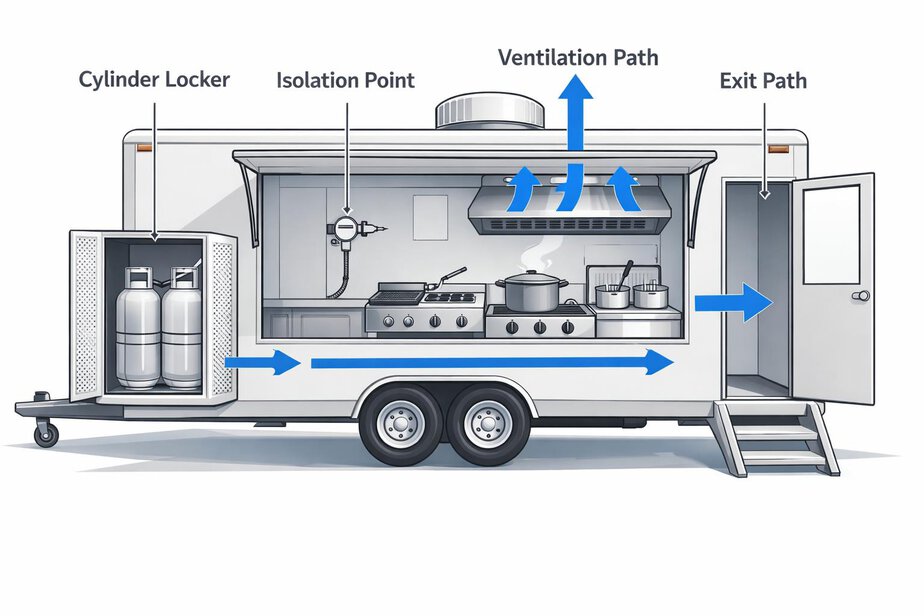
There is an important difference between fixed vehicle LPG installations and portable stall equipment. A purpose-designed mobile catering vehicle may have an externally vented cylinder compartment and professionally installed pipework. That is not the same as placing a loose cylinder inside the cabin, cargo area or cooking space.
Operators should never improvise gas plumbing. Installation, modification, repair and certification belong to qualified gasfitters and other authorised professionals. In Victoria, mobile catering vehicle gas installations are treated as complex and may require Energy Safe acceptance before commissioning. In NSW, official guidance also points to the relevant gas standards and the need for qualified work. These are examples of state guidance, not a blanket national rule.
Practical safety points include:
- Keep cylinders properly secured so they cannot tip, roll or move during travel or service.
- Use the correct externally vented compartment or approved storage arrangement for the vehicle type.
- Keep cylinders away from heat sources, ignition sources and food preparation heat.
- Use only approved hoses, fittings, regulators and valves fitted by competent people.
- Know the location of isolation valves and keep access to them clear.
- Inspect for visible damage, corrosion, missing caps, loose restraints or signs of tampering before each shift.
Operators should not change pipework, shorten clearances, shift appliance positions or alter ventilation arrangements on their own. What looks like a minor adjustment can affect combustion, leak management and emergency shutdown.
For market stalls, the same principle applies even when the equipment is portable: keep the cylinder stable, well ventilated and placed according to the correct rules for the equipment and location. Never store a cylinder loose inside a confined kitchen space unless the vehicle or appliance system is specifically designed and approved for that purpose.
Event organisers should check whether LPG use, cylinder placement and storage conditions are covered by the venue or event risk assessment. Requirements can change between councils, states and event types.
4. Gas leak warning signs and evacuation procedure
Every operator and staff member should know the warning signs of a gas problem. The obvious signs include smell, hissing, a flame that behaves strangely, a regulator issue, or visible damage to pipework and fittings. Less obvious signs can include appliances failing to light correctly, unusual soot, or a sudden drop in appliance performance.
If LPG is suspected to be leaking, the response should be calm and immediate:
- Stop work and warn everyone nearby.
- Do not use switches, lighters, matches or open flames.
- Do not search for the leak with a flame.
- Evacuate people away from the hazard.
- Isolate gas only if it is immediately safe and the shutoff point is known.
- Call 000 from a safe location if there is danger, fire or any doubt about escalation.
- Arrange inspection by a competent gasfitter before restarting.
If the leak is inside a van, enclosed stall or service area, the risk can build quickly because gas may pool and ignition sources are close by. Ventilation helps, but it does not make a leaking system safe.
Public-facing staff should be trained to act early. They do not need to diagnose the fault. Their role is to raise the alarm, isolate people from danger, and hand over to emergency responders or a gasfitter.
5. Deep fryers, hot oil and other cooking fire risks
Cooking equipment causes many mobile food fires because it combines heat, grease and human distraction. Deep fryers, grills and hotplates need constant attention. Overheated oil can ignite. Spills can spread fire. Nearby packaging, tea towels and cardboard can catch quickly.
Safe cooking practice starts with staying with the equipment. Never leave frying or hot oil unattended. Keep lids, baskets, utensils and cleaning materials organised so staff are not tempted to reach across heat or leave equipment running while serving customers.
Key prevention steps include:
- Keep combustibles away from cooking surfaces.
- Maintain safe working space around fryers and hotplates.
- Train staff to recognise oil overheating and unsafe flame behaviour.
- Keep appliance controls, isolation points and shutdown procedures clear.
- Clean grease and residue before it builds up.
- Do not overload fryers or let water contaminate hot oil.
Never pour water on an oil or grease fire. That can spread burning oil and make the fire much worse. For a small contained oil fire, trained staff may use suitable approved equipment only if it is safe to do so and the escape path remains clear. If in doubt, raise the alarm, evacuate and call 000.
Range considerations matter too. A coffee van might only have a small hotplate or toaster, but a small fire still becomes serious in a confined space. A larger burger or chip truck may need more separation, stronger ventilation and more rigorous cleaning because oil vapour and grease accumulate faster.
Equipment choice also affects risk. High-output appliances can increase heat load inside the vehicle. If staff are working in cramped conditions, the chance of a spill, bump or delayed response rises. Good design reduces those risks before the first trade.
6. Rangehoods, grease filters and duct cleaning
Grease build-up in rangehoods, filters and ducts can turn a kitchen fire into a larger structural fire. That risk exists in fixed restaurants and in mobile food vehicles. Grease deposits can ignite, spread flame into hidden spaces and make fire behaviour unpredictable.
Operators should keep cleaning and servicing records, and they should not assume that visible cleanliness means the duct is clean. Rangehood systems need routine attention by people who understand commercial kitchen equipment. Cleaning should focus on grease filters, hoods, accessible duct sections and any other parts that collect residue.
Useful practices include:
- Remove grease deposits before they become heavy.
- Replace or service filters when required.
- Check that fan operation and airflow are not blocked.
- Keep combustible items away from hood edges and hot surfaces.
- Arrange specialist servicing for commercial kitchen fire protection systems where fitted.
Do not ignore a greasy smell, poor extraction or smoke spilling into the work area. Those are signs the system may need cleaning or repair. In a confined food truck, weak extraction can also increase heat stress for staff and increase the chance of a cooking error.
Fire services in Australia commonly stress staff training, maintained exits, suitable extinguishers and regular professional cleaning. The precise equipment and maintenance arrangements depend on the kitchen type, appliance load and local requirements. Operators should confirm the correct standard for their setup rather than assuming one rule fits every food business.
7. Electrical safety: leads, load, wet weather and batteries
Electrical faults are a major cause of incidents in mobile trading because operators often connect to temporary power under time pressure. Overloaded circuits, damaged cords, unprotected leads, poor plug connections and wet-weather exposure can all start fires or create shock hazards.
Electrical safety basics include:
- Use only equipment that is suitable for the load and environment.
- Keep cords out of walkways and away from hot surfaces and sharp edges.
- Protect connections from rain, puddles and splashing.
- Do not overload power boards or adaptors.
- Do not use damaged or taped-up leads.
- Arrange repairs and alterations through qualified electrical tradespeople.
Portable residual current devices, if required for the setup, should be matched to the site and equipment and installed or checked by competent people. Do not rely on a homemade solution or a cord dragged through a wet path.
Battery-powered devices add another layer of risk. Lithium batteries can fail if damaged, charged incorrectly or exposed to heat. This matters for point-of-sale devices, lights, communications gear and e-bikes or similar equipment brought onto site. Keep batteries away from heat, use approved chargers and replace damaged units promptly.
For coffee vans, the electrical load can be significant because espresso machines, grinders, pumps, fridges and hot water systems all compete for supply. For market stalls, the risk often comes from temporary leads and weather exposure rather than fixed plant. Either way, the same principle applies: manage the load, keep equipment dry, and fix faults before trading.
8. Generators: exhaust, refuelling, carbon monoxide and fuel storage
Generators are useful, but they can create serious hazards if they are treated casually. Petrol and diesel generators produce exhaust gases, heat, noise and fuel risks. They should never run inside enclosed vehicles, tents or poorly ventilated spaces. Carbon monoxide can build up without warning and can kill.
Safe generator practice includes:
- Position the generator outdoors where exhaust cannot enter the vehicle, stall or canopy.
- Keep hot exhaust parts away from combustibles and foot traffic.
- Refuel only when the generator is shut down and cooled, following manufacturer instructions.
- Store fuel safely and separately from ignition sources.
- Check cables and leads for condition and load compatibility.
- Keep people away from the generator operating area.
Exhaust direction matters. Do not place the exhaust where wind, walls, awnings or queue barriers can push fumes back into the trading area. Do not use the generator as a makeshift heater or use it as a shelf for stock or packaging.
Refuelling is a common mistake point because staff are busy and the unit may be hot. A minor spill near a hot exhaust or electrical connection can ignite quickly. Fuels should be managed as a planned hazard, not as spare items thrown into the van.
Where a site uses mains power rather than a generator, the same discipline still applies. Cables should be suitable, protected and not overloaded. Event organisers should ask how power will be supplied, where it will run, and who is responsible for checking it before service starts.
9. Fire extinguishers, fire blankets and access to equipment
Fire equipment must suit the hazard. The right choice depends on the cooking method, the fuel type, the electrical load and the local rules. There is no single universal extinguisher setup that fits every food truck, coffee van or market stall.
Operators should understand three things. First, staff need training in the equipment they actually carry. Second, the equipment must be maintained and accessible. Third, the vehicle or stall must be designed so that using the equipment does not block escape.
Useful principles include:
- Keep extinguishers and blankets visible, accessible and not buried behind stock.
- Make sure staff know which hazard each item is intended to address.
- Keep service and inspection records current.
- Do not place equipment where heat, grease or vibration can damage it.
- Do not rely on fire equipment instead of prevention and evacuation.
Some commercial cooking setups may require specialised suppression arrangements. That is a design and compliance question for qualified professionals, not a matter of guessing from a photo online. A blanket or extinguisher can be useful only if staff know when and how to use it and when to back away.
Equipment placement should not create new hazards. If an extinguisher is in the only exit path, or if the blanket is stored above a fryer where it may be reached through flame, the setup needs review. Access is part of the safety system.
10. Daily inspection checklist, service checks and shutdown routine
A short, repeatable checklist is one of the best tools in food truck fire safety Australia operators can use. It catches small problems before they become emergencies and it helps staff work consistently, even on busy event days.
Printable daily pre-opening inspection
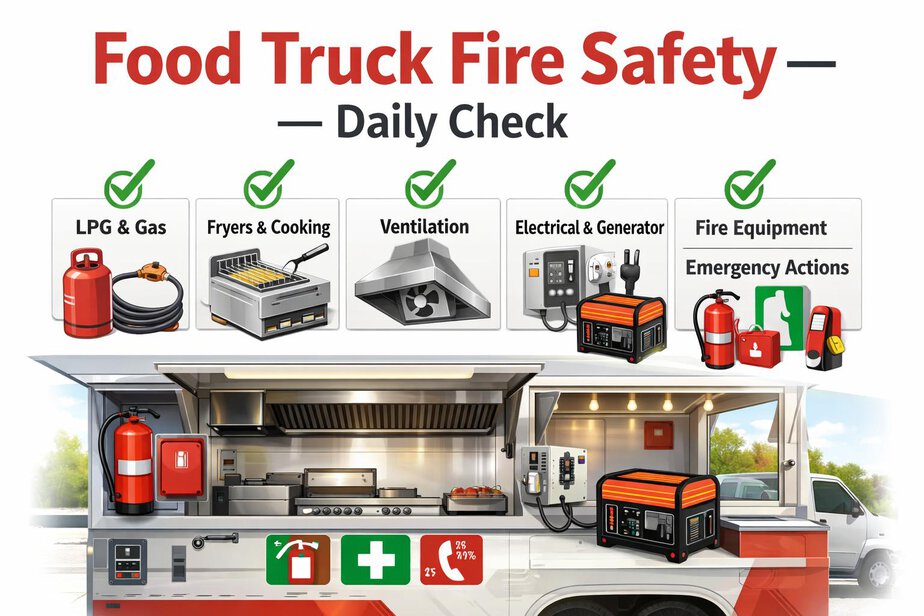
- Check LPG cylinders, restraints, visible hose condition and isolation points.
- Confirm no smell of gas and no sign of leaks or damage.
- Check fryers, hotplates, ovens and controls for safe condition.
- Confirm grease filters and accessible surfaces are reasonably clean.
- Check electrical leads, plugs, sockets and power boards for damage.
- Confirm generator location, exhaust direction, fuel state and cooling.
- Make sure extinguishers, blankets and exits are visible and unobstructed.
- Confirm staff know emergency roles and the location of 000 contact details.
During-service observations
- Watch for unusual flames, smells, smoke, flickering appliances or tripped power.
- Keep people and packaging away from heat sources.
- Do not let grease or clutter build up during busy periods.
- Re-check that cylinders, leads and hoses remain secure after movement or weather changes.
Shutdown checks
- Turn off and isolate hot equipment in the correct order.
- Confirm burners, electrical appliances and generators are properly shut down.
- Allow equipment to cool safely before refuelling or packing away.
- Remove waste and grease residue.
- Record any fault, near miss or repair need before the next shift.
A paper or digital checklist should be simple enough that staff actually use it. It is not a substitute for a formal inspection, but it makes a real difference in day-to-day control.
11. Emergency action plan: gas leak, cooking fire, smoke, injury and evacuation
Every mobile food business should have a short emergency action plan that staff can read quickly under pressure. The plan should focus on public actions first, then trained responder actions.
Fill-in emergency action plan
Business name: ________________________________
Site or event: ________________________________
Supervisor on shift: ________________________________
Nearest exit / assembly area: ________________________________
Gas isolation point: ________________________________
Electrical isolation point: ________________________________
Generator shutoff point: ________________________________
Emergency contacts: ________________________________
If gas is suspected: stop work, warn people, isolate only if safe, evacuate, keep ignition sources away and call 000 if there is danger.
If oil or grease ignites: do not use water, raise the alarm, turn off heat only if safe, protect escape, evacuate and call 000.
If smoke starts: stop trading, move people away, identify the source only if safe, and do not re-enter a hazardous area without clearance.
If someone is injured: call 000 for serious injury, give first aid within training and keep others clear of the hazard.
If evacuation is needed: close down if safe, move customers and staff to the assembly area, account for people and wait for responders.
Training should make it clear that staff are not expected to perform dangerous rescue actions, move burning cylinders or improvise repairs. Their role is to warn, isolate where safe, evacuate and hand over.
12. Staff induction, refresher drills and incident reporting
A written emergency plan is useful only if people know it. New staff should be inducted before they handle cooking, gas, electrical equipment or customer queues. Casual and event staff should receive the same basic briefing, even if they work only one day.
Induction should cover:
- What the main hazards are on this site.
- Where shutoff points are located.
- Which extinguisher or blanket is used for which hazard.
- How to clear customers away quickly and politely.
- Who calls 000 and who meets emergency services.
- Who is authorised to restart or close the business after an incident.
Refresher drills do not need to be dramatic. A short walk-through can be enough to remind staff where the shutoffs are and how to report smoke, gas smell or oil overheating. The purpose is speed and clarity, not perfect memory under stress.
After any incident, near miss or equipment fault, record what happened, who was involved, what was isolated and what follow-up is needed. Those records help with maintenance, insurance, council discussions and future training. They also reveal patterns, such as repeated tripping, frequent grease build-up or staff confusion about shutdown order.
13. Australian compliance overview: Victoria, NSW and how to check local rules
Compliance for mobile food businesses is layered. Food registration is one part. Gas, electrical, fire safety and event approval are separate issues. Do not assume that council registration alone makes a setup safe or legally complete.
In Victoria, temporary or mobile food premises may need council registration or notification through the relevant food business process, and event trading may involve additional permits or a Statement of Trade. That food registration does not replace gas acceptance, electrical requirements or event fire safety conditions.
Victoria also treats mobile catering vehicle gas installations as complex in current Energy Safe guidance. That means the gas system may need acceptance before commissioning, with the relevant application and statement of compliance. The referenced checklist also points to AS/NZS 5601.2:2020 for LPG cylinders and piping and relevant clauses of AS/NZS 5601.1:2022 for commercial cooking appliances. Treat that as a professional reference, not a do-it-yourself guide.
In NSW, official advice also identifies the same gas standards for mobile food truck gas installations and warns about issues found during audits, such as poor cylinder clearances, incorrect joints, inadequate supports, missing ventilation and appliance-clearance defects. Again, gasfitting is for appropriately qualified people.
Other states and territories may have different combinations of gas, electrical, food and event requirements. Councils and venue managers may also add their own conditions. Before publishing or relying on any checklist, confirm the latest local rules with the relevant state regulator, council and event organiser.
For event operators, a useful rule is simple: if the event includes cooking with LPG, fuels or generators, then the risk assessment must address access, spacing, emergency response, storage and shutdown. WorkSafe Victoria and Energy Safe Victoria both publish event guidance that should be checked at the time of planning.
14. What firefighters want operators, inspectors and event organisers to know
From a responder perspective, food trucks and market stalls present a compact but complex fire environment. The access may be narrow, the heat source may be hidden behind a service panel, and the fuel source may include gas, electricity, batteries and generator fuel at the same time.
Firefighters and incident controllers usually want to know:
- Where the LPG cylinders are stored and how they are isolated.
- Whether any cylinders or pipework are exposed to heat or flame.
- Where the electrical supply enters the vehicle or stall.
- Whether a generator is running nearby and where its exhaust is directed.
- Whether grease ducts, hood cavities or ceiling spaces may be involved.
- How many people are inside or around the site.
- Which exit paths are open and which are blocked.
Operationally, the priority is to keep responders informed, reduce crowd pressure, and prevent the hazard from spreading. Narrow lanes, parked vehicles, queue barriers and locked service gates can delay access. If a cylinder is heating, responders need room to work and a clear handover about where shutoffs are located.
For inspectors and event organisers, the practical lesson is that access and layout are fire safety controls, not just convenience items. A beautifully fitted stall can still be unsafe if it has no workable exit path or if the generator exhaust and fuel are placed where they can escalate the incident.
Do not give responders an improvised tour in a crisis if there is a safer way to brief them from a distance. Clear, factual handover is best: what is burning, what is powered, what has been isolated, who is missing if anyone, and which hazards remain live.
15. FAQs and practical next steps
Do all food trucks need the same fire equipment?
No. Fire equipment depends on the hazards present, the equipment fitted and the local requirements. A coffee van, fryer truck and market stall may all need different controls. Get the setup assessed rather than guessing.
Can staff fix a gas leak themselves?
No. Staff should evacuate, avoid ignition sources and get a competent gasfitter to inspect the system. If there is danger, call 000 from a safe location.
Can I use water on a fryer fire?
No. Never pour water on an oil or grease fire. Raise the alarm, turn off heat only if safe, evacuate and call 000.
Can a generator run inside the van with the doors open?
No. Generators produce carbon monoxide and heat. They must be used outdoors in a safe position with exhaust and fuel managed properly.
What should I do first if I am starting a food truck business?
Start with the layout, then the gas and electrical design, then staff training, then the emergency plan. Check the relevant state regulator, council and event rules before buying equipment or trading.
Practical next steps:
- Get the vehicle or stall layout reviewed before opening.
- Use qualified professionals for gas and electrical installation or modification.
- Create a one-page emergency action plan and daily checklist.
- Train every worker on gas leaks, oil fires, shutdown and 000 calling.
- Check local council, food registration and event approvals before trading.
- Keep maintenance and service records in one place.
Downloadable resources: this article is designed to support a printable daily inspection checklist, a fill-in emergency plan, a brief staff-training sheet and a site or event compliance checklist. Use them as operational aids only; they do not replace professional inspections or legal approvals.
Suggested internal FireRescue guides: workplace emergency planning, portable fire extinguisher basics, LPG safety for small businesses, generator safety, and event fire safety planning.
Author note: prepared as an Australia-first FireRescue draft for review by a qualified editor, and then by a relevant gas, electrical or fire safety professional before publication.
Review note: verify current standards, regulator guidance, council conditions and event requirements before publication, because local procedures can change.
Conclusion: food truck fire safety is a systems issue. The safest operators combine good site planning, compliant professional installation, disciplined daily checks, trained staff and a clear emergency plan. If you keep escape paths open, manage LPG and electricity properly, clean grease regularly and practise the shutdown sequence, you reduce the chance of a small fault becoming a serious incident. Always verify the facts, standards and local procedures before you publish or trade.
FireRescue Training Hub
Access practical fire and emergency study support resources, downloads, checklists, audio guides, and member-only course content.
- Course library
- PDF downloads
- Audio guides
- Checklists
Study support only. Not accredited training or a replacement for workplace procedures.
About the author and safety review
Ken Walker
Former Station Officer and fire service educator
Former career firefighter with extensive career and volunteer fire service experience.
Qualifications: Associate Diploma of Applied Science in Fire Technology; Institute of Fire Engineers studies.
Author profilehttps://www.firerescue.com.au/about-us/