If you or someone you care for relies on powered medical equipment, prepare a personalised outage plan with your healthcare team, equipment supplier and support people. The plan should explain how the equipment will keep working, when to seek help and where you can safely go if home is no longer suitable.
Registering a life-support need with your electricity provider is important, but it does not guarantee continuous electricity or priority restoration. Unexpected outages can still happen. Registration arrangements, eligibility and customer protections also vary by provider and jurisdiction.
Start with the person’s needs, not a battery purchase
There is no single backup-power solution for all medical equipment. The consequences of an interruption, the equipment’s electrical needs and the person’s ability to move or seek help all matter.
Start by asking the treating clinician what an interruption would mean for this person. Then ask the equipment supplier how the particular device can be supported safely. If several devices are involved, include every essential item in the discussion.
Australian Government Energy Made Easy guidance encourages people using life-support equipment to plan where they would go, how they would get there, how they would transport equipment and how they would contact others during an outage.
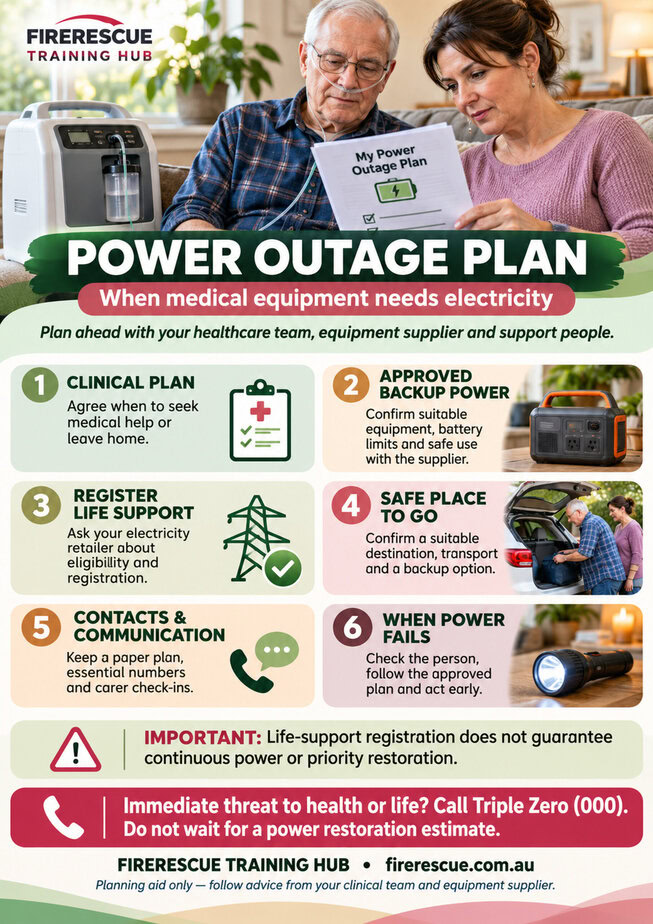
Your plan should answer five questions
- What happens to the person if their equipment loses power?
- Which backup arrangements are approved for their exact equipment?
- What is the trigger to call for help or leave home?
- Who can help, and what happens if that person is unavailable?
- Where can the person receive suitable support if the outage continues?
Write the answers down in an accessible format. Keep a paper copy where the person and carers can find it, rather than relying only on a phone or cloud account.
Check backup runtime with the equipment supplier
Do not use a general internet estimate to decide how long medical equipment will run during a blackout. A device’s advertised battery duration may not represent its performance in the person’s circumstances.
Ask the supplier or responsible clinical service to confirm the exact device model, battery arrangement and relevant operating conditions. Ask what information they need to assess runtime and how to check battery readiness without putting treatment at risk.
| Question to ask | What to record |
|---|---|
| Does this device have an internal battery? | Whether it has one, what it supports and any limitations explained by the supplier. |
| What backup duration should we plan around? | A supplier-confirmed planning estimate for the person’s actual setup, including any uncertainty. |
| How do we recognise low battery or a fault? | The relevant indicators, alarms and response instructions. |
| Which spare batteries or external power sources are compatible? | The exact approved products and any required accessories. |
| How should batteries be charged, stored and maintained? | The manufacturer’s instructions and replacement or servicing requirements. |
| What happens when mains power fails or returns? | Whether any checks or actions are required, and who is trained to perform them. |
Do not deliberately interrupt essential treatment or disconnect equipment to test a battery. Arrange any performance testing through the equipment supplier or clinical team using their approved process.
Ask your clinician to turn this equipment information into a practical decision point. The plan should allow for contacting support, preparing the person and equipment, and travelling—not assume it is safe to stay until a battery is nearly empty.
Choose backup power only after checking compatibility
A battery pack, uninterruptible power supply (UPS), generator or home battery system should not be assumed suitable simply because a device can be plugged into it. A supplier needs to confirm that the proposed arrangement is appropriate for the medical equipment and its intended use.
Before buying or borrowing anything, ask:
- Has the equipment supplier approved this exact backup arrangement?
- Can it support all the essential equipment involved?
- Who will install, maintain and operate it?
- Can the person or their carers use it safely, including at night?
- What is the alternative if it fails or cannot be recharged?
Do not assume rooftop solar or an existing home battery will keep medical equipment running during a network outage. Have the installer and equipment supplier explain what the system can actually supply when the grid is unavailable.
Never run a fuel-powered generator indoors or in an enclosed space, and never connect a portable generator to household wiring yourself. Generator arrangements need appropriate electrical advice, safe operation and device-specific compatibility checks. This guide is not a connection or operating procedure.
Energy Made Easy suggests asking an energy provider about access to a temporary generator where necessary. Treat this as a question to investigate in advance, not a promise that a generator will be available, delivered in time or suitable for your equipment.
Register a life-support need with your electricity provider
Contact your electricity retailer—the business that sends your electricity bill—and explain that someone at the property uses medical equipment. Ask whether life-support registration applies and what medical confirmation is required.
Energy Made Easy describes a process involving a registration form, confirmation from a doctor and return of the completed paperwork. The current process and eligibility requirements must be confirmed locally.
The electricity distributor operates the local network. It is generally the organisation to contact for network faults and outage information. Ask your retailer and distributor how registration information is shared and whether you need to take any separate action with either organisation.
Questions to settle before an outage
- Is this equipment eligible for life-support registration under the arrangements that apply here?
- What documents are needed, and when must they be returned?
- How will I know the registration has been recorded?
- What planned-outage notifications and other protections apply?
- Which phone number should I use for an unexpected outage?
- How do I update an address, phone number, nominated contact or equipment change?
Keep copies of the paperwork and confirmation with the outage plan. If you move, arrange registration for the new address rather than assuming it transfers automatically.
Registration is not a medical response service. Do not assume it means someone will visit, provide backup equipment or restore your property first. Confirm what assistance, if any, is actually available.
Even if equipment is not eligible for a formal registration category, its loss of power may still affect the person’s health. Continue planning with the healthcare team.
Agree when to seek help and when to leave
The safest decision point is personal. It depends on the clinical consequences of interruption, reliable backup capacity, available assistance and how long a safe move will take.
Ask the healthcare team to document the circumstances in which the person should contact their clinical service, move to an agreed destination or call Triple Zero. Include any symptoms, equipment alarms or failures that require urgent action.
Do not base the plan only on the electricity provider’s estimated restoration time. An estimate is not a guarantee, and conditions may change.
Confirm a suitable destination
A nearby relative’s home may be affected by the same outage. A hotel may have electricity but not the access, care or equipment arrangements the person needs.
Before naming a destination, check:
- Whether the person can enter, move around and use essential facilities there.
- Whether the equipment supplier considers the proposed power arrangements suitable.
- Whether required care and assistance will be available.
- How you will confirm that the destination is accessible and has power before travelling.
- What alternative is available if the first destination cannot be used.
Do not assume an evacuation centre, community venue or hospital can provide routine accommodation, charging or a particular treatment. Ask the relevant health service or local emergency-planning authority about suitable options beforehand. A medical emergency requires emergency assistance, not an unconfirmed accommodation arrangement.
Arrange transport that meets the person’s needs
Record who can transport the person, how to contact them and who is the backup driver or service. Discuss mobility, carer assistance and equipment transport with the healthcare team and supplier.
Confirm which equipment and accessories must travel, whether equipment can operate during the journey, and who is trained to manage it. Do not assume a vehicle socket can safely power or charge a medical device.
Allow for delays caused by weather, road closures or unavailable support. Follow local emergency directions and do not travel into a known hazard to reach a charging point.
Plan for phones and internet to stop working
Energy Made Easy warns that some phones do not work without power. Your communication plan should not depend entirely on home Wi-Fi, a cordless phone or a single mobile connection.
Ask your telecommunications provider what happens to your particular phone and internet services during an outage. This includes any personal alarm or monitoring service that depends on those connections. Do not assume a wall-mounted phone will keep working.
- Keep mobile phones and compatible portable chargers ready.
- Write down essential numbers and addresses.
- Ask the distributor which outage updates it offers, such as recorded phone information or messages.
- Arrange check-ins with a nearby support person, including what to do if contact fails.
- Consider a battery-powered radio for broader emergency information; it will not provide personalised medical advice or necessarily identify your local fault.
Mobile networks can also be disrupted. Agree in advance whether a nearby person can check on you if calls fail, provided it is safe for them to do so.
If emergency help is needed and a call cannot connect, seek another available way to contact emergency services without leaving a person who needs continuous care unsupported or entering danger yourself.
Keep a one-page action plan ready
A short action sheet is easier to use under stress than a collection of manuals. Keep detailed supplier instructions separately, but put the most important decisions on the first page.
| Plan section | Include |
|---|---|
| Person and equipment | Name, address, essential devices and the support needed. |
| Backup arrangements | Approved backup equipment, where it is kept and who can operate it. |
| Decision points | Clinician-agreed triggers for seeking advice, leaving or calling 000. |
| Contacts | Clinical service, equipment supplier, carers, retailer, distributor and transport. |
| Destination | Primary and alternative locations, contacts and access requirements. |
| Communication failure | Check-in arrangements and what supporters should do if there is no response. |
| Essential items | Equipment accessories, current medication information and other items identified by the care team. |
Share the plan with the person’s consent and in a way that respects their privacy. Make sure every regular carer knows where it is and understands their role.
When the power goes out
- Check the person first. If there is an immediate threat to health or life, call 000.
- Follow the agreed equipment instructions. Check the device’s status and use only the approved backup process.
- Contact the nominated support person. Confirm who is available rather than assuming someone is on the way.
- Seek outage information if communications allow. Use the distributor’s contact details, but do not let this delay medical help or an agreed move.
- Act on the plan’s decision point. Leave enough time for assistance and transport rather than waiting for backup power to be exhausted.
NSW SES advises preparing for disruption to electricity and telecommunications during severe weather. General advice to switch off appliances must not be interpreted as an instruction to disconnect essential medical equipment: follow the person’s clinical and supplier-approved plan.
Review the plan and keep supplies ready
Set a recurring review date with the healthcare team and equipment supplier. Ask them how often batteries, chargers and other backup items need checking or servicing. There is no single maintenance interval suitable for every device.
Review the plan sooner after a change in treatment, equipment, battery condition, address, carers, transport or destination. An outage or near miss is also a useful prompt to check what did and did not work.
Walk through the plan with carers without interrupting treatment: find the paperwork, locate approved accessories, check contact details and confirm transport arrangements. Keep backup equipment charged and ready in accordance with its instructions.
A useful plan does more than identify a battery. It gives the person and their supporters clear, agreed steps for getting help before an outage becomes a medical crisis.
If you identify an outdated process or an accessibility gap in this guide, please let the FireRescue.com.au editorial team know so it can be reviewed.
Related FireRescue guides
- Food Truck Fire Safety in Australia: LPG, Cooking Equipment and Emergency Planning
- Emergency Planning for Autistic People and Sensory-Sensitive Families
- Power Outage Checklist Australia, Home Emergency Preparedness Guide
Sources and further reading
- Energy Made Easy, Australian Government: Life support equipment – be prepared and make a plan
- NSW State Emergency Service: Electricity, gas and water safety information
Source material was gathered for this draft on 17 November 2026. Confirm current official advice for your location. Readers can contact FireRescue with corrections or relevant field experience.
FireRescue Training Hub
Access practical fire and emergency study support resources, downloads, checklists, audio guides, and member-only course content.
- Course library
- PDF downloads
- Audio guides
- Checklists
Study support only. Not accredited training or a replacement for workplace procedures.
About the author and safety review
Ken Walker
Former Station Officer and fire service educator
Former career firefighter with extensive career and volunteer fire service experience.
Qualifications: Associate Diploma of Applied Science in Fire Technology; Institute of Fire Engineers studies.
Author profilehttps://www.firerescue.com.au/about-us/