Severe weather warnings can give you valuable time to act, but only if you understand what the warning means and where it comes from. In Australia, the Bureau of Meteorology (BOM), state and territory emergency services, the Australian Warning System and the new AusAlert system all play different roles. This guide explains how they fit together and what you should do when conditions start to worsen.
Safety first
Do not wait for a phone alert if you can already see that conditions are dangerous. Follow current instructions from emergency authorities. If life is in immediate danger, call Triple Zero (000).
Key takeaways
- BOM weather warnings describe forecast or observed weather hazards.
- Australian Warning System levels tell communities how serious an emergency is and what action may be needed.
- AusAlert is a national cell-broadcast system that can send urgent emergency messages directly to compatible mobile devices.
- Do not rely on a single app, website, text message or social-media account.
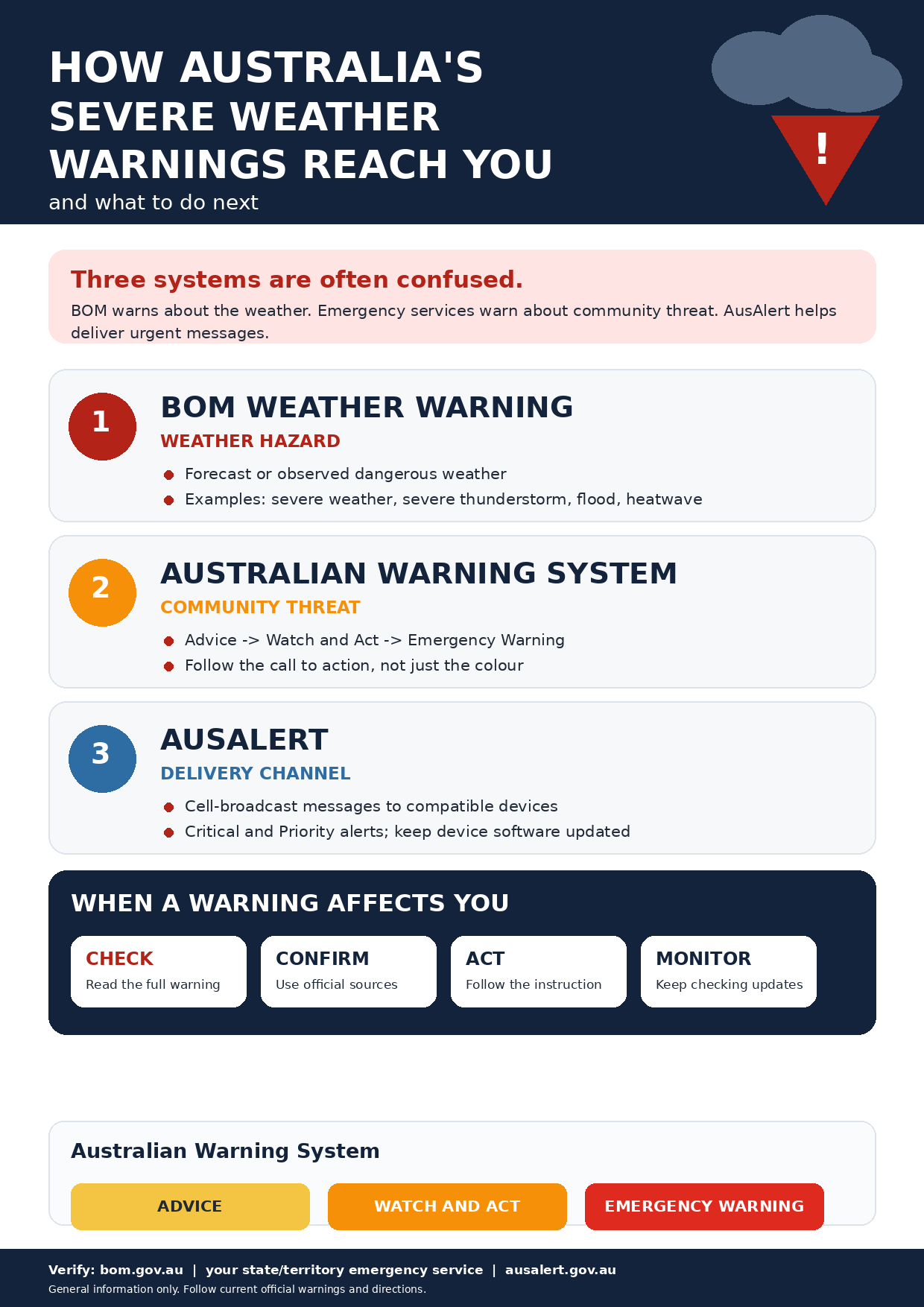
- When a warning affects you: CHECK -> CONFIRM -> ACT -> MONITOR.
What’s been updated for 2026?
This article has been substantially rebuilt. It now separates BOM weather warnings from the Australian Warning System, adds AusAlert, removes outdated and speculative material, clarifies the role of state and territory emergency agencies, and replaces broad climate claims with current evidence from BOM and CSIRO.
How Australia’s warning system fits together
One of the easiest mistakes to make is to treat every alert as if it belongs to the same warning scale. It does not. Australia uses several connected systems, and each has a different job.
| Layer | What it does | Example |
|---|---|---|
| 1. Forecast and monitoring | Shows developing weather and expected conditions. | BOM forecast, radar, observations and heatwave outlook. |
| 2. BOM weather warning | Warns that a defined weather hazard is occurring or expected. | Severe Weather Warning or Severe Thunderstorm Warning. |
| 3. Emergency-service warning | Explains the community threat and actions people should take. | Advice, Watch and Act, or Emergency Warning. |
| 4. Delivery channel | Gets the warning to you. | State emergency app, website, radio, AusAlert or other authorised alert. |
This distinction matters. A BOM warning tells you about the weather hazard. An emergency-service warning can tell you about the impact and action required. AusAlert is one way that urgent emergency information can be delivered to a device.
What a BOM Severe Weather Warning means
BOM issues Severe Weather Warnings for hazardous or dangerous weather that is not solely covered by severe thunderstorm, tropical cyclone or bushfire warning services. Depending on the location and situation, the warning may cover damaging or destructive winds, heavy or intense rain that may lead to flash flooding, and blizzards in alpine areas.
BOM says Severe Weather Warnings are issued when severe weather is happening or is expected to develop or move into an area. Lead time varies with the weather situation and can range from about an hour to 36 hours. While the threat continues, warnings are routinely updated, and more frequent updates may be issued if needed.
Severe Weather Warning is not the same as Severe Thunderstorm Warning
A Severe Thunderstorm Warning is a separate BOM product. A thunderstorm is classified as severe when it is producing, or is expected to produce, at least one severe phenomenon such as damaging wind gusts, large hail, a tornado or heavy rainfall that may lead to flash flooding.
This is important because the safest action can depend on the hazard. A damaging-wind event, a fast-moving thunderstorm and flash flooding can all create very different risks even if they affect the same suburb.
Do not read the headline only
Open the full warning. Check the affected area, expected hazards, timing, observations, recommended actions and when the next update is due. A warning that covers a large forecast district may not affect every location in the same way.
Australian Warning System levels
The Australian Warning System provides a nationally consistent way to describe the seriousness of many emergencies. These are not “BOM alert levels”. They are community emergency-warning levels used by emergency-management authorities.
Advice
An incident has started. There is no immediate danger. Stay up to date in case the situation changes.
Watch and Act
There is a heightened level of threat. Conditions are changing and you need to start taking action now.
Emergency Warning
This is the highest warning level. You may be in danger and need to take action immediately.
The warning level may be paired with a specific call to action such as prepare now, avoid the area, move to higher ground, leave now or take shelter now. Always follow the action statement in the warning rather than relying only on the colour or heading.
AusAlert: Australia’s new national phone-alert system
AusAlert is the major warning-system change Australians need to understand in 2026. It uses cell-broadcast technology to send emergency messages from mobile towers to compatible devices in a defined area. It is different from an ordinary SMS.
Following community testing and a national test in July 2026, AusAlert became available for use from October 2026. The transition is not necessarily identical in every state and territory. NEMA has advised that some jurisdictions may continue using existing Emergency Alert arrangements alongside AusAlert while they transition.
What an AusAlert can tell you
- what the emergency is
- where it is happening
- how serious it is
- what you should do
- which authority sent the message
- where to find more information
Critical and Priority alerts
AusAlert uses two principal alert types. A Critical Alert is for the most serious emergencies and requires immediate attention. A Priority Alert indicates a high level of threat and changing conditions. These are AusAlert delivery categories and should not be confused with the three Australian Warning System levels above.
Important
AusAlert adds another powerful warning channel, but it is not a reason to stop checking BOM, your state or territory emergency-service app or website, local radio and official instructions. Keep your device software updated and continue using multiple trusted sources.
What to do when a severe weather warning affects you
When a warning arrives, use a simple four-step process:
1. CHECK
Read the full message. Check the location, hazard, timing and expected impact.
2. CONFIRM
Confirm the situation using BOM and your state or territory emergency-service source.
3. ACT
Follow the official action advice. Do not delay a safety action to protect property or finish a task.
4. MONITOR
Keep checking updates. The threat area, timing and recommended action can change.
Before the event reaches you
- Charge phones and backup power banks.
- Make sure warning notifications are enabled for the locations that matter to you.
- Secure loose outdoor items if it is safe to do so.
- Move vehicles under suitable cover or away from trees where appropriate.
- Bring pets to a safe location.
- Check medications, torches, drinking water and essential supplies.
- Tell family or household members what the plan is.
- Avoid unnecessary travel when authorities warn that roads may become unsafe.
Do not wait for perfect certainty
Warnings are based on the best information available, but severe weather can develop quickly and local impacts can vary. If conditions around you are clearly unsafe, take protective action. Do not wait for a second notification simply because your phone has not updated yet.
Quick actions by hazard
| Hazard | Immediate priorities | Avoid |
|---|---|---|
| Damaging winds / storms | Move indoors, stay away from windows, secure loose items beforehand, monitor falling-tree and powerline hazards. | Sheltering under trees, approaching fallen powerlines, unnecessary travel. |
| Flash flooding | Move away from low-lying areas if directed, monitor local warnings and road closures, move to safer ground when instructed. | Driving, walking, riding or playing in floodwater. |
| Severe thunderstorm / hail | Shelter indoors, move away from exposed windows, protect vehicles only if this can be done before conditions become dangerous. | Going outside during hail or lightning to protect property. |
| Heatwave | Follow health advice, keep hydrated, reduce heat exposure and check people at higher risk. | Assuming one hot afternoon is the whole risk; heatwaves involve sustained heat and can worsen over several days. |
| Coastal / cyclone-related hazards | Follow local cyclone, storm surge, surf and evacuation advice. Prepare early because access routes may close. | Going to beaches, headlands or flooded coastal roads to watch conditions. |
Where to get reliable warning information
The safest approach is to build a small warning network rather than depend on one channel.
- BOM website and BOM Weather app: forecasts, radar, observations and weather warnings.
- Your state or territory emergency-service app or website: incident warnings and community action advice.
- AusAlert: targeted urgent messages to compatible devices when authorised agencies use the system.
- Emergency broadcasters: particularly useful during prolonged incidents, power disruption or when mobile access is unreliable.
- Official social-media accounts: useful as a secondary source, but check the account and timestamp before sharing.
Set up the BOM Weather app before you need it
BOM allows warning notifications for saved locations. Depending on the location, notifications can include severe weather, severe thunderstorm, flood, heatwave, tropical cyclone, fire weather, coastal hazards, marine wind and tsunami warnings. If you travel, review your saved locations rather than assuming your usual settings cover where you are.
Why multiple sources matter
A phone can be flat, damaged, switched off, outside coverage, running old software or simply not in the target area when an alert is sent. Power and telecommunications can also be affected during storms. Build redundancy into your warning plan.
What firefighters and emergency-service professionals want the public to know
From an emergency-management perspective, warnings are most useful when they change behaviour early enough to reduce exposure. The goal is not to predict the event yourself. The goal is to understand the official information, recognise when your location is affected and act before options become limited.
For households, that means knowing in advance where you will get information, who in the household will monitor updates, what conditions would stop travel, and who may need extra help. During large events, emergency services can be dealing with many incidents at once. Self-preparation and early action can reduce avoidable exposure and make emergency response more effective.
Operational perspective – Ken Walker
Ken Walker is a former Station Officer and fire-service educator with career and volunteer firefighting experience. His practical view is simple: warnings work best when people have already decided how they will receive information and what actions they will take. Waiting until conditions are severe creates fewer safe options.
For emergency-service and workplace teams
Organisations should treat public warnings as part of a broader situational-awareness process. Depending on the organisation, that may include monitoring BOM products, agency intelligence, local observations, road and infrastructure status, staff welfare, communications resilience and pre-agreed escalation triggers. Workplace procedures and agency doctrine must always take precedence over general public guidance in this article.
How a changing climate affects warning risk
It is more accurate to talk about specific hazards than to say that every type of severe weather is simply becoming more frequent.
The BOM and CSIRO State of the Climate reporting shows that Australia is experiencing more extreme heat, more dangerous fire-weather days and more intense short-duration heavy rainfall in many areas. These changes can increase warning and response challenges, particularly where intense rainfall contributes to flash flooding or where heat and fire-weather risks combine.
Tropical cyclones show why careful wording matters. The number of tropical cyclones in the Australian region has declined since reliable satellite observations began, but projections indicate that a greater proportion of future cyclones may be high intensity, with heavier associated rainfall and impacts worsened by higher sea levels.
For the public, the practical message is straightforward: warning systems need to keep evolving, but households also need a reliable way to receive and act on warnings across multiple hazards.
Frequently asked questions
Is a BOM Severe Weather Warning the same as a Watch and Act?
No. A BOM Severe Weather Warning is a meteorological warning about dangerous weather. Watch and Act is a warning level within the Australian Warning System used by emergency authorities to communicate community threat and action.
What is the difference between a Severe Weather Warning and a Severe Thunderstorm Warning?
They are separate BOM warning products. Severe Thunderstorm Warnings are specifically for thunderstorms expected to produce defined severe phenomena such as damaging winds, large hail, heavy rainfall leading to flash flooding or tornadoes. Severe Weather Warnings cover other hazardous weather situations including damaging or destructive winds and heavy or intense rain that may lead to flash flooding.
Do I need to download an app to receive AusAlert?
AusAlert uses cell broadcast rather than a normal app notification or standard SMS. Compatible devices in the target area can receive an authorised alert. Keep your device software current and still maintain other warning sources.
Does AusAlert replace the BOM Weather app?
No. BOM remains the primary source for official weather forecasts and weather warnings. AusAlert is an emergency-message delivery system. State and territory emergency apps and websites also remain important.
Why did someone nearby receive an alert when I did not?
There can be differences in device compatibility, software, tower connection, target area and timing. Never assume you are safe simply because your phone did not alert. Check official sources if severe weather is nearby.
Should I wait for an Emergency Warning before acting?
No. You may need to act at an earlier warning level or before a formal emergency warning reaches you. Follow the action advice in the current warning and respond to obvious local danger.
What if I am driving when an alert sounds?
Do not handle or read a phone while driving. Continue to obey road laws, move to a safe place when possible and only check the message when it is safe and legal to do so.
Practical next steps
- Install or update the BOM Weather app and review your warning-notification settings.
- Install or bookmark your state or territory’s official emergency-warning service.
- Keep mobile-device software updated for AusAlert compatibility.
- Choose a backup information source such as local radio.
- Talk through the CHECK -> CONFIRM -> ACT -> MONITOR process with your household.
- Write down who may need extra help during storms, floods, heat or power outages.
Related FireRescue Guides
- Severe Storms and Hail: How to Harden Your Roof and Windows
- Flash Flooding in Cities: Garage, Basement and Carpark Safety
- Emergency Evacuation Plan: Guide and Example
Sources
- Bureau of Meteorology – Severe weather and coastal hazard warning services
- Bureau of Meteorology – BOM Weather app help and warning notifications
- Australian Institute for Disaster Resilience – Australian Warning System
- National Emergency Management Agency – AusAlert
- AusAlert official website
- CSIRO and Bureau of Meteorology – State of the Climate
About the author and safety review
Ken Walker – former Station Officer and fire-service educator with career and volunteer firefighting experience.
Last reviewed: 5 October 2026
Review basis: Checked against current BOM, AIDR, NEMA/AusAlert, state emergency-service and CSIRO/BOM guidance.
This article provides general educational information for an Australian audience. It does not replace site-specific professional advice, agency procedures or current directions from emergency authorities. Conditions can change rapidly. During an emergency, follow official warnings and directions.
Conclusion
Australia’s warning system is becoming more capable, but technology alone cannot make a decision for you. BOM warnings explain the weather hazard. Emergency services explain the community threat and required action. AusAlert adds a fast national way to deliver urgent messages to compatible devices. Your job is to know where to look, recognise when your location is affected and act early enough to keep safe options open.
If you are a firefighter, emergency-service member or community reader and you notice an outdated warning link, unclear wording or a practical lesson that would improve this guide, FireRescue welcomes corrections and useful field or community experience. Important safety claims should be verified against current official guidance before they are added.
FireRescue Training Hub
Access practical fire and emergency study support resources, downloads, checklists, audio guides, and member-only course content.
- Course library
- PDF downloads
- Audio guides
- Checklists
Study support only. Not accredited training or a replacement for workplace procedures.
About the author and safety review
Ken Walker
Former Station Officer and fire service educator
Former career firefighter with extensive career and volunteer fire service experience.
Qualifications: Associate Diploma of Applied Science in Fire Technology; Institute of Fire Engineers studies.
Author profilehttps://www.firerescue.com.au/about-us/