A bathroom exhaust fan is easy to overlook. You switch it on, the mirror clears, and the noise fades into the background. Yet some fans sit just below a ceiling cavity containing electrical wiring, insulation and combustible debris. If the motor fails, airflow becomes restricted or heat cannot escape, a small fault can become a serious fire hazard.
This Australian guide explains the warning signs of a faulty bathroom exhaust fan, how to clean accessible parts safely, when to call an electrician and why ceiling insulation deserves special attention. It also covers combination heater-light-fan units, rental properties and a less obvious issue involving older gas heaters.
Emergency: If you see flames or smoke, smell strong burning, or suspect a fire in the ceiling, get everyone out, stay out and call Triple Zero (000). Do not enter the roof space or pull apart the fan to investigate.
In this guide
Quick answer · Causes and ceiling risks · Warning signs · Safe cleaning · Insulation and renovations · What to do in a fire · Checklist · FAQs
Quick answer: Can a bathroom exhaust fan cause a fire?
Yes. A bathroom exhaust fan is an electrical appliance, and faults can occur. In a ceiling-mounted installation, overheating may affect nearby material or equipment in the roof space. Risk factors can include a failing motor, damaged wiring, accumulated dust, restricted airflow and insulation placed too close to equipment that must release heat. These conditions do not mean every dusty fan is about to catch fire.
ACT Fire & Rescue has reported investigations involving bathroom fans and downlights covered by insulation. The South Australian Metropolitan Fire Service also identifies exhaust fans and bathroom heater-light-fan combinations among heat-generating roof-space devices that need suitable clearances. ACT Emergency Services Agency | SA Metropolitan Fire Service
The most useful household rule is simple: keep the accessible cover clean, notice changes in how the fan behaves, and have hidden or electrical problems assessed by a qualified professional.
Why a fire can start above the bathroom ceiling
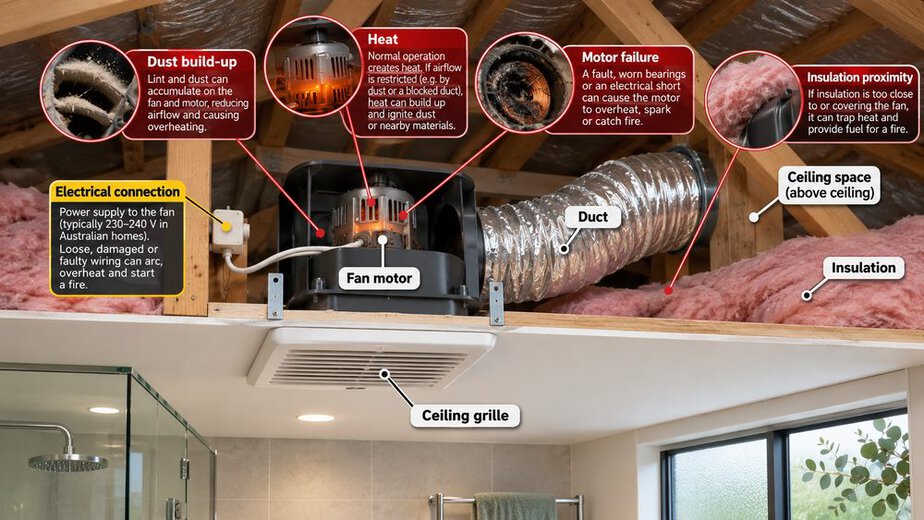
Many bathrooms use a ceiling-mounted extraction fan to remove steam and odours. The visible grille is only the beginning. Depending on its design, the assembly may include a motor, wiring, ducting, a backdraught damper and, in some homes, heat lamps or lights.
A failing motor or electrical connection
Motors generate some heat during normal operation. A worn bearing, jammed impeller or other fault may make a fan run hotter, noisier or less efficiently. Damaged electrical connections can also create dangerous heat. You generally cannot identify the exact fault from a sound or smell alone, but these changes are reasons to stop using the appliance and arrange an inspection.
Do not treat a tripping circuit breaker as an inconvenience. Repeated tripping may signal a fault that needs an electrician. Never bypass a safety switch, replace it with an unsuitable device or keep resetting it so a suspect fan can run.
Dust, lint and blocked airflow
Dust can gather on grilles, fan blades and nearby surfaces. Heavy build-up may restrict airflow or interfere with moving parts. However, the amount of dust visible on the grille does not tell you whether hidden components are safe. Equally, a clean-looking cover does not prove the motor or wiring is sound.
A useful maintenance habit is to clean only those parts the manufacturer says a householder can access. Routine cleaning helps, but it cannot repair a failing motor, remove an electrical defect or confirm safe clearances above the ceiling.
Insulation and combustible material in roof spaces
Ceiling insulation helps keep a home comfortable, but it must not cover equipment that requires a clearance. Heat-producing appliances, fan housings and certain light fittings have different installation requirements. The correct separation depends on the exact product, its instructions and applicable electrical and building requirements.
Queensland Fire Department warns that insulation placed on or too close to bathroom heater-exhaust fans may contribute to roof fires. ACT Fire & Rescue has also noted dust and other materials around fans and electrical equipment in roof-space fire investigations. These accounts describe possible contributing conditions; they do not prove that all ceiling fires have the same cause. Queensland Fire Department
Never climb into a roof space to move insulation or inspect wiring yourself. Ask an appropriately licensed electrician or another suitably qualified specialist to assess the installation safely.
Bathroom exhaust fans, heat lamps and 3-in-1 units
Bathroom ventilation products vary, and their risks are not identical. Knowing what you have helps you ask the right maintenance questions.
Standard exhaust-only fans
A basic exhaust fan removes moist air. It may be ceiling-mounted, wall-mounted or connected to ducting. Important considerations include the condition of the motor, grille, switches, wiring, duct and any required ventilation openings.
Combined heater, light and exhaust units
Often called 3-in-1 bathroom units, these appliances combine several electrical functions in one ceiling fitting. Heat lamps and associated components may operate at higher temperatures than an exhaust-only fan. Their installation and clearances therefore deserve particular care. Never add insulation, a DIY cover or decorative material around a fitting without checking the approved instructions and having any required work done professionally.
Ducted and non-ducted installations
Some fans move moist air through a duct to the outside. Other older arrangements may discharge into a roof space, which can create moisture and ventilation problems. The Australian Government’s YourHome guidance recommends venting bathroom moisture outdoors and notes that exhaust fan openings into roof spaces can cause uncontrolled air movement and other concerns. An installer can assess whether an existing arrangement needs improvement. YourHome — Ventilation and airtightness
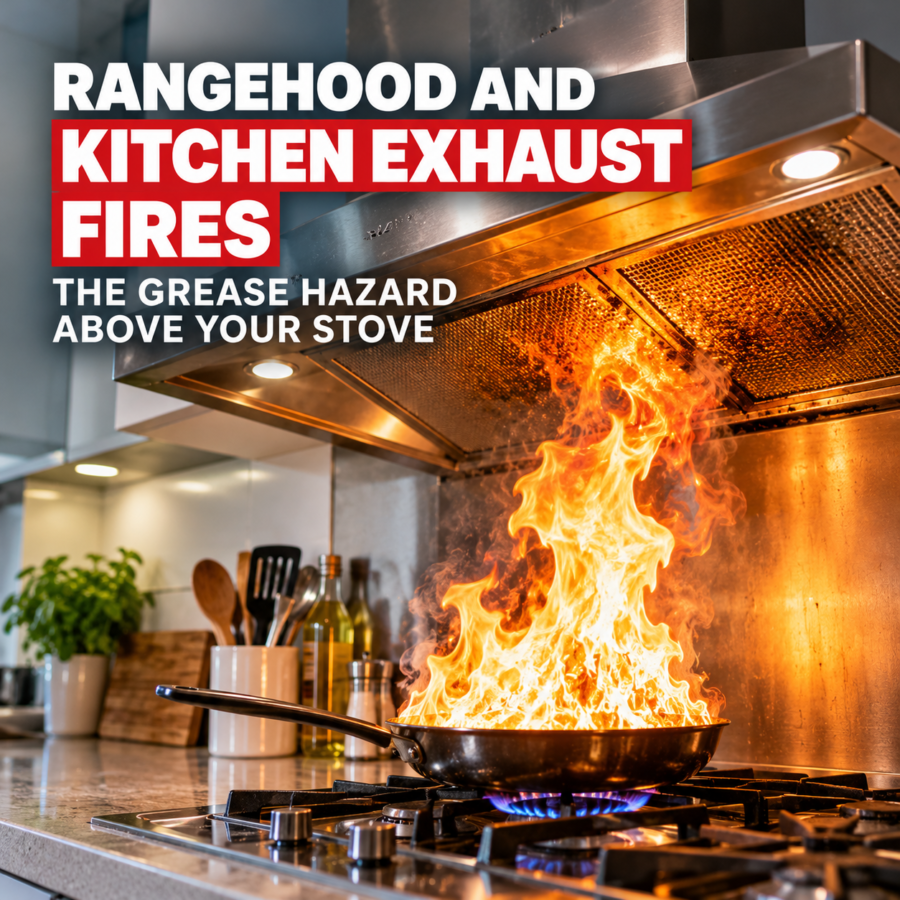
Important distinction: This article concerns bathroom ceiling and extraction fans. Kitchen rangehood grease fires involve a different fuel source and are covered in our separate rangehood and kitchen exhaust fire guide.
Seven warning signs that need attention
A warning sign is not proof a fire will occur. It is a reason to stop, check what you can safely observe and arrange appropriate repairs.
- A new burning or hot-electrical smell. Switch the appliance off if safe, keep away and arrange urgent professional advice. If smoke or fire is present, evacuate and call 000.
- Grinding, scraping, loud humming or rattling. A change in sound can indicate a mechanical problem or a loose component.
- Very weak airflow. A blockage or fan fault may be preventing steam from leaving the bathroom properly.
- A fan that stops, starts or slows unexpectedly. Do not assume intermittent operation is normal unless the product is designed to work that way.
- Repeated breaker or safety-switch trips. Leave the circuit and appliance alone and contact a licensed electrician.
- Discolouration, melting or scorch marks. These need prompt professional investigation, even if the fan still works.
- Excessive heat at a fitting or switch, or visible smoke. Move away. If there is smoke, flames or a suspected ceiling fire, evacuate and call 000.
A fan that takes longer than usual to clear steam could also reflect inadequate ventilation, room conditions or a duct problem, not necessarily an electrical fire hazard. The aim is to find the reason rather than guess.
How to clean a bathroom exhaust fan safely
Regular maintenance should be simple and limited to accessible, non-electrical parts. Read the instructions for your exact make and model first. Some covers are removable by the owner; others should only be handled by a professional.
Before you begin
- Switch the fan off and allow the fitting to cool. Follow the manufacturer’s isolation instructions, especially where heat lamps or hard-wired components are fitted.
- Use a stable position that does not require risky climbing or overreaching. If you cannot reach the grille safely, ask for help from a suitable service provider.
- Check the manual for permitted cleaning methods and whether the cover can be removed without exposing wiring.
- If the fan smells burnt, has scorched parts, keeps tripping a circuit or appears damaged, do not clean it as a workaround. Arrange professional assessment.
Clean only what the manufacturer allows
Gently remove surface dust from an accessible grille with a suitable soft brush or vacuum attachment, as the manual allows. If the manual permits the cover to be removed by the householder, follow its procedure and replace the cover securely. Keep water, sprays and cleaning chemicals out of electrical parts and the motor.
Never reach into the fan housing while it may be energised. Do not touch wiring, bypass a thermal cut-out, dismantle the motor or pull down a fixed fitting. After cleaning, use the appliance only when the cover is secure and everything is dry, and only if no fault symptoms remain.
How often should it be checked?
There is no universal cleaning interval that suits every fan. Follow the manufacturer and adjust your household reminder for dust, use and environmental conditions. As a practical prompt, CFA suggests linking annual smoke-alarm cleaning with another regular task such as cleaning bathroom exhaust fans. That is a reminder, not a substitute for the fan maker’s maintenance schedule. CFA smoke alarm maintenance
What renovations and ceiling insulation installers need to know
A bathroom fan may run for years without obvious trouble, then develop problems after ceiling work. Renovations can disturb ducts, wiring, insulation and covers. Added insulation may conceal equipment or block required ventilation. Even a small change above the bathroom can matter if it affects an electrical fitting.
Before insulation, ventilation or lighting work, make sure the people doing the job know where the fan, heat lamps, downlights, cables and ducting are. A qualified installer should confirm clearances and use the manufacturer’s instructions. The homeowner should not rely on a generic distance copied from another product: clearance requirements are installation-specific.
The South Australian Metropolitan Fire Service specifically warns about heat-producing roof-space devices and the added risks from insulation and debris. Queensland Fire Department also recommends inspection by a qualified person if there are concerns about ceiling insulation. SA MFS — Roof spaces | Queensland Fire Department
What about older homes and asbestos?
Some older Australian buildings may contain asbestos-containing materials. If a renovation or repair might disturb a ceiling, sheeting or insulation material you cannot identify, stop and obtain advice from an appropriately qualified professional. This is another reason not to open ceiling cavities or remove fixtures casually.
A real Australian incident: suspected exhaust fan failure
In September 2026, Western Australia’s SafetyLine Hub reported a bathroom fire in a mine accommodation room. Its initial findings suggested that a wall-mounted exhaust fan malfunctioned and overheated, allowing hot material to fall onto toilet paper below. A building alarm alerted people nearby, and the incident was contained.
That report did not establish a universal cause for bathroom fan fires. It is useful because it shows how several factors can interact: electrical equipment, nearby combustible material, early detection and maintenance systems. In accommodation and workplace settings, the same lesson extends to who receives fault reports and who arranges repairs. WA SafetyLine Hub incident report
Keep paper, towels, cleaning products and other combustibles away from fittings that can become hot, particularly wall-mounted units or heat lamps. Do not block air openings or place items over a fan.
Renters, homeowners and building managers: who should act?
Homeowners can keep accessible covers clean, watch for changes in operation and arrange qualified inspection when needed. When renovating, tell electricians and insulation installers about existing roof-space equipment.
Renters should report unusual noises, burning smells, poor operation or visible damage to the landlord or property manager promptly, preferably in writing. Do not attempt repairs to hard-wired electrical equipment. If the defect poses an immediate danger, follow emergency procedures and seek urgent assistance.
Strata managers and accommodation operators should have a clear process for recording complaints, isolating faulty equipment, arranging competent repairs and checking common or centrally maintained ventilation systems. In workplaces, the relevant operator should follow applicable safety and maintenance obligations.
For all three groups, a maintenance note is better than an uncertain memory. Record the fan location, problem reported, date and repair outcome. Do not claim an appliance was inspected unless that work actually occurred.
An additional hazard: fans and older open-flued gas heaters
There is another risk that is separate from a fan catching fire. In some homes with an open-flued gas heater, running an exhaust fan can reduce indoor air pressure. Under certain conditions, this may draw combustion gases, including carbon monoxide, back into living areas.
Energy Safe Victoria warns about this effect and advises suitable gas-heater servicing and assessment of negative pressure. If your home has an open-flued gas heater, ask a licensed gasfitter about safe use with bathroom fans and rangehoods. Do not block permanent ventilation openings or change gas-heater arrangements yourself. Energy Safe Victoria
This is a carbon monoxide risk, not the same mechanism as an exhaust-fan fire. It deserves attention because it involves the same everyday appliance.
What to do if you suspect a ceiling fire
A roof-space fire can develop out of sight. You may notice smoke coming from a grille, an unusual burning smell, crackling above the ceiling or a smoke alarm sounding. Do not wait for visible flames to confirm the problem.
- Warn people nearby and leave immediately. Take the safest clear exit.
- Close doors behind you if safe. Do not stop to investigate, collect belongings or move equipment.
- Call Triple Zero (000) from outside. Give the address and explain that the smoke or heat may be coming from a bathroom fan or ceiling cavity.
- Stay outside. Do not enter the roof, pull down ceiling panels or return to switch off the fan.
- Follow firefighters’ directions. Tell them if electrical equipment, roof insulation, heaters or vulnerable occupants are involved.
If there is only a minor operational fault and no sign of fire or immediate danger, stop using the fan, isolate it only if you can do so safely and as instructed by a qualified person, and organise an electrician. Never restart an appliance that appears to have overheated.
Firefighter perspective: the hidden space above the room
From an operational fire-safety perspective, a ceiling fire can be deceptive. Occupants may see only a little smoke at a grille while heat and combustion products develop above the plasterboard. The layout of roof voids, installed insulation, electrical services and possible paths of extension can complicate assessment and access.
For responding firefighters, priorities can include the safety and location of occupants, evidence of hidden fire spread, smoke movement, electrical isolation and the condition of the roof structure. Any opening-up work, ventilation choice or extinguishing method belongs to trained crews following their agency procedures and the conditions found on scene.
This section explains recognised operational considerations; it does not claim the author attended the incidents cited in this guide. Household readers should never attempt roof-space firefighting or inspection.
Practical bathroom exhaust fan safety checklist
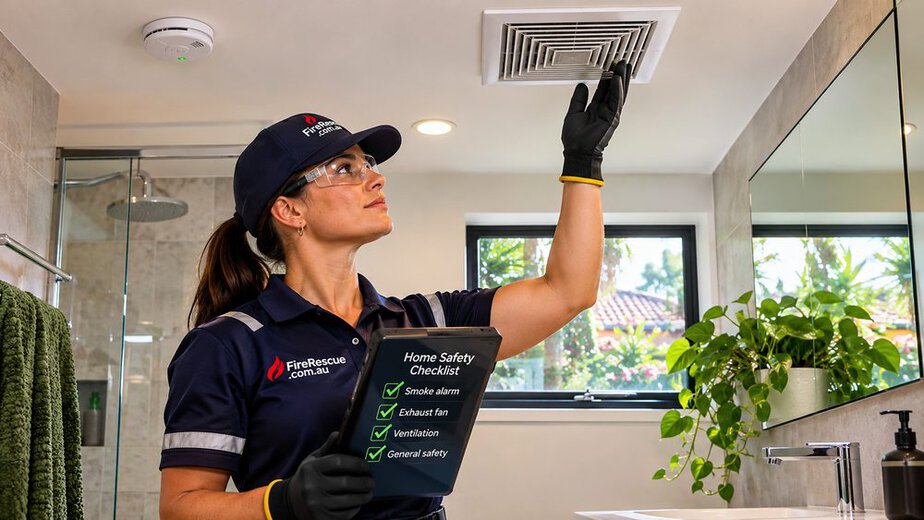
Use this quick checklist during normal household maintenance, not during an emergency.
- [ ] The fan’s grille is free from obvious heavy dust and blockage.
- [ ] The fan sounds normal and clears moisture as expected.
- [ ] There are no burning smells, scorch marks or signs of melting.
- [ ] Switches and circuits operate normally, without repeated tripping.
- [ ] The maker’s cleaning and maintenance instructions are available.
- [ ] A qualified person has assessed any suspected wiring, motor or ceiling-clearance problem.
- [ ] Recent ceiling insulation, renovation and electrical work did not conceal or disturb the fitting.
- [ ] Household members know to leave and call 000 if smoke or fire occurs.
- [ ] Smoke alarms are working and the household has an escape plan.
One useful action today: Look at the bathroom fan from the floor. If it’s dusty, faulty or unfamiliar, find the model instructions and decide whether it needs safe surface cleaning or a professional visit. You don’t need to climb into the roof to make a good safety decision.
Frequently asked questions
Can bathroom exhaust fans catch fire when switched off?
An appliance can have an electrical fault even when it is not actively moving air, depending on its design and supply. However, do not assume every stopped fan is still heating. If you suspect electrical damage, do not use the fitting and ask an electrician to assess it. Visible smoke or fire requires evacuation and a call to 000.
Is a dusty bathroom exhaust fan dangerous?
Heavy dust can affect operation and may contribute to poor airflow or overheating under some conditions. It does not automatically mean a fire is imminent. Clean accessible parts according to the manual, and seek professional help if there are other warning signs.
Can I move ceiling insulation away from the fan myself?
Do not enter the roof space or move insulation near electrical equipment as a DIY fire-prevention task. You could disturb wiring, damage equipment or encounter other hazards. Arrange assessment by an appropriately qualified professional.
Is a bathroom 3-in-1 heat lamp unit the same as an exhaust fan?
No. It combines ventilation with lighting and heating functions. Heat-producing parts may have special clearance and installation requirements. Follow the exact product instructions and use a qualified tradesperson for any electrical or concealed work.
Should I leave the bathroom fan running all night to remove steam?
Follow the appliance instructions and any controls designed for that model. Some systems run automatically or for extended periods; others do not. A faulty, noisy or overheating fan should not be left running. Good ventilation should not depend on ignoring warning signs.
Does my smoke alarm protect me from a roof-space fire?
Working smoke alarms are essential, but no alarm provides a guarantee of early detection for every fire location. Follow local installation rules and agency guidance, test alarms regularly and maintain a practical escape plan. CFA recommends monthly smoke alarm testing. CFA smoke alarm maintenance
The takeaway: a small fan deserves a regular check
Bathroom exhaust fan fire safety is not complicated, but it does need attention. Look for changes in sound, smell and operation. Keep accessible parts clean as the manufacturer directs, never interfere with wiring or roof-space insulation, and report faults early.
The biggest lesson is that an apparently small bathroom fitting may connect to a much larger hidden space. Good maintenance and early reporting reduce preventable risks, while working smoke alarms and a practiced escape plan help protect people if something does go wrong.
Next steps: Check the fan instructions, book professional help for anything suspicious and share these simple checks with someone who manages a home, rental or accommodation building.
Related FireRescue guides
- Clothes Dryer Fire Safety in Australia — lint, airflow and electrical warning signs.
- Rangehood and Kitchen Exhaust Fires — why grease-laden kitchen exhaust systems need different care.
- Fire Doors in Apartments — how shared escape routes and fire doors protect residents.
- Home Fire Safety — more Australian household safety guides.
Official sources and further reading
- ACT Emergency Services Agency — Home fire and ceiling safety.
- South Australian Metropolitan Fire Service — Roof spaces.
- Queensland Fire Department — Structural fire safety and ceiling insulation.
- CFA — Smoke alarm maintenance.
- Australian Government YourHome — Ventilation and airtightness.
- WA SafetyLine Hub — Suspected exhaust fan failure, September 2026.
- Energy Safe Victoria — Negative-pressure environments.
Author: Ken Walker — FireRescue Training Hub. This is general Australian fire-safety education, not an electrical inspection or a substitute for professional advice. Follow the appliance manufacturer, current local requirements and emergency-service directions. Readers can contact FireRescue through the website with corrections or useful community observations. Publication requires a final editorial and link check.
FireRescue Training Hub
Access practical fire and emergency study support resources, downloads, checklists, audio guides, and member-only course content.
- Course library
- PDF downloads
- Audio guides
- Checklists
Study support only. Not accredited training or a replacement for workplace procedures.
About the author and safety review
Ken Walker
Former Station Officer and fire service educator
Former career firefighter with extensive career and volunteer fire service experience.
Qualifications: Associate Diploma of Applied Science in Fire Technology; Institute of Fire Engineers studies.
Author profilehttps://www.firerescue.com.au/about-us/