Command, Control and Tactical Strategies for Wildfires in the Australian Outback
A practical operational guide for incident commanders, strike teams and frontline firefighters operating in remote, high-risk bushfire environments.
Understanding the Outback Environment and Fire Behaviour
Effective command and control in the Australian outback begins with an unflinching appreciation of the landscape and the fire behaviour it produces. The outback is not a single environment: it is an assemblage of arid plains, spinifex and mulga shrublands, intermittent woodlands and long grass country. Each fuel type and landform produces different intensity and spread characteristics that must inform operational planning.
Key environmental drivers
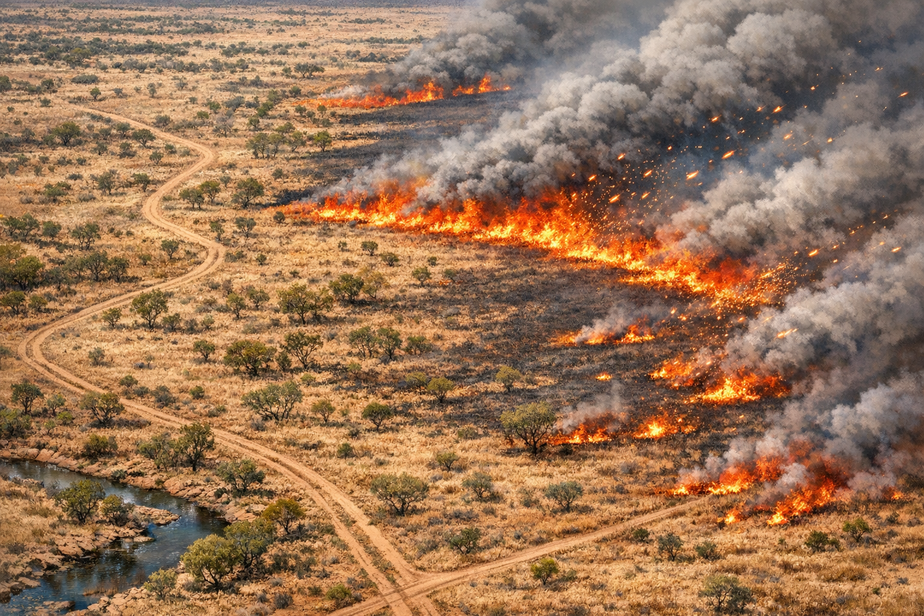
- Fuel: Spinifex and dry tussock grasses can yield extremely fast-moving fire fronts with low flame heights but high spotting potential; mulga and eucalyptus stands can produce intermittent crown runs and sustained high-intensity flame lengths.
- Climate: Prolonged drought, persistent high temperatures and low relative humidity prime fuels for rapid ignition and long-range ember transport.
- Wind: Erratic, strong winds create rapid changes in direction and intensity — a critical factor for safety planning and choosing tactics.
- Topography and access: Subtle rises, gullies and creeklines can accelerate or channel fire; sparse tracks limit egress and supply lines.
Typical fire behaviours to expect
In the outback you must routinely plan for:
- Long-range spotting: Embers can be lofted kilometers ahead of the main front during windy runs, igniting spot fires that overwhelm containment lines.
- Fire whirls and sudden updrafts: These create pulsing, localized extreme behaviour, endangering crews working close to the fire edge.
- Crown runs and transition between surface and canopy fire: Where trees or tall shrubs are contiguous, isolated flare-ups can become sustained crown behaviour rapidly.
- Fast grass runs: In contiguous grasslands, fire can travel at very high rates of spread, reducing safe reaction time.
Operational takeaway
Base planning on fuel mapping, weather forecasting and access analysis. When in doubt, anticipate rapid spotting and erratic wind shifts and keep tasking short, explicit and supported by redundant communications.
Incident Command System (ICS) Adaptations for Remote Australian Fires
The Incident Command System provides a robust scaffold for organizing personnel and resources, but adaptations are essential in remote outback incidents. Limited logistics, extended timelines for resource arrival and complex air operations demand flexibility and a strong liaison function.
Roles and structure
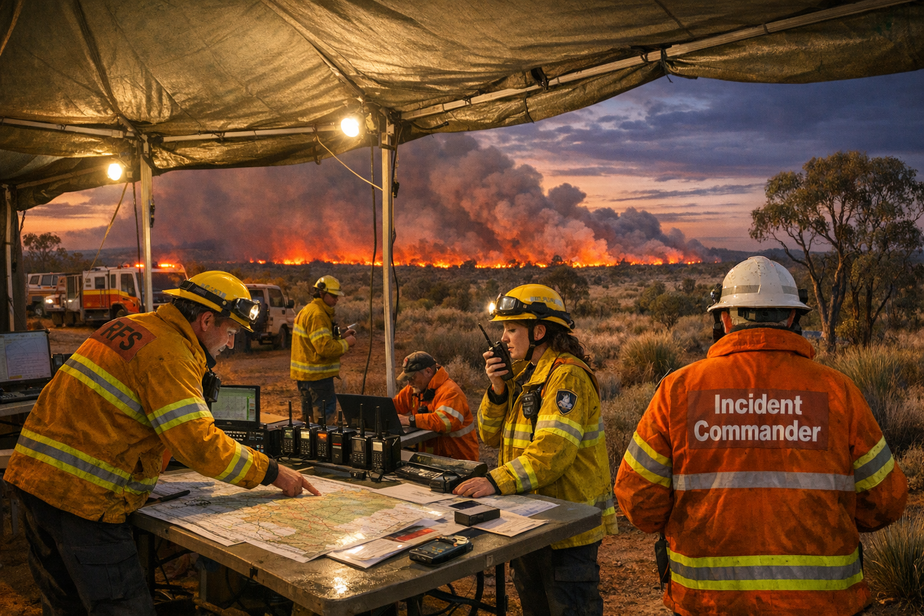
A scalable ICS tailored for the outback should include:
- Incident Controller: Strategic decision-maker with delegated authority for life safety, asset protection and resource allocation.
- Operations Section: Manages strike teams, ground crews, heavy plant, and crews coordinating immediate suppression actions.
- Planning Section: Fuel and fire-behaviour analysts, mapping, forward planning and operational intelligence — crucial for anticipating spot fires and aligning aerial recon.
- Logistics Section: Responsible for water resupply chains, fuel, food, accommodation and tasking of resupply aircraft or convoys.
- Safety Officer: Monitors triggers, escape routes, safety zones and ensures decision points for withdrawal are respected.
- Remote Operations Liaison: A dedicated role to coordinate community contacts, Indigenous rangers, and aviation coordination when runways or helipads are ad hoc.
Scalability and integration
Plan the ICS to expand and contract. Early phases may be small: a local crew, a dozer and a single helicopter. As the incident grows, integrate state and federal aerial assets, incoming strike teams, and external specialists (meteorologists, behavioural analysts). Establish an onboarding routine so new units receive the same safety brief, frequency plans and common operating picture.
Communication protocols
Redundancy is non-negotiable. Recommended practices include:
- Primary VHF/UHF radio networks with pre-planned frequencies for command, operations and aviation.
- Secondary satellite phones or satellite messaging where terrestrial networks are unreliable.
- Scheduled comms check-ins and position reports — even brief ones — to maintain situational awareness for remote crews.
- A dedicated aviation frequency and a single aviation coordinator within the command structure.
“Establish the forward command post early where possible — its durability and clear routines around brief/brief-out, safety demarcation and liaison will make remote operations manageable and safer.” — Operational guidance
Strategic Objectives and Prioritisation in the Outback
Strategic objectives must be realistic and prioritize life safety above all else while balancing protection of critical infrastructure and cultural assets. In remote settings, containment may be impractical across vast distances; strategy should be driven by risk assessment and clear prioritisation.
Setting objectives
Incident objectives are typically framed as:
- Save lives — communities, isolated stations, travelling people.
- Protect critical infrastructure — power lines, communications, water bores, main roads.
- Maintain access for emergency services and supply lines.
- Contain fire where feasible to reduce further escalation and protect environmental/cultural sites.
Risk-based prioritisation
Use a risk matrix that combines consequences and likelihood to rank tasks. Examples of prioritisation rules:
- Immediate life safety tasks (evacuation assistance, rescue) are highest priority.
- Protection of isolated communities and water infrastructure follows.
- Containment tasks where access and resources allow; otherwise focus on defensive protection of assets.
Control options
Tactical choices should be explicit:
- Direct attack: Where crews can safely work at the fire edge (limited in grass runs).
- Indirect control: Using roads, rivers or dozer lines as control features when direct attack is unsafe.
- Tactical backburning: For removing fuel ahead of a run but requires clear weather windows, aerial ignition support and contingency plans.
- Transition criteria: Predefine triggers to move from aggressive suppression to defensive posture (safety zone compromise, resource exhaustion, forecasted extreme winds).
Strategic takeaway
Explicitly document which assets you will protect and why. When containment is impractical, allocate resources to defend prioritized nodes and maintain situational control through reconnaissance and monitoring.
Tactics and Tasking: Ground Crews, Heavy Equipment and Aerial Resources
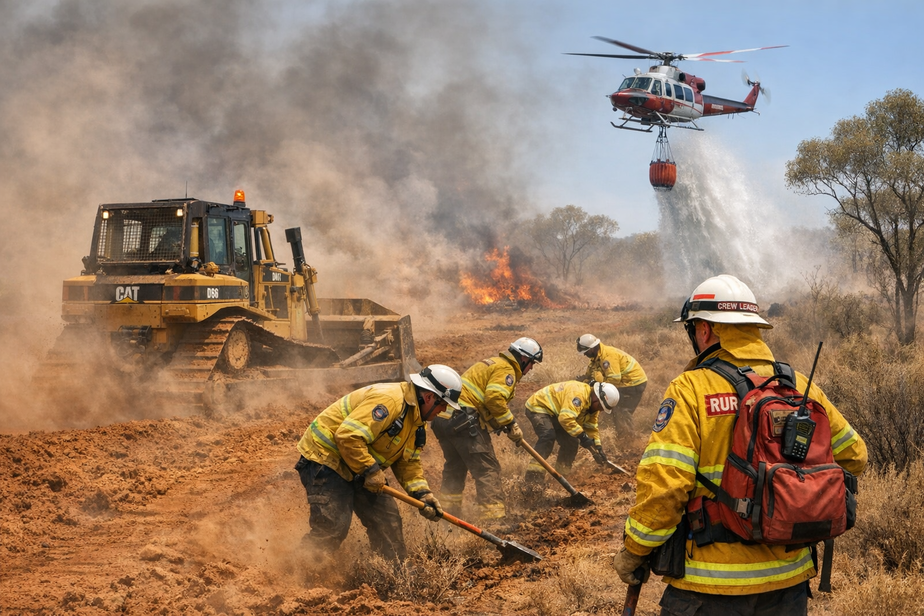
On-the-ground tactics must align with strategic objectives and the realities of the outback: long supply lines, variable fuel mosaics and limited escape routes. Tasking should be short, assignable and measurable.
Ground tactics
- Construct and reinforce firebreaks using hand tools and mechanical plant where available; focus on creating depth, not just a single narrow line.
- Hose-lay operations are effective near reliable water points — pre-plan hose lays and relay pumps for long distances.
- Anchor and flank protection: select anchor points (roads, creeklines, dozer lines) that reduce the risk of encirclement and allow safe suppression work.
- Controlled burns ahead of the main front when conditions permit and aerial ignition is available.
Heavy plant coordination
Dozers and graders are force multipliers in the outback. Best practice includes:
- Clear assignment of supervisory control and exclusion zones for crews working near machinery.
- Using heavy plant to create wide containment lines where terrain and soil conditions allow rapid line construction.
- Ensuring machine operators have up-to-date situation reports and that plant is refuelled and serviced according to a logistics plan.
Aerial roles and integration
Aircraft provide reconnaissance, retardant/water delivery, and aerial ignition capability. Integration steps:
- Use fixed-wing reconnaissance to map spot fires and give the Planning Section a current common operating picture.
- Coordinate water/retardant drops with ground crews to maximise effectiveness — e.g., drops to blunt a run before crews move in to reinforce lines.
- Plan aerial ignition carefully with meteorological windows and escape contingencies for crews below.
Tasking templates
Effective tasking in remote incidents should be concise and repeatable. A recommended tasking template:
- Task: Clear objective (e.g., “Establish 1.5 km handline from Grid 34 to Grid 36 to secure eastern flank”).
- Location: Grid reference and visual landmarks.
- Resources: Crew size, equipment, aerial support expected.
- Duration: Estimated time (2–4 hours) and planned relief time.
- Communications: Primary and secondary frequencies; check-in schedule.
- Safety: Identified safety zone, escape route, trigger points for withdrawal.
Safety Management and Crew Welfare in Remote Incidents
Safety must be the core decision filter. Remote incidents present unique challenges: prolonged exposure to extreme heat, delayed medical evacuation, and limited resources for rest and recovery.
Safety systems and trigger points
Establish and communicate:
- Designated safety zones and multiple escape routes per crew assignment.
- Clear trigger points that force immediate withdrawal (e.g., sudden wind shift of X degrees, flame height exceeding Y metres, or smoke density reducing visibility below Z metres).
- Daily briefings emphasising route awareness and the nearest extraction points.
Managing heat stress and fatigue
Practical measures include enforced rest rotations, hydration protocols with measured water allocations per hour, shaded rest areas at forward locations and routine medical checks. Use crew tracking and a rostering system to avoid cognitive and physical overload during multi-day deployments.
Medical and extraction planning
Forward medical capability should include trauma kits, basic stabilisation supplies and a plan for air medevac or ground extraction. Pre-identify landing zones and keep a reserve aircraft or rapid-response vehicle where feasible.
Safety takeaway
Prioritise safety zones, pre-defined trigger points, and enforced rest cycles. In remote incidents, a moment’s hesitation about safety is preferable to exposing crews to untenable conditions.
Community Engagement, Indigenous Knowledge and Cross-Agency Coordination
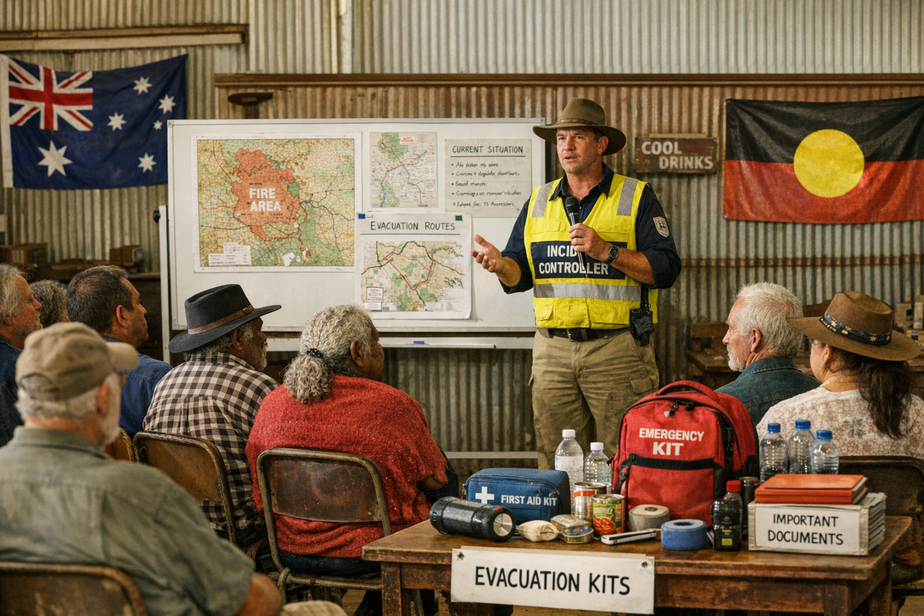
Successful outback wildfire management is as much social as it is tactical. Early, respectful engagement with communities, station managers and Indigenous rangers improves situational awareness and leverages local knowledge that can change operational choices for the better.
Engaging remote communities
- Establish contact early and agree on protection priorities and evacuation triggers.
- Provide succinct, factual briefings with maps and clear instructions; avoid technical jargon that can confuse decision-making under stress.
- Issue simple evacuation checklists and appoint local contact points for updates.
Indigenous knowledge and cultural burning
Indigenous rangers and elders hold deep, place-based understanding of fire patterns and cultural burning methods. Integrating this knowledge can improve fuel reduction strategies, identify culturally important sites to protect, and inform timing and methods for controlled burns.
Cross-agency coordination
A unified approach between local councils, SES, police, air services and national agencies is essential. Practical steps:
- Regular multi-agency briefings and a shared common operating picture (maps, spot reports).
- Pre-agreed roles for evacuation, traffic management and public messaging.
- Safeguards for using volunteers: limited scope, strong supervision and clear safety briefs.
Community takeaway
Early, respectful partnership with communities and Indigenous custodians enhances operational effectiveness and reduces social harm. Invest time in building these relationships before the season peaks.
Conclusion: Operational Summary and Next Steps
Managing wildfires in the Australian outback demands disciplined command and control, pragmatic tactic selection and an unwavering commitment to crew safety. Successful outcomes depend on:
- Comprehensive understanding of local fuels and weather-driven behaviour.
- An adaptable ICS with strong communication redundancy and a dedicated liaison role for remote stakeholders and aviation.
- Strategic prioritisation that protect lives and critical assets when full containment is not feasible.
- Short, clear tasking for crews supported by aerial reconnaissance, heavy plant and reliable logistics.
- Robust safety management including trigger points, rest cycles and medevac planning.
- Early engagement with communities and inclusion of Indigenous fire knowledge for long-term resilience.
Final takeaway
When command, tactics and community engagement are aligned, teams can operate more safely and effectively in remote, high-risk environments. Continual learning from each incident — captured in planning notes, brief templates and after-action reviews — builds resilience for future seasons.
Prepare Your Team and Community for Outback Wildfires
Download tactical checklists, incident brief templates and safety worksheets to improve command, control and tasking on remote wildfire incidents.
FireRescue Training Hub
Access practical fire and emergency study support resources, downloads, checklists, audio guides, and member-only course content.
- Course library
- PDF downloads
- Audio guides
- Checklists
Study support only. Not accredited training or a replacement for workplace procedures.
About the author and safety review
Ken Walker
Former Station Officer and fire service educator
Former career firefighter with extensive career and volunteer fire service experience.
Qualifications: Associate Diploma of Applied Science in Fire Technology; Institute of Fire Engineers studies.
Author profilehttps://www.firerescue.com.au/about-us/