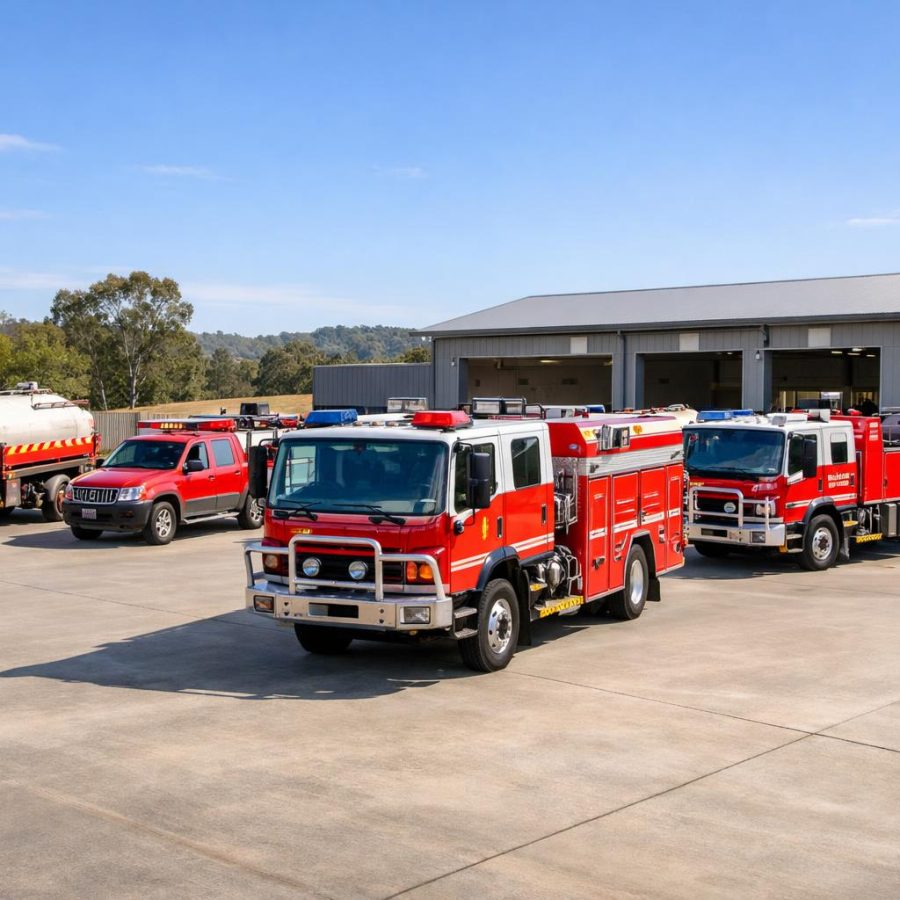
In remote and regional Australia, an emergency response can involve far more than one vehicle turning up from down the road. Help may need to travel long distances by road, aircraft or both, with police, ambulance, fire and rescue, SES, RFDS, and volunteer teams all working together to reach people who may be hours from the nearest town.
Why remote emergency response is different
Emergency management in Australia is built on a simple idea: the right service should respond as quickly and safely as possible, and the response should match the type of incident. That principle is the same in a city or in the outback, but remote Australia creates extra challenges.
Distance is the most obvious one. A person injured on an isolated highway, a stranded family on a station track, or a bushfire threatening a small community may be a very long way from hospital, heavy rescue equipment, or specialist crews. Weather, rough terrain, limited daylight, poor roads, flood damage, and patchy mobile coverage can all slow the response.
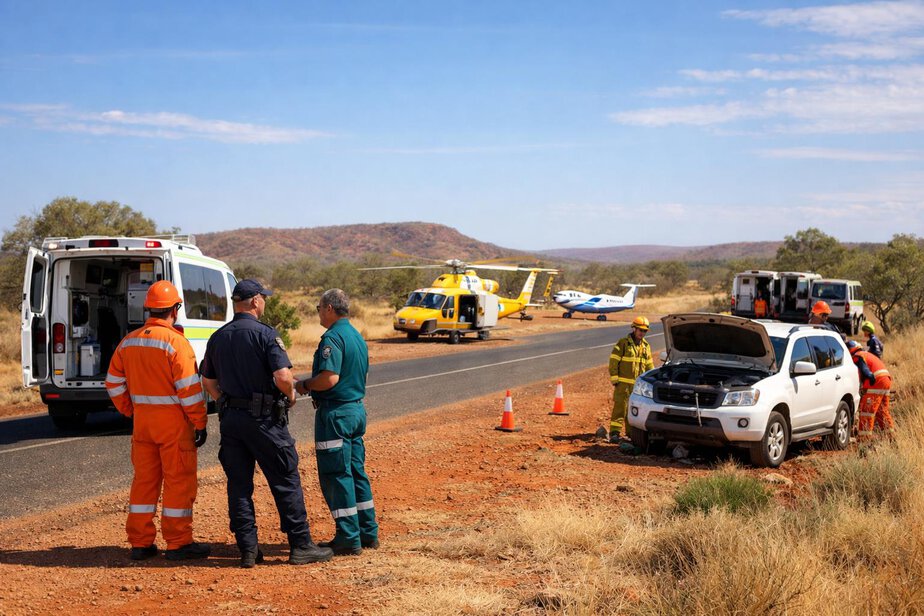
Because of that, the emergency system relies on coordination. Police, ambulance, fire services, SES, volunteer rescue groups, aeromedical services, and local agencies may each have a different role. In many situations they do not act alone. They work under a coordinated incident management system so that everyone understands who is leading, what resources are needed, and where they should go.
For travellers, this means planning matters. In the outback, a breakdown is not just an inconvenience. It can quickly become a safety issue if the vehicle is hard to find, the weather turns, or the route is isolated. Prevention, preparation and clear communication often make the biggest difference.
What happens when you call Triple Zero
Triple Zero (000) is Australia’s primary emergency number. If a situation is immediately life threatening, people in Australia should call Triple Zero straight away. The call operator will connect the caller to Police, Fire or Ambulance, depending on the emergency and the location.
The first job of the operator is to establish what is happening and where. In remote areas, the location question is especially important. A street address may not exist, and a caller may only know a highway name, a station boundary, a nearby sign, a distance from a town, or a GPS coordinate. The more precise the location, the easier it is for responders to move quickly and avoid delay.
Call-takers generally need to know:
- what has happened
- exact location details
- how many people are involved
- whether anyone is injured or in immediate danger
- any hazards such as fire, floodwater, smoke, downed powerlines, leaking fuel or unstable ground
- the safest way for crews to reach the scene
Call-takers also pass information to the appropriate emergency communications centre. That centre may belong to police, ambulance, fire and rescue, or a specialist coordination unit, depending on the jurisdiction and the incident. Once the call is assessed, dispatchers send the most appropriate resources available.
In remote areas, the caller may be asked to stay on the line, provide landmarks, describe road conditions, or use a device with GPS if one is available. If the incident involves multiple people or a long-distance retrieval, the call may trigger several agencies at once.
Sometimes the first information received is incomplete or changes as more details come in. That is normal. Emergency communications are designed to update plans as new facts are confirmed.
How incidents are assessed and resources are chosen
Once the call is received, the incident is assessed for urgency, risk and the type of support needed. Not every incident needs every service. A broken-down vehicle may need roadside assistance and monitoring. A serious crash may need police, ambulance, fire, SES and aeromedical support. A bushfire may need fire crews, police for road control and evacuation support, and SES for warnings or sandbagging depending on the situation.
Emergency agencies work with different responsibilities, but they often share information and operate within the same coordinated framework. This helps avoid duplication and ensures that specialist resources are used where they are most needed.
| Incident type | Main likely responders | Why coordination matters |
|---|---|---|
| Road crash on an isolated highway | Police, ambulance, fire and rescue, rescue helicopter or RFDS | Traffic control, patient care, rescue access and possible air transport |
| Flooded crossing or washed-out road | SES, police, local road authorities, possibly ambulance | Scene safety, detours, warnings and rescue support |
| Bushfire near a small community | Fire agency, police, SES, local volunteers | Suppression, evacuation, warnings and access management |
| Medical emergency on a remote property | Ambulance, RFDS, possibly police or local support | Rapid patient care and suitable transport to hospital |
The incident management approach helps separate the public-facing actions from trained responder tasks. For example, a traveller may be asked to make the scene safe, keep bystanders clear and wait for instructions, while trained crews carry out rescue, triage, technical access, or transfer planning.
This distinction matters. It reduces confusion, protects the public, and lets specialist responders do work that requires training, equipment and authority.
The roles of police, ambulance, fire and SES
Police
State and territory police often play a central role in remote emergencies. They may assist with incident coordination, traffic management, welfare checks, missing persons, crash response, search coordination and scene security. On remote highways, police may be the first agency to arrive because they can travel long distances and manage the scene until other services reach it.
Police may also help determine safe access routes for other responders. In some situations they direct traffic away from danger, assist with evacuations, and gather key details from witnesses or stranded travellers.
Ambulance
Ambulance services provide patient assessment, treatment and transport coordination. In remote areas, a road ambulance may be the first medical resource, but it may also be supported by aeromedical retrieval or on-ground medical teams. Ambulance personnel decide what care is appropriate at the scene and whether the patient should go by road, helicopter or fixed-wing aircraft.
They also help match the patient’s needs with the best transport option. A critically ill patient may need a faster or more direct aeromedical transfer, while a stable patient may be transported by road if that is safer and more practical.
Fire and rescue
Fire and rescue agencies respond to structure fires, motor vehicle crashes, hazardous materials incidents, and some technical rescue situations. In remote settings, they may also support access in difficult terrain, scene safety around fuel spills or vehicle fires, and rescue from entrapment. Depending on the state or territory, rural fire services and country fire services may be involved in bush and grass fire response, property protection, and support to local communities.
State Emergency Service
The SES is often called on for storm damage, flood response, searches, road crash support, rescue, and access to isolated properties when conditions are difficult. In rural and remote locations, SES volunteers are sometimes an essential bridge between local knowledge and formal emergency systems. They may help with sandbagging, clearing hazards, supporting evacuations, and assisting police or ambulance access.
SES roles vary across states and territories, but the common theme is practical support in difficult conditions where local terrain, weather or flooding affects response.
RFDS, rescue helicopters and fixed-wing aircraft
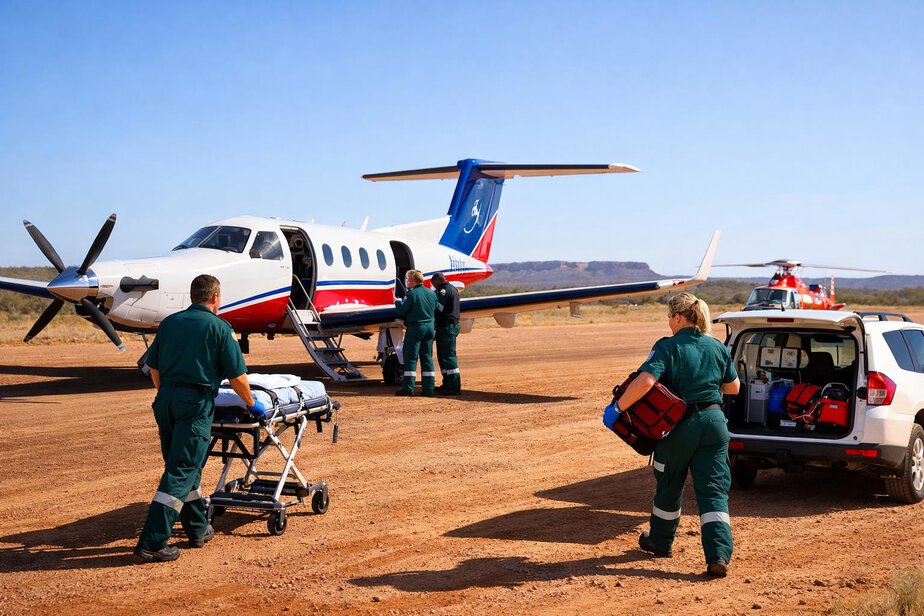
Air support is a major part of remote emergency response in Australia. The Royal Flying Doctor Service, rescue helicopter providers and other aeromedical aircraft can reach people who are too far away for a timely road response.
What RFDS does
The RFDS primarily operates fixed-wing aeromedical aircraft. These aircraft are used for emergency retrievals, inter-hospital transfers and primary health services across rural and remote Australia. In practical terms, that means they can move patients over long distances and connect small communities with major hospitals.
Fixed-wing aircraft are usually efficient for long flights and can carry medical staff and equipment suited to retrieval work. However, they generally need a suitable airstrip or landing area. That means the scene must either be close to an airfield or the patient must be moved to one if that is safe and practical.
What rescue helicopters do
Rescue helicopters are often used when speed, terrain or access makes them the best option. They can sometimes land close to an incident, hover, or use a winch in specialist operations when conditions and crews allow it. Different organisations operate helicopters in different states and territories, and they may be tasked for rescue, retrieval, or transport depending on local arrangements.
Helicopters are especially useful when a road is blocked, a patient is in difficult terrain, or a crash scene is too remote for quick ground access. They are not always the answer, though. Strong wind, smoke, darkness, poor visibility or lack of a safe landing area can limit helicopter use.
How aircraft are chosen
Aircraft selection depends on several factors:
- patient condition and urgency
- distance to hospital or airstrip
- landing area availability
- weather, visibility and wind
- terrain and obstacles
- daylight or night conditions
- aircraft availability and fuel range
There is no single aircraft that suits every situation. Aeromedical teams and dispatchers weigh safety and practicality before a flight is approved. Sometimes a helicopter is best because it can reach a scene quickly. Sometimes a fixed-wing aircraft is better because it can carry the patient longer distances more efficiently. Sometimes road transport is still the safest option.
In remote Australia, the aircraft that arrives first is not always the aircraft that was originally preferred. Safety, weather and access conditions often shape the final decision.
Search and rescue, road crashes and isolated highway incidents
Search and rescue in remote Australia may involve police, SES, local volunteer rescue groups, marine rescue organisations, surf lifesaving services near the coast, and specialist teams. The exact mix depends on whether the incident is inland, coastal, on a road, in water, in the bush or on private property.
For road crashes and breakdowns on isolated highways, the response often begins with location confirmation and scene safety. Travellers may be asked to move to a safer place if possible, switch on hazard lights, and provide information about what is visible from the road. But if moving creates more risk, staying with the vehicle may be safer.
Vehicles are often easier for rescuers to find than people on foot. In most remote situations, remaining with the vehicle is the safer default unless the vehicle itself is unsafe, such as if it is on fire, in floodwater, at risk of being struck by traffic, or in another immediate danger.
Typical public actions while waiting may include:
- calling Triple Zero if needed
- keeping everyone together
- making the scene as visible as possible from a safe position
- conserving water and shade
- treating any basic first aid needs within your training
- monitoring weather, fuel, and battery levels
- following operator advice exactly
Never enter floodwaters. Never stand in the path of traffic. Never approach a crash, fire or aircraft simply because it looks like help is needed. If a rescue scene involves helicopters, always keep clear until the flight crew or ground crew gives instructions. Rotor blades, downwash and loose debris can all be dangerous.
How to stay safe while waiting for help
Waiting for emergency services in a remote area can be stressful, especially when help is far away. The aim is to stay safe, stay visible and avoid creating a second emergency.
Make the scene safer
- Move to a safe place away from traffic if you can do so without risk.
- Turn on hazard lights and, if safe, use additional warning devices.
- Place the vehicle where it can be seen from the road.
- Keep clear of unstable ground, smoke, fuel spills, floodwater and downed powerlines.
- Keep children, pets and bystanders controlled and calm.
Communicate clearly
Keep your phone charged if possible. If coverage is weak, send one clear message with location details, vehicle description, number of people and any urgent hazards. If you have a satellite phone or emergency messaging device, know how to use it before you travel. If a Personal Locator Beacon (PLB) is carried, understand when and how it should be activated. It is an emergency tool, not a routine contact device.
Use the right device for the location
Mobile coverage is not reliable across many remote regions. Travellers should consider satellite phones, PLBs or satellite emergency messaging devices, especially on long trips, remote tracks or station roads. These devices can improve the chance that an emergency signal or message reaches help when normal mobile service is unavailable.
Before travelling, check that devices are charged, registered where required, and packed where they can be reached quickly. Tell someone where you are going, when you expect to return and what to do if you do not check in.
When preparing to wait, basic comfort and safety items matter more than most people think. Water, shade, food, a torch, warm clothing, blankets, power banks and a first aid kit can turn a difficult wait into a manageable one.
Emergency planning, vehicle preparation and first aid
Prevention is the most effective emergency response. A well-prepared trip reduces the chance of needing rescue and improves the odds if something does go wrong.
Remote travel checklist
- sufficient drinking water for all travellers
- food that can be stored safely and eaten without cooking
- comprehensive first aid kit
- torch and spare batteries
- power bank and charging cables
- maps, navigation equipment and backup navigation method
- spare tyres and recovery equipment where appropriate
- fire extinguisher suitable for vehicle use
- warm clothing, hats and emergency blankets
- satellite phone, PLB or satellite message device if needed
- written emergency contacts and trip details
Vehicle preparation
Before leaving, check tyres, fuel, coolant, oil, lights and windscreen condition. Carry enough fuel for detours or delays where possible. Make sure the spare tyre and tools are usable. In remote areas, a minor mechanical issue can quickly become a stranded vehicle if it is not fixed early.
Plan for road conditions as well. Gravel roads, floodways, corrugations, heat and long distances all affect travel speed and vehicle wear. A route that looks easy on a map may be far more demanding in real conditions.
First aid and health planning
Carry a first aid kit and know the basics of using it. That means being able to manage common problems such as cuts, sprains, burns, dehydration and heat stress until help arrives. Do not attempt invasive procedures or use specialist clinical equipment unless you are trained and authorised to do so.
If anyone in the group has a medical condition, plan ahead. Carry medicines safely, understand storage needs, and keep a simple written summary of important health information in case you need to hand it to responders. This should be factual and easy to read.
Weather, terrain and public behaviour around helicopters and aircraft
Remote weather can change response options quickly. Rain can cut roads, flood low crossings and close airstrips. Smoke can ground aircraft. Strong winds and low cloud can delay or prevent helicopter movements. Night operations may also be limited by terrain, obstacles and visibility. That is why emergency planners often keep multiple options open until the safest one is confirmed.
If a helicopter is operating near you, remember that the crew controls the scene. Stay back unless instructed otherwise. Loose hats, paper, tarps and other lightweight items can be blown around by rotor wash. Dust and debris may also be lifted from the ground, reducing visibility and creating extra hazard.
When aircraft are landing or taking off, the safest public action is usually to remain where directed, keep low if necessary, and wait for the crew to signal that it is safe to move. Never run toward an aircraft, never stand in a marked landing area, and never try to help load or unload equipment unless asked by authorised personnel.
For communities and travellers, understanding these limits helps set expectations. An aircraft may be ready to go, but conditions on the ground, weather at the destination, or patient stability can still change the plan. That is not delay for delay’s sake. It is part of safe aeromedical decision-making.
Why coordination and prevention matter most
The strength of Australia’s remote emergency system is not just the size of the response. It is the way services combine local knowledge, volunteer effort, specialist rescue skills and aeromedical support under one coordinated approach. Police, ambulance, fire and rescue, SES, RFDS, rescue helicopters and other teams each bring something different, and each is most effective when their role is clear.
For travellers, the practical message is straightforward. Plan before you leave. Carry the right equipment. Share your route. Know how to call for help. Use satellite communication tools where mobile coverage is unreliable. Stay with your vehicle unless staying there is unsafe. Keep clear of floodwater, fire, traffic and aircraft. Follow emergency instructions exactly.
Good preparation does not remove all risk, but it makes a big difference in remote Australia, where a small problem can become serious quickly. Most importantly, never place yourself in danger trying to carry out a rescue. If something looks beyond your ability or training, call Triple Zero, make the scene safe from a distance, and let trained responders take over.
In the end, the emergency response system works best when the public and responders each do their part. Travellers provide clear information, avoid unnecessary risk and prepare well. Emergency services bring the training, equipment and coordination needed to manage the incident. Together, those actions save time, reduce harm and improve outcomes across remote and regional Australia. Before publication, verify facts, device guidance and local procedures for the state or territory concerned.
FireRescue Training Hub
Access practical fire and emergency study support resources, downloads, checklists, audio guides, and member-only course content.
- Course library
- PDF downloads
- Audio guides
- Checklists
Study support only. Not accredited training or a replacement for workplace procedures.
About the author and safety review
Ken Walker
Former Station Officer and fire service educator
Former career firefighter with extensive career and volunteer fire service experience.
Qualifications: Associate Diploma of Applied Science in Fire Technology; Institute of Fire Engineers studies.
Author profilehttps://www.firerescue.com.au/about-us/