The Complete Bushfire Safety Book by Joan Webster OAM is one of Australia’s best-known public bushfire-safety references. First published in the 1980s and later expanded, it helped popularise ideas that are now familiar in official bushfire guidance: written survival plans, emergency kits, planning for children and older people, pet safety and making important decisions before a fire is on the doorstep.
But a classic book and current emergency advice are not the same thing. The paperback edition still sold today dates from 2000, and the ebook edition was released in 2012. Australia now uses the Australian Fire Danger Rating System, warning systems and digital emergency information that did not exist in their current form when those editions were published.
Yes, the book is still worth reading for background, bushfire behaviour, preparedness thinking and the history of Australian public safety advice. But do not use an older edition as your authority for current Fire Danger Ratings, warning terminology, evacuation triggers, apps, local restrictions, building requirements or emergency instructions. For those, always use your current state or territory fire service and official emergency information.
What’s been updated
- Repositioned the article as a 2026 review and safety companion to Joan Webster’s classic book.
- Added publication dates and author background from the publisher.
- Separates enduring principles from advice that must now be checked against current agencies.
- Uses the current AFDRS levels: No Rating, Moderate, High, Extreme and Catastrophic.
- Updates warning language and leave-early advice.
- Removes tactical household wording such as universal wet-towel/gap-blocking instructions.
- Removes the unverified Amazon affiliate promotion from the safety-critical introduction.
Who wrote The Complete Bushfire Safety Book?
Joan Webster OAM has written about bushfire safety for the Australian public for decades. Penguin describes her work as influential in the development of many concepts later adopted in official public information, including bushfire safety planning, action lists, survival kits, protecting children and vulnerable people, pet planning and the long-running debate about leaving or staying.
The current Penguin listing shows a 368-page trade paperback published on 3 November 2000 and an ebook published on 1 January 2012. The book’s historical value is substantial: it helped move bushfire safety away from vague advice and toward planned actions that ordinary households could understand.
Many ideas that now feel obvious—write the plan down, decide what you will do before the day, prepare vulnerable household members, pack essential items and understand how fire can attack a home—became normal partly because people like Joan Webster translated fire behaviour and survival lessons into practical public advice.
FireRescue 2026 relevance audit
The safest way to use an older bushfire reference is to separate enduring principles from time-sensitive instructions.
| Topic | Still useful in 2026? | What to do now |
|---|---|---|
| Understanding bushfire behaviour | Yes — strong background value. | Use the book for concepts, then check current local forecasts and official agency advice. |
| Written household plan | Yes — more important than ever. | Use your state or territory’s current bushfire-plan template and warning channels. |
| Emergency kit | Yes — core concept remains sound. | Update medicines, phones, chargers, power banks, current documents and individual needs. |
| Children, older people, disability and pets | Yes — essential planning principle. | Build extra time, transport, medication and support needs into the leave plan. |
| Fire Danger Ratings | Older editions are outdated. | Use current AFDRS: No Rating, Moderate, High, Extreme and Catastrophic. |
| Warning levels and apps | Must be updated. | Use current official warnings, agency websites/apps, ABC emergency broadcasts and local directions. |
| Leave / stay decisions | Historical context is useful, but current policy takes priority. | Leaving early is the safest option. Never plan to stay and defend on Catastrophic days. |
| Building and property requirements | Do not rely on an older book alone. | Check current planning, building, BAL and local authority requirements. |
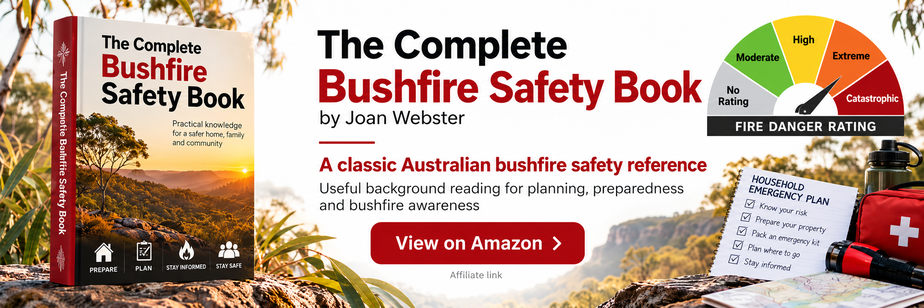
What changed most: Australia’s Fire Danger Ratings
Since 1 September 2022, Australia has used the Australian Fire Danger Rating System. Current public ratings are:
Stay aware. Fires can still occur.
Plan and prepare.
Be ready to act.
Take action now to protect life and property.
For your survival, leave bushfire-risk areas.
That is a major reason an older bushfire book cannot be your sole current reference. If an edition uses older rating names such as Very High, Severe or Code Red, translate the concept through current agency guidance rather than using the old terminology operationally.
The biggest safety lesson that still holds: decide early
One of the strongest ideas running through Australian bushfire-safety education is that major decisions are safer when they are made before conditions deteriorate. Modern CFA guidance is explicit: leaving early before a fire starts is the safest option.
For Victoria, current CFA advice says households in high-risk areas should plan to leave the night before or early in the day when Extreme or Catastrophic conditions are forecast. It also says not to wait for an official warning before leaving. Other jurisdictions use their own planning tools and instructions, so always follow local official guidance.
A Fire Danger Rating tells you how dangerous a fire could be if one starts. An incident warning tells you about an emergency that is happening or has happened. Current warning levels under the Australian warning approach include Advice, Watch and Act and Emergency Warning. A warning may arrive late or the first warning may already be at a high level, so do not build your plan around waiting for one.
What a modern household plan should cover
This is an area where Webster’s original approach remains highly relevant. A modern plan should still answer basic human questions rather than becoming a complicated document:
- When will we leave? Set a trigger before the season.
- Where will we go? Choose a location with much lower bushfire risk.
- How will we get there? Consider road closures and a backup option.
- What will we take? Medicines, documents, communications, water, clothing and individual essentials.
- Who needs extra help? Children, older people, people with disability or medical needs and anyone without transport.
- What about animals? Leads, carriers, transport, feed, water and medication.
- Who will know where we are? Include family or trusted contacts.
Emergency kits: the principle survives, the contents evolve
The idea of a personal survival kit was one of the practical concepts associated with Webster’s work, and it remains sound. The contents should now reflect modern life and current official checklists.
NSW RFS, for example, recommends preparing an emergency survival kit before bushfire season with items such as a battery radio, torch, spare batteries, first aid, emergency contacts and protection for valuables, then adding medications, a phone and charger, important documents, clothing and drinking water before leaving.
Today it also makes sense to include a charged power bank, backup access to important digital information and any specialist equipment your household relies on. The exact kit should reflect your family, location and safer destination.
Property preparation: principles versus current technical requirements
The book remains useful for understanding why ember attack, fuel around a building and house condition matter. But current property work must be based on today’s rules and the building itself.
General preparation can include maintaining grass, clearing loose fine fuels, cleaning gutters where safe, moving combustible material away from buildings and addressing obvious gaps or damage. Larger vegetation clearing, construction changes, BAL-related work and bushfire building requirements need current local planning and professional advice.
A well-prepared house has a better chance of surviving, but preparation does not make a house fireproof and should never be used to justify remaining in conditions where official guidance says to leave.
Children, older people, disability and pets
One of the book’s enduring strengths is that it treats bushfire survival as a household problem, not just a building problem. People have different mobility, health, communication and emotional needs, and those differences affect how much time is required to leave safely.
A current plan should include medication, mobility aids, backup power where relevant, transport, accessible destinations, carers or support people, and realistic arrangements for pets or livestock. Do not assume emergency services or neighbours will be available at the exact moment you need them.
Digital warnings are a major 2026 difference
Older safety books were written for a world dominated by radio, television, telephone trees and local observation. Those methods still matter, but Australians now also receive information through emergency apps, websites, mobile alerts and digital mapping.
In Victoria, VicEmergency is the central source for warnings and incident information and allows users to create watch zones. Other states and territories have their own official systems. Use more than one reliable channel because power, mobile coverage or a single device can fail.
Technology has improved access to information, but it has not removed the need for observation and early decisions. CFA explicitly warns that official messages are not guaranteed to arrive before you need to act.
What I would not take directly from an older edition
A few categories should always be checked against current official sources rather than copied from an older book:
- Fire Danger Rating names and recommended actions
- warning levels, warning apps and emergency telephone services
- legal fire restrictions and Total Fire Ban rules
- building standards, BAL requirements and planning rules
- protective equipment recommendations
- current evacuation or sheltering instructions
- current first-aid, smoke and health advice.
That is not criticism of the author. It is simply what happens to any safety publication over time: some principles remain excellent while operational terminology, technology, law and official policy continue to change.
For firefighters and emergency-service readers
For firefighters, Webster’s work is useful partly because it shows how public bushfire messages evolved. Understanding what householders have historically been told can help with community education and conversations about preparedness.
It should not be used as operational doctrine. Current agency procedures, AIIMS arrangements, PPE requirements, crew safety systems, training and incident-controller directions take priority.
Is the book worth buying or reading in 2026?
Yes — with the right expectation. It is valuable as a substantial Australian reference on bushfire behaviour, household preparedness and the development of public bushfire-safety thinking. It is especially interesting for firefighters, emergency-management students, community educators, rural residents and readers who want more background than a short agency brochure can provide.
It is not the book I would open first to check today’s Fire Danger Rating, app, warning, Total Fire Ban, evacuation instruction or building requirement. Those must come from current official sources.
View The Complete Bushfire Safety Book at Penguin Books Australia →
The previous version used an Amazon short link. This renewal does not assume that link is still an active FireRescue affiliate link. The safe default is the publisher link above. If the Amazon link is later confirmed as belonging to an active affiliate account, it can be restored as a clearly labelled optional purchase link without changing the safety advice.
Bushfire safety in 2026: the five things to do first
- Know your local risk. Check your state or territory fire service and local conditions.
- Check the current Fire Danger Rating. Use the current national system, not an old chart.
- Write your plan. Decide when you will leave, where you will go and who needs help.
- Prepare the property and kit. Do the work before the dangerous day.
- Act early. Do not wait for flames or depend on receiving an official warning before making your decision.
Related FireRescue guides
- How to Prepare for a Bushfire: Practical Guide for Australians
- Bushfire Preparedness: Practical Steps That Make a Real Difference
- 72-Hour Emergency Kit Australia Guide
Conclusion
Joan Webster’s The Complete Bushfire Safety Book deserves respect as an important Australian safety reference. Its strongest contribution is not a particular checklist or old rating table; it is the idea that household survival improves when ordinary people understand fire, make decisions early and prepare deliberately.
Use the book for that depth and perspective. Then pair it with current official guidance for the decisions that matter today. A good bushfire plan should be informed by experience and history, but it must operate in the conditions, warnings and rules of 2026.
Sources checked
- Penguin Books Australia — The Complete Bushfire Safety Book ebook and paperback listings; Joan Webster author information
- Australian Fire Danger Rating System — current national rating levels and public actions
- Country Fire Authority Victoria — bushfire plans, leaving early, warning levels and VicEmergency
- NSW Rural Fire Service — emergency survival kit and current planning resources
- Services Australia — current natural-disaster support information
Ken Walker — former Station Officer and fire-service educator with career and volunteer firefighting experience.
This article provides general educational information for an Australian audience. It does not replace site-specific professional advice, agency procedures or current directions from emergency authorities. Older books and archived safety material may use terminology or recommendations that have since changed. During an emergency, follow current official warnings and directions.
Corrections and field experience: FireRescue Training Hub welcomes source-backed corrections, especially where bushfire guidance has changed, and useful observations from firefighters, community educators and people with direct bushfire experience. Current official guidance always takes priority.
FireRescue Training Hub
Access practical fire and emergency study support resources, downloads, checklists, audio guides, and member-only course content.
- Course library
- PDF downloads
- Audio guides
- Checklists
Study support only. Not accredited training or a replacement for workplace procedures.
About the author and safety review
Ken Walker
Former Station Officer and fire service educator
Former career firefighter with extensive career and volunteer fire service experience.
Qualifications: Associate Diploma of Applied Science in Fire Technology; Institute of Fire Engineers studies.
Author profilehttps://www.firerescue.com.au/about-us/