A road is blocked, but the damaged vehicle is well down the street. A fire appears to be out, yet people still cannot enter the building. A footpath remains closed even though nobody seems to be working immediately beside it.
From outside an emergency scene, a closure can look larger or last longer than necessary. But the visible hazard is only one part of the picture.
Responders may also need space to work, a clear route for vehicles, protection from surrounding risks or time to preserve and examine evidence. The boundary people encounter may serve one or several of these purposes.
The practical rule is simple: do not use what you can see as permission to cross a closure. Check current official information and follow directions at the scene. Who can establish a restriction, how it operates and who may enter depend on the jurisdiction and incident.
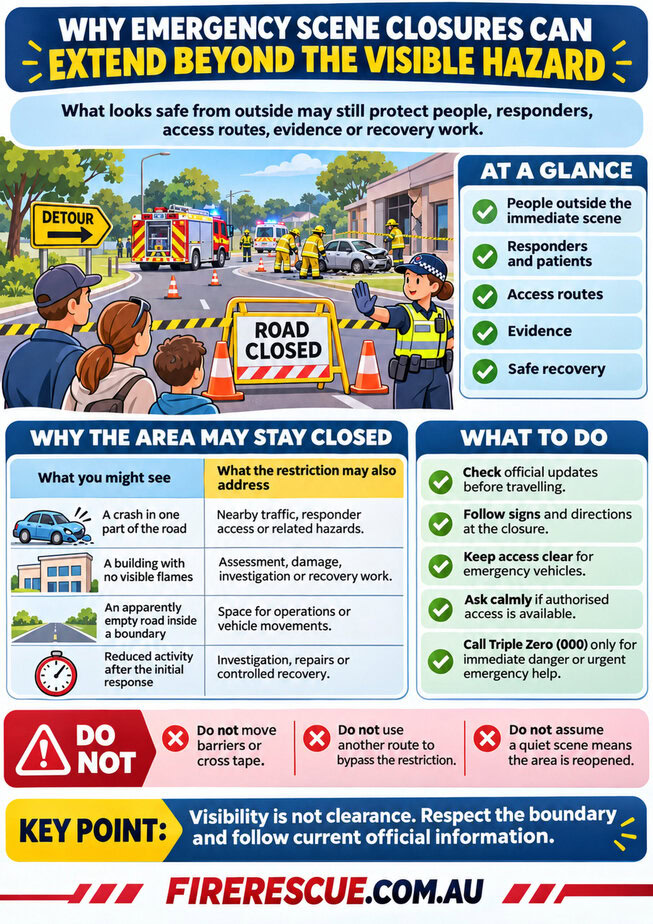
At a glance: what a closure may be protecting
- People outside the immediate scene: some hazards are difficult to recognise from a distance.
- Responders and patients: work can extend beyond the damaged building or vehicle.
- Access routes: congestion can interfere with emergency vehicles and other essential movements.
- Evidence: an investigation may continue after rescue or firefighting activity has reduced.
- Safe recovery: assessment, repairs or removal work may still be needed.
These are possible reasons, not a diagnosis of every closure. The actual reason depends on the incident and may change as more information becomes available.
The visible incident is not the whole risk area
What looks like the edge of an incident is not necessarily the edge of its effects. A crashed vehicle, for example, may be accompanied by a fuel spill, damaged infrastructure or traffic backing into another hazardous location.
Some risks are also hard for a passer-by to judge. A person looking along a street cannot reliably assess the condition of damaged infrastructure or establish whether an area has been cleared for public access.
A useful, jurisdiction-specific example comes from Queensland Police Service traffic crash guidance. It identifies a hazardous environment or threat to public safety, including congestion, as relevant to police attendance. Examples include fuel spills and fallen power lines.
That guidance illustrates why the concern can extend beyond the vehicles involved. It does not establish a national rule for closure boundaries or identify who can close every type of incident scene.
No visible activity does not mean no remaining work
A quiet scene can be misleading. Visible rescue activity may have finished while assessment, investigation or recovery arrangements continue.
Likewise, an empty stretch of road inside a restriction is not necessarily unused space. It may separate public traffic from work or keep an approach available. You cannot reliably determine its purpose from outside the boundary.
Why responders need room beyond the incident itself
Emergency work does not always fit within the footprint of a damaged vehicle or building. People, equipment and vehicles may need to move around it.
Nearby traffic can create an additional problem. Drivers may be concentrating on the incident rather than the road ahead. Queues, parked vehicles and people gathering to watch can also reduce the space available for responders.
A closure may therefore manage the surrounding movement of people and vehicles, rather than simply keep people away from one dangerous object.
| What you might see | What the restriction may also address |
|---|---|
| A crash in one part of the road | Nearby traffic, access for responders or hazards associated with the crash |
| A building with no visible flames | Remaining assessment, damage, investigation or recovery work |
| An apparently empty road inside a boundary | Separation from operations or space needed for vehicle movements |
| Reduced activity after the initial response | A transition to investigation, repairs or controlled recovery |
These examples explain possible purposes. They are not reopening criteria and do not establish a standard distance that should apply at every incident.
Why a closure may remain for an investigation
Dealing with the immediate emergency and establishing what happened are different tasks.
After rescue or firefighting activity has reduced, investigators may still need to examine, document or preserve parts of the scene. Uncontrolled entry can disturb material or change the condition of the area before that work is complete.
This is one reason access may remain restricted even when the most obvious danger appears to have passed. It does not mean every continuing closure is a crime scene, or that every fire or crash requires the same investigation.
The legal basis for protecting an investigation scene differs between jurisdictions and circumstances. Police crime-scene powers, road-management arrangements and emergency-response powers should not be treated as interchangeable.
Do not enter to retrieve an item, inspect damage or take photographs without permission. Tell personnel at the access point what you need and ask what arrangements, if any, are available.
Who decides where the boundary goes?
There is no single answer that covers every Australian emergency.
Depending on the location and incident, decisions may involve emergency services, police, a road authority, the relevant incident management arrangements or an infrastructure operator. Their responsibilities and legal powers are not identical.
It helps to separate three questions:
- What needs protection? This could include the public, responders, access routes, infrastructure or evidence.
- What restriction is appropriate? The answer depends on the incident and the information available.
- Who can authorise or enforce it? This depends on the applicable law and arrangements.
The person providing directions at a barrier may not be the person who set the wider boundary. They may need to refer an access request to someone else rather than make an immediate exception.
Can a closure change?
Yes. A restriction may be adjusted as the incident is assessed and the work changes. A boundary might expand if additional risks are identified, or access might become less restrictive when conditions permit.
A change is not, by itself, evidence that the earlier decision was unnecessary. Responders may be working with information that develops over time.
There is no universal perimeter size or reopening time that can be inferred from the appearance of the scene. One part of an area becoming accessible also does not mean every nearby restriction has ended.
Not every restricted area serves the same purpose
Terms such as road closure, cordon, traffic management point and evacuation area can appear in emergency information. They should not be assumed to mean the same thing.
In broad terms, a road closure restricts use of a road. A cordon restricts access around an area. An evacuation instruction concerns leaving an area. A traffic management point may control movement or access. The precise meaning and arrangements must be checked against local instructions.
Incident type matters too:
- Fires: restrictions may relate to response activity, remaining hazards, assessment or investigation.
- Crashes: traffic management, patient care, recovery and investigation may overlap.
- Hazardous-materials incidents: access decisions may depend on specialist assessment, not what a bystander can see.
- Infrastructure damage: assessment or repair requirements may remain after the event that caused the damage.
- Police investigations: preserving and examining a scene may be a central reason for continued restrictions.
These are general distinctions, not a national operating procedure or a statement of legal authority.
What to do when you encounter a closure
Before travelling
- Check the relevant state or territory’s official road-traffic information service.
- For local streets, check the responsible council or road authority where appropriate.
- Check relevant emergency service or police updates for incident-specific information.
- Look at the update time and the exact road section affected, rather than relying on a headline or shared screenshot.
- Allow for delays and consider postponing a non-essential trip.
A navigation app can help with route planning, but a suggested route is not permission to pass a closure. Conditions on the ground may have changed since an online update.
At the closure point
- Follow signs and directions from personnel managing the restriction.
- Do not move barriers, cross tape or use another route to bypass the restricted area.
- Keep vehicle access clear. Do not stop nearby simply to watch or photograph the incident.
- If directed to turn around, follow the directions rather than making an abrupt manoeuvre.
- Ask questions calmly without obstructing the access point.
If your home, workplace, vehicle or essential medication is inside the area, explain the need. Ask whether an authorised access arrangement is available. Being a resident, property owner or worker does not itself mean you have permission to enter.
If someone faces immediate danger or needs urgent emergency assistance, call Triple Zero (000). Do not use Triple Zero to ask when a road will reopen.
The key point: visibility is not clearance
Emergency scene closures can extend beyond the visible hazard because an incident involves more than its most obvious damage. Working space, traffic, surrounding risks, evidence and recovery needs may all influence access.
For the public, the safest approach is to check current official updates, respect the boundary and ask about access rather than assuming it is available. An area looking quiet is not the same as an area being reopened.
Have you spotted an outdated detail or a jurisdiction-specific distinction we should explain more clearly? Let the FireRescue.com.au editorial team know so it can be reviewed.
Related FireRescue guides
- Clandestine Drug Laboratories, First Responder Hazards, Scene Safety and Emergency Response
- Structural Collapse Scene Assessment , Part 2 of 6, Hazards, Size Up and Dynamic Risk
- Establish Rescue Scene Safety, Part 3 of 8, Hazards, Work Areas and Vehicle Stabilisation
Sources and further reading
FireRescue Training Hub
Access practical fire and emergency study support resources, downloads, checklists, audio guides, and member-only course content.
- Course library
- PDF downloads
- Audio guides
- Checklists
Study support only. Not accredited training or a replacement for workplace procedures.
About the author and safety review
Ken Walker
Former Station Officer and fire service educator
Former career firefighter with extensive career and volunteer fire service experience.
Qualifications: Associate Diploma of Applied Science in Fire Technology; Institute of Fire Engineers studies.
Author profilehttps://www.firerescue.com.au/about-us/