News & Updates
Key takeaways
Lithium-ion battery fires present unique challenges due to their rapid thermal runaway and toxic emissions, requiring specialised suppression methods beyond conventional firefighting approaches.
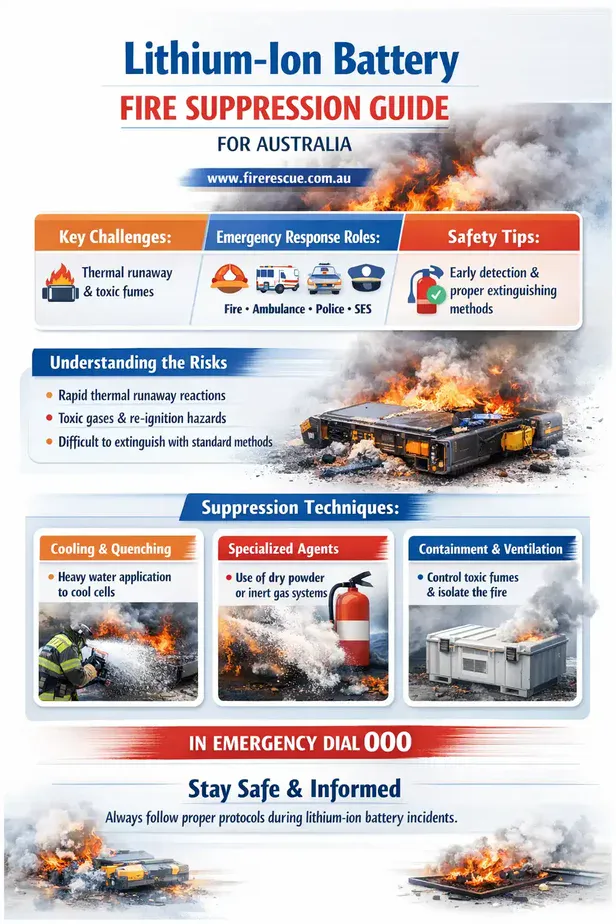
Emergency response in Australia involves coordinated roles: Fire & Rescue handle fire suppression, Ambulance provides medical aid, Police manage scene safety, and SES may assist with evacuations or logistics.
Understanding battery construction, early detection, and appropriate extinguishing agents can significantly reduce risks and improve safety outcomes in residential, industrial, and transport settings.
Lithium-Ion Battery Fire Suppression Guide for Australia
A practical PDF covering lithium-ion battery fire risks, thermal runaway, suppression methods, toxic fumes, emergency response roles, and prevention tips in an Australian context.
Background and context
Lithium-ion batteries have become ubiquitous in everyday life, powering everything from smartphones and laptops to electric vehicles and renewable energy storage systems. Their high energy density and rechargeability make them indispensable, but these same properties also introduce fire hazards that differ significantly from traditional combustible materials.
A lithium-ion battery fire is often initiated by thermal runaway, a self-sustaining chemical reaction that rapidly increases temperature and pressure, leading to the release of flammable electrolytes and toxic gases. Once ignited, these fires can be extremely difficult to extinguish and may reignite hours or even days later if residual heat remains.
In Australia, where the adoption of electric vehicles and renewable energy storage is accelerating, the importance of effective lithium-ion battery fire suppression strategies is growing. Fire services and emergency responders are continuously updating their training and equipment to address these emerging risks.
Understanding lithium-ion battery fire behaviour
The complex chemistry inside lithium-ion cells means that once a fire starts, it can spread quickly through battery modules or packs. Thermal runaway occurs when a cell’s temperature reaches a critical point, causing breakdown of internal components and triggering an exothermic reaction. This reaction generates heat and gas, which can rupture the cell casing and ignite flammable electrolyte liquids.
One of the chief challenges in suppressing these fires is that traditional water-based methods, while effective for cooling, may react with battery materials, producing hydrogen gas and potentially worsening the situation if not applied correctly. Alternatively, some specialised extinguishing agents like foam or dry chemical powders may not fully stop thermal runaway or prevent reignition.
Due to the risk of toxic fumes such as hydrogen fluoride and other hazardous gases, containment and ventilation are critical components of managing lithium-ion battery fires. Emergency responders must use appropriate respiratory protection and establish exclusion zones to protect public health.
Lithium-ion battery fire suppression techniques
Cooling and quenching
Effective suppression often relies on rapid and sustained cooling to interrupt thermal runaway. Applying copious amounts of water can help cool adjacent cells and reduce the spread of fire, but firefighters must be mindful of potential chemical reactions and electrical hazards. In some cases, flooding the fire area and allowing the batteries to cool over hours may be the safest approach.
Use of specialized extinguishing agents
Some fire services incorporate Class D fire extinguishers or special powders designed for metal fires, though their effectiveness on lithium-ion batteries can be limited. Research continues into novel agents such as aerosol suppressants and inert gases which may smother flames without causing dangerous chemical reactions.
Containment and ventilation
Physical containment of burning batteries, for example by using sand, earth, or metal containers, can help prevent fire spread and limit toxic emissions. Meanwhile, ensuring adequate ventilation to disperse hazardous fumes is vital to protect both emergency personnel and the public.
Emergency response considerations in Australia
In the event of a lithium-ion battery fire, the first step is to call triple zero (000) immediately and clearly communicate the nature of the incident. Fire & Rescue NSW, or the relevant state fire service, will take the lead on fire suppression, utilising their specialised training and equipment for chemical and electrical fires.
Ambulance services provide medical care for anyone injured or affected by smoke inhalation. Police oversee scene safety and traffic control, ensuring emergency crews can operate efficiently. The State Emergency Service (SES) may be called upon for additional support such as evacuations, securing the site, or managing hazards related to power outages and structural damage.
Coordination between these agencies is essential to manage risks effectively and protect life and property. Community members are advised to follow instructions from emergency services and avoid attempting to extinguish lithium-ion battery fires themselves.
Practical implications for safety and prevention
Prevention remains the best strategy to reduce lithium-ion battery fire risks. Consumers should only use chargers and batteries approved by manufacturers, avoid exposing batteries to high temperatures or physical damage, and replace batteries showing signs of swelling or damage.
In workplaces and industrial sites, risk assessments should consider battery storage and charging areas, incorporating fire-resistant enclosures, smoke detection, and automatic suppression systems where feasible. Staff training on emergency protocols and safe handling is also critical.
For electric vehicle owners, regular maintenance checks and observing manufacturer guidelines for charging and storage reduce fire hazards. In the event of a battery fire in a vehicle, moving away and calling emergency services immediately is imperative.
Beyond immediate response, ongoing research and development in battery technology aim to create safer battery chemistries and designs that inherently reduce fire risks. Innovations such as solid-state batteries and enhanced thermal management systems are under exploration and may transform fire suppression needs in the future.
In addition, public awareness campaigns and community education on lithium-ion battery safety are becoming increasingly important. Understanding the risks, recognising early warning signs such as unusual heat, swelling, or odd smells, and knowing when to seek professional help can prevent many incidents from escalating.
Emergency services across Australia are also investing in specialised equipment such as thermal imaging cameras to detect hotspots within battery packs and drones to assess fire scenes remotely, thereby improving safety for responders and increasing the effectiveness of suppression efforts.
Collaboration between manufacturers, emergency services, regulators, and research institutions is vital to develop comprehensive standards and protocols tailored specifically for lithium-ion battery fire scenarios. This holistic approach ensures that as battery usage grows, Australia remains prepared to manage associated fire risks efficiently and safely.
Furthermore, addressing the challenges posed by lithium-ion battery fires requires not only reactive measures but proactive innovation in fire detection technologies. Advanced sensors capable of early detection of thermal anomalies within battery packs are being trialled to provide critical lead time before fires escalate. These systems can alert users or facility managers to potential hazards, allowing for timely intervention and minimising damage.
Another important aspect is the design and implementation of dedicated fire suppression infrastructure in high-risk environments such as battery manufacturing plants, large-scale storage facilities, and electric vehicle charging stations. Integrating automatic fire suppression systems tailored to lithium-ion battery fires, combined with robust emergency shutdown procedures, enhances overall safety and operational resilience.
Training for emergency responders continues to evolve, encompassing scenario-based exercises that simulate lithium-ion battery fires. These drills improve familiarity with the unique hazards and appropriate suppression tactics, including the safe use of personal protective equipment and decontamination protocols after exposure to toxic gases.
Community engagement also plays a pivotal role in mitigating risks. Educational initiatives aimed at schools, workplaces, and the general public foster a culture of safety and awareness. By disseminating practical knowledge on battery care, safe charging practices, and emergency response steps, the likelihood of incidents and their severity can be substantially reduced.
In summary, managing lithium-ion battery fire risks in Australia demands a multi-faceted approach combining advanced technology, specialised firefighting techniques, coordinated emergency response, and widespread public education. As the nation transitions towards greater reliance on battery-powered technologies, sustained investment and collaboration across sectors will be essential to safeguard communities and infrastructure from these emerging fire hazards.
FireRescue Training Hub
Access practical fire and emergency study support resources, downloads, checklists, audio guides, and member-only course content.
- Course library
- PDF downloads
- Audio guides
- Checklists
Study support only. Not accredited training or a replacement for workplace procedures.
About the author and safety review
Ken Walker
Former Station Officer and fire service educator
Former career firefighter with extensive career and volunteer fire service experience.
Qualifications: Associate Diploma of Applied Science in Fire Technology; Institute of Fire Engineers studies.
Author profilehttps://www.firerescue.com.au/about-us/