Fire & Rescue Insights
Understanding Structural Collapse During Fires
Structural collapse forecasting in fire conditions is a critical aspect of emergency response planning and firefighter safety in Australia. Fires compromise the integrity of buildings in complex ways, making it challenging to predict when and how structures might fail. Being able to anticipate structural collapse not only protects lives but also guides tactical decision-making during firefighting operations.
Key Takeaways
Forecasting structural collapse during fires requires understanding materials’ behaviour under heat and recognising early warning signs of failure. Firefighters must integrate this knowledge with continuous scene assessment to adjust tactics safely and effectively.
In Australia, coordination between Fire/Rescue, Police, Ambulance, and the State Emergency Service (SES) ensures a comprehensive approach to managing structural collapse incidents. Knowing who to call and when is vital for prompt, safe, and effective response.
Practical safety measures, including pre-incident planning and use of protective equipment, underpin effective collapse forecasting and risk mitigation during fire emergencies.
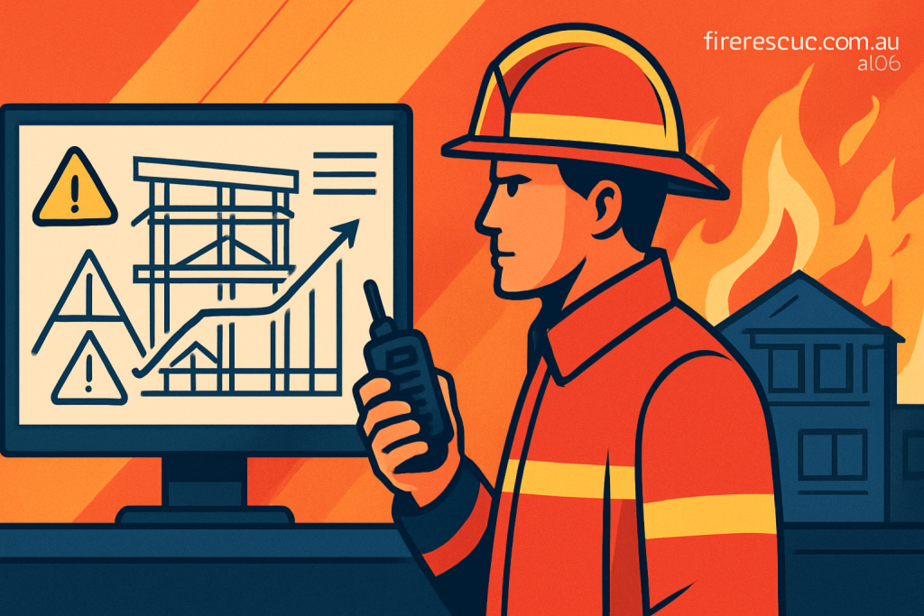
Background and Context
Structural collapse during fire incidents poses significant risks to both occupants and emergency responders. Fires weaken structural components such as timber, steel, and concrete by altering their load-bearing capacity. Timber softens and chars, steel loses strength rapidly at elevated temperatures, and concrete can spall or crack, all contributing to potential failure points.
In Australia’s varied building stock, including residential homes, commercial buildings, and industrial facilities, understanding how different construction types react to fire conditions is essential. For instance, lightweight timber frames common in residential construction can fail more suddenly than masonry walls, while older buildings may have hidden vulnerabilities.
Firefighters rely on both training and on-site assessment to forecast collapse potential. Indicators such as heavy smoke, fire location, heat intensity, visible structural deformation, and sounds like creaking or popping signal increasing risk. However, unpredictable factors like fire spread behind walls or in concealed spaces complicate forecasting.
Moreover, the complexity of modern structures, which often incorporate mixed materials and innovative design elements, adds layers of uncertainty during fire incidents. Hybrid constructions combining steel, timber, and composite materials require responders to have a broad understanding of how these interact under fire exposure. For example, engineered timber products like laminated veneer lumber (LVL) can behave differently from traditional solid timber, sometimes maintaining integrity longer but failing suddenly once critical thresholds are exceeded.
Environmental factors such as wind, ambient temperature, and humidity can also influence fire spread and structural degradation. In Australia’s often harsh and variable climate, these external conditions might accelerate fire intensity and complicate collapse prediction. Consequently, responders must consider both the building characteristics and environmental context when evaluating collapse risk.
Science Behind Structural Collapse Forecasting
Material Behaviour Under Fire
Each building material reacts differently to fire exposure. Timber, a common Australian building material, chars at a predictable rate, which can sometimes provide a temporary protective layer delaying collapse. Steel, meanwhile, can lose half its strength at around 550°C, leading to rapid deformation or buckling. Concrete’s behaviour is more complex; it can withstand heat but may crack or spall, exposing reinforcement bars that may then weaken.
Understanding these behaviours guides responders in identifying which parts of a structure are most at risk. For example, steel beams exposed to direct flame are more vulnerable than masonry walls, which may provide some passive fire resistance. Fire conditions such as ventilation, fuel load, and fire duration also influence the rate and extent of damage.
Recent advances in fire science have improved the ability to model temperature distributions within structural elements, helping predict the onset of critical weakening. Computational tools simulate how heat penetrates walls and floors, revealing hidden areas where materials may reach failure temperatures sooner than visible areas. This scientific insight supports more accurate collapse forecasting and safer operational planning.
Signs of Imminent Collapse
Firefighters are trained to recognise early warning signs of collapse. These include sagging floors or ceilings, cracked or bulging walls, distorted steel members, heavy smoke pushing through joints, and unusual noises such as groaning or creaking. Rapid changes in fire behaviour or unexpected collapse of non-structural elements like facades can also precede larger failures.
A cautious approach, combining visual inspection with communication and ongoing risk assessment, helps predict collapse potential. Firefighters should always assume structural integrity may be compromised in advanced fire conditions and maintain safe distances when possible.
In addition to visual and auditory cues, the use of technological aids such as thermal imaging cameras enhances the detection of hotspots and structural weaknesses not immediately visible. These devices can identify areas where fire has compromised critical supports, allowing crews to avoid dangerous zones proactively. Continuous monitoring during an incident is essential, as conditions can deteriorate rapidly.
Training exercises simulating collapse scenarios improve firefighters’ instincts and decision-making under pressure. These drills incorporate realistic conditions and emphasize the importance of teamwork, communication, and adherence to safety protocols to minimise risk during real incidents.
Practical Implications for Emergency Response
Roles and Coordination in Australian Emergencies
In the event of a fire with suspected or actual structural collapse, the primary emergency call should be made to Triple Zero (000) immediately. Fire and Rescue services are typically the first responders responsible for fire suppression, rescue operations, and initial collapse risk assessment.
Police play a critical role in securing the scene, managing crowds, and facilitating safe access for emergency services. Ambulance services provide medical care for injured occupants and responders. The State Emergency Service (SES) may be called upon to assist with specialized rescue operations, particularly when structural collapse leads to entrapment or debris clearance is required.
Effective communication and understanding of each agency’s capabilities ensure a coordinated response. Incident commanders must continually monitor conditions and adjust strategies, including withdrawal or repositioning of personnel, to maintain safety.
Inter-agency training and joint exercises are pivotal in fostering seamless cooperation during complex emergencies involving structural collapse. By rehearsing real-world scenarios, emergency services refine their protocols, clarify roles, and improve the speed and effectiveness of their combined responses.
Additionally, community education initiatives help the public understand the hazards associated with structural fires and collapses, promoting safer behaviours and timely reporting. Early notification and accurate information from witnesses can greatly assist responders in assessing risks and deploying appropriate resources.
Safety Measures and Tactical Considerations
Pre-incident planning, including building knowledge and risk profiling, enhances collapse forecasting. Firefighters use thermal imaging cameras and other technologies to assess hot spots and hidden fire spread. When collapse risk is high, defensive tactics such as perimeter protection rather than interior attack may be necessary.
Personal protective equipment (PPE) remains essential, but it cannot fully mitigate collapse risks. Training on rapid evacuation, safe zones, and collapse avoidance procedures is vital. Fire agencies in Australia regularly update protocols to reflect evolving understanding of fire dynamics and structural behaviour.
Tactical decisions must balance the urgency of rescue with the imperative of responder safety. In some instances, withdrawal from a high-risk structure may be the safest course, while in others, rapid, well-coordinated entry is necessary to save lives. Incident commanders rely on real-time intelligence and expert advice to make these critical calls.
The adoption of emerging technologies, such as drones equipped with thermal sensors, provides aerial perspectives that complement ground assessments. These tools help identify structural weaknesses and fire hotspots inaccessible to personnel, enabling more informed tactical planning.
Furthermore, psychological preparedness and resilience training for emergency responders are increasingly recognised as crucial components. The stress and unpredictability of structural collapse incidents demand mental readiness alongside physical skills to maintain clear judgment and effective action.
Looking Ahead: Enhancing Collapse Forecasting
Ongoing research and technology development support improved collapse prediction. Advances in sensors, real-time structural monitoring, and computer modelling offer promise for better situational awareness. Australian fire services are increasingly integrating these tools into training and operations.
Continuous knowledge sharing between fire agencies, engineers, and academic institutions strengthens the evidence base for collapse forecasting. Ultimately, protecting lives depends on informed decision-making, situational awareness, and teamwork across emergency services.
Looking forward, the integration of artificial intelligence and machine learning algorithms presents new opportunities for predictive analytics in fire emergencies. By analysing vast datasets from past incidents, environmental conditions, and structural designs, these technologies can provide early warnings and decision support to responders on the ground.
Moreover, the development of smart building materials with embedded sensors could revolutionize collapse forecasting by providing continuous, real-time data on structural health during fires. Such innovations would enable proactive interventions and more precise risk assessments, ultimately enhancing firefighter safety and operational effectiveness.
For anyone witnessing a fire or structural collapse emergency, calling Triple Zero (000) promptly ensures the right services respond quickly. Remember, staying clear of unstable structures and following instructions from emergency personnel is crucial for everyone’s safety.
FireRescue Training Hub
Access practical fire and emergency study support resources, downloads, checklists, audio guides, and member-only course content.
- Course library
- PDF downloads
- Audio guides
- Checklists
Study support only. Not accredited training or a replacement for workplace procedures.
About the author and safety review
Ken Walker
Former Station Officer and fire service educator
Former career firefighter with extensive career and volunteer fire service experience.
Qualifications: Associate Diploma of Applied Science in Fire Technology; Institute of Fire Engineers studies.
Author profilehttps://www.firerescue.com.au/about-us/