News & Updates
Key takeaways:
Drones have become an invaluable tool in fireground intelligence, providing real-time aerial imagery that supports safer and more effective firefighting operations. Their ability to access difficult or hazardous areas enhances situational awareness for incident commanders and crews on the ground.
Integration of drones requires careful planning, appropriate training, and coordination between emergency services including Fire/Rescue, Police, Ambulance, and SES to maximise benefits while ensuring operational safety and compliance with regulations.
Understanding when and how to deploy drones during emergency incidents can improve tactical decision-making, reduce risks to personnel, and contribute to faster containment and control of fires.
Background and context
In recent years, the use of unmanned aerial vehicles—commonly known as drones—has expanded rapidly within emergency services worldwide, including here in Australia. Fire agencies have increasingly adopted drone technology to enhance their fireground intelligence capabilities. By providing aerial perspectives that were previously difficult or dangerous to obtain, drones offer incident commanders a powerful tool to assess fire behaviour, identify hotspots, and monitor changes in real time.
Fire/Rescue services typically lead fire suppression efforts, while Police manage incident scene security and public safety. Ambulance services attend to medical emergencies, and the State Emergency Service (SES) supports in rescues and logistical roles. Effective drone deployment requires collaboration across these agencies to ensure information is shared promptly and operations are coordinated safely.
The evolution of drone technology has been driven by the need for rapid situational awareness in environments where human access is limited or perilous. In bushfire scenarios, for instance, drones can quickly traverse rugged terrain and dense smoke plumes, providing commanders with crucial updates without putting personnel directly in harm’s way. This shift not only improves operational safety but also enables more dynamic response strategies tailored to the fire’s behaviour.
How drones enhance fireground intelligence
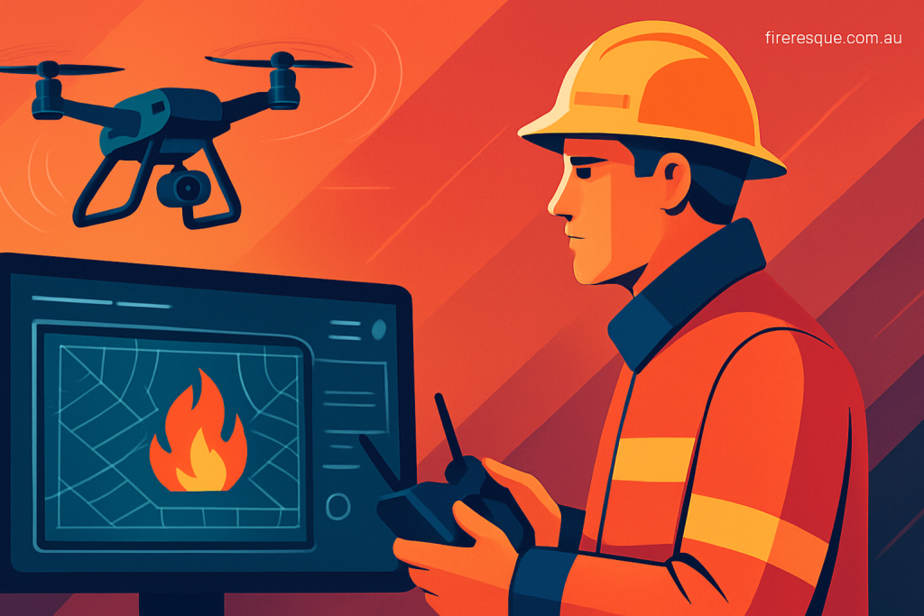
Drones provide a bird’s eye view of fire incidents, enabling firefighting teams to see beyond smoke and terrain obstacles. Equipped with high-resolution cameras and thermal imaging sensors, drones can detect heat signatures, locate active fire fronts, and identify structural risks around the fireground. This data is invaluable for forming a comprehensive situational picture.
The ability to transmit live video feeds to command centres allows incident controllers to make informed decisions quickly and adjust tactics as conditions evolve. For example, identifying new flare-ups or spotting trapped individuals can direct resources more precisely, reducing the risk to personnel and improving outcomes.
Beyond visual imagery, drones equipped with multispectral sensors can assess vegetation health and moisture levels surrounding a fire, offering predictive insights about fire spread patterns. This capability aids in deploying containment lines optimally and allocating resources where they are most needed. Additionally, drones can map fire perimeters in near real-time, providing updated geospatial data that supports coordinated efforts among multiple agencies.
Operational benefits and safety improvements
Using drones reduces the need to send crews into potentially dangerous environments for reconnaissance. This minimises exposure to hazards such as unstable structures, heavy smoke, or rapidly changing fire behaviour. Moreover, drones can cover large or inaccessible areas quickly, delivering data that ground teams alone might take much longer to gather.
In addition, drones support post-incident assessments, helping teams evaluate damage and plan recovery efforts. This capability can accelerate the transition from active firefighting to safety management and community support.
The deployment of drones also enhances firefighter safety by enabling remote monitoring of hazardous conditions such as gas leaks, unstable terrain, or potential structural collapses. This early warning capacity allows command teams to reroute personnel and adjust safety protocols dynamically. Furthermore, drones equipped with loudspeakers or communication devices can assist in delivering evacuation instructions or warnings to civilians in hard-to-reach areas, thereby augmenting community safety measures.
Practical implications for emergency services
For agencies considering or already using drones, establishing clear protocols is essential. This includes defining who is authorised to operate drones, ensuring pilots are appropriately trained and certified, and setting guidelines for data management and privacy. Coordination with local air traffic control and adherence to Australian Civil Aviation Safety Authority (CASA) regulations is mandatory to maintain safe airspace during incidents.
At a fire incident, Fire/Rescue typically direct drone deployments as part of their command structure. Police may utilise drones for crowd management or perimeter control, while SES can leverage them for search and rescue support. Ambulance services benefit indirectly by receiving timely updates on access routes or casualty locations. Cross-agency communication ensures drone operations do not conflict or interfere with manned aircraft such as helicopters.
Agencies must also consider the logistical aspects of drone operations, such as establishing dedicated launch and recovery zones that are safely distanced from emergency personnel and equipment. Battery life management, maintenance schedules, and rapid redeployment capabilities are critical to sustaining continuous aerial surveillance throughout extended incidents. Additionally, integrating drone data feeds into existing incident management software and communication networks enhances the accessibility and usability of aerial intelligence for all responders on site.
Training and planning considerations
Regular training exercises that include drone deployment scenarios help familiarise teams with operational workflows and technical limitations. Simulated incident environments enable crews to practice integrating drone intelligence into decision-making processes. This preparation improves confidence and effectiveness when responding to real emergencies.
Emergency management plans should incorporate drone operations as a standard component, clarifying how and when drones are requested, launched, and supported onsite. This foresight helps prevent delays and confusion during critical moments.
Furthermore, cross-agency training fosters a shared understanding of drone capabilities and limitations, promoting smoother coordination during multi-service responses. Addressing challenges such as signal interference, airspace deconfliction, and data security through joint exercises can mitigate risks and enhance operational resilience. Keeping abreast of technological advancements and regulatory updates is also crucial to maintaining effective and compliant drone programs.
Community guidance and emergency response
For the public, understanding the roles of different emergency services and when to call 000 is vital. Fire/Rescue respond to fires and related emergencies, Police manage public order and safety, Ambulance attend medical emergencies, and SES assist with rescues and disaster response. When witnessing a fire, immediate notification to 000 ensures prompt dispatch of appropriate resources, including any drone support if available.
Community members should avoid interfering with drone operations, as these devices contribute significantly to firefighter safety and operational success. Maintaining clear access for emergency vehicles and following official instructions supports smooth incident management.
Public education campaigns can reinforce awareness about the importance of drones in emergency response, helping to dispel misconceptions and encourage cooperation. Understanding that drones are operated by trained professionals within strict safety and privacy guidelines can increase community trust. Additionally, informing residents about the potential for drone use during incidents may reduce curiosity-driven disruptions and enhance overall incident efficiency.
Looking ahead: evolving drone technology and fireground intelligence
As drone technology continues to advance, capabilities such as longer flight durations, improved sensor arrays, and autonomous navigation will further enhance fireground intelligence. Integration with geographic information systems (GIS) and artificial intelligence (AI) may provide predictive insights to anticipate fire spread and resource needs more accurately.
However, technological progress must be matched by ongoing investment in training, inter-agency collaboration, and regulatory frameworks to fully realise these benefits while maintaining safety, privacy, and community trust.
Future developments may also include swarm drone technology, where multiple drones operate collaboratively to cover vast firegrounds, enabling comprehensive data collection and rapid area assessment. Enhanced onboard analytics could allow drones to autonomously identify critical fire behaviours or hazards and alert incident commanders in real time, further augmenting tactical decision-making.
Moreover, advances in drone payloads might incorporate environmental sensors capable of monitoring air quality, toxic gases, or weather conditions, providing a multidimensional understanding of the fire environment. Such integrated data streams will support more nuanced risk assessments and improve the safety of both emergency personnel and affected communities.
For emergencies, always call 000 immediately and follow instructions from Fire/Rescue, Police, Ambulance, or SES personnel on scene.
FireRescue Training Hub
Access practical fire and emergency study support resources, downloads, checklists, audio guides, and member-only course content.
- Course library
- PDF downloads
- Audio guides
- Checklists
Study support only. Not accredited training or a replacement for workplace procedures.
About the author and safety review
Ken Walker
Former Station Officer and fire service educator
Former career firefighter with extensive career and volunteer fire service experience.
Qualifications: Associate Diploma of Applied Science in Fire Technology; Institute of Fire Engineers studies.
Author profilehttps://www.firerescue.com.au/about-us/