Fire Safety Insight
Wildfire plume behaviour plays a critical role in how fires develop and spread. Understanding this can improve emergency planning and operational decisions. Australian firefighters and emergency services use plume data to predict fire impact zones and manage resources effectively.
Being aware of plume behaviour helps communities stay safer by recognising when conditions could change rapidly. Always follow official advice from Fire/Rescue NSW, the Country Fire Authority (CFA), or your local fire service during bushfires.
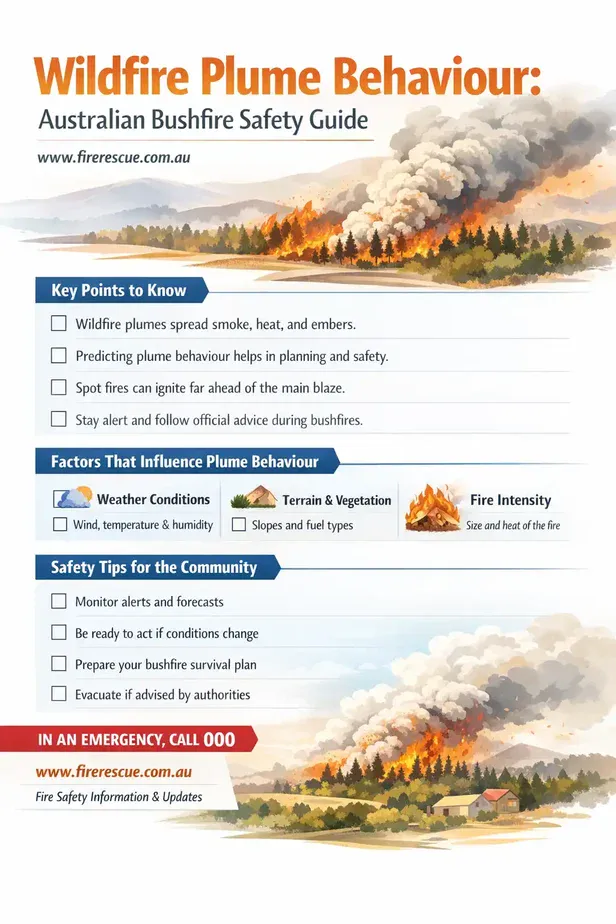
Download the Bushfire Safety Checklist and Guide
Get a clean, practical PDF covering bushfire awareness, safer planning, and simple actions you can take before conditions change.
- Quick checklist format
- Easy to save or print
- Useful for households in bushfire-prone areas
Simple bushfire safety information from www.firerescue.com.au.
What Is Wildfire Plume Behaviour?
A wildfire plume is the rising column of smoke, heat, and gases generated by the fire. This plume can reach hundreds or even thousands of metres into the atmosphere depending on the fire’s intensity and weather conditions. The behaviour of this plume influences fire spread, spotting of new fires, and local weather patterns.
Plumes carry burning embers that can ignite spot fires far ahead of the main fire front, which is one reason wildfires can spread quickly and unpredictably. The strength and direction of plume rise and drift depend on factors such as wind speed, humidity, terrain, and fuel type.
Understanding plume behaviour assists firefighters and emergency managers in predicting fire movement, planning containment lines, and issuing timely community warnings.
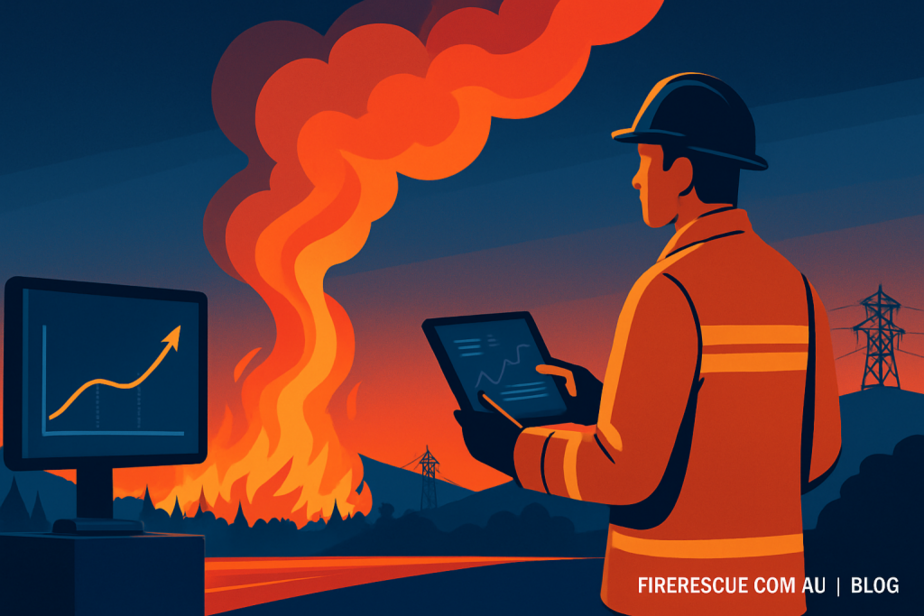
Factors Influencing Plume Behaviour
Weather Conditions
Wind is the primary driver of plume direction and speed. Strong winds push the plume downstream, increasing the likelihood of spot fires igniting downwind. Temperature and humidity also impact plume height and stability. Hot, dry air encourages stronger plumes, while moist air can dampen plume rise.
Terrain and Vegetation
Slopes and hills can funnel air currents, affecting plume shape and movement. Steep terrain may cause plumes to tilt or disperse unevenly. The type and dryness of vegetation determine how much heat and smoke the fire produces, influencing plume intensity.
Fire Intensity and Size
More intense fires release greater heat, creating higher and stronger plumes. Larger fires produce wider plumes covering greater areas. Intense plumes can also affect local wind patterns, sometimes generating firestorms or pyrocumulus clouds that further complicate firefighting efforts.
Why Understanding Plume Behaviour Matters
For emergency services, recognising how wildfire plumes behave is essential for safe and effective operations. It helps to predict where spot fires may start, anticipate sudden changes in fire direction, and assess risks to personnel and communities.
For the public, understanding plume behaviour raises awareness of changing fire risks and the importance of heeding official warnings. Large plumes can reduce visibility and air quality, impacting health and safety during bushfire events.
Operational Considerations for Fire Services
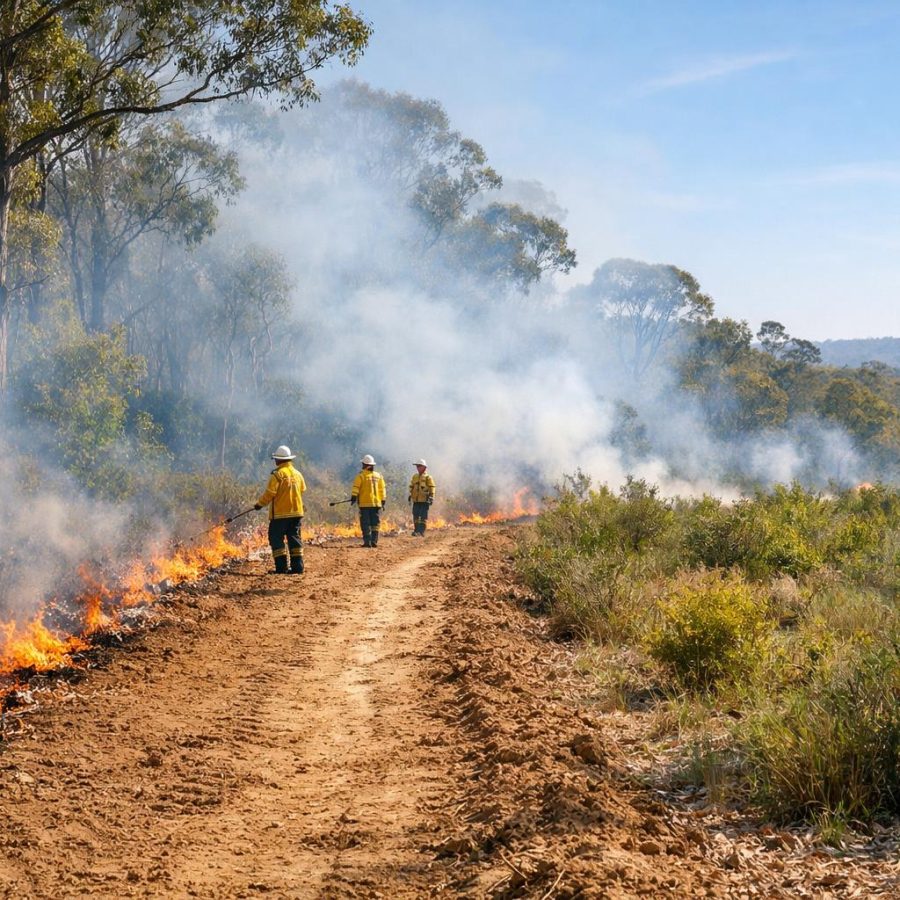
Australian firefighting agencies such as Fire and Rescue NSW, the Country Fire Authority (CFA) in Victoria, and rural fire services rely on plume behaviour models to guide tactical decisions. This includes determining safe zones, planning backburns, and allocating resources to high-risk areas.
Continuous monitoring using satellites, drones, and weather stations provides real-time data on plume development. This helps responders adjust strategies as fire conditions evolve. Communication with police, SES, and ambulance services ensures coordinated efforts during evacuations and medical emergencies.
Community Preparedness and Safety
Residents in bushfire-prone areas should understand that large plumes signal intense fire activity and potential dangers such as spot fires and rapid fire spread. Keeping informed through official sources like the Bureau of Meteorology, local fire services, and emergency apps is crucial.
Prepare your property by clearing debris, maintaining firebreaks, and having an emergency plan in place. During fire events, follow instructions from Fire/Rescue, CFA, or your local emergency broadcaster. Never attempt to approach or drive through smoke plumes, as visibility can be dangerously reduced.
In addition, recognising the signs of plume development can help individuals anticipate changes in fire intensity. For example, a sudden increase in plume height or density may indicate a flare-up or the merging of fire fronts. Such changes often precede rapid fire spread, requiring immediate attention and possibly evacuation.
Airborne smoke and particulate matter from plumes can also have significant health impacts, especially for vulnerable populations such as children, the elderly, and those with respiratory conditions. Understanding this risk encourages communities to take protective actions such as staying indoors, using air purifiers, or wearing masks during heavy smoke periods.
If You Only Do Five Things
Monitor official warnings from fire and emergency services to stay updated on plume activity and fire behaviour in your area. Recognise that large smoke plumes indicate a serious fire and possible spot fires downwind. Prepare your home by removing flammable materials and ensuring easy exit routes. Have a clear and practiced evacuation plan so you can leave promptly if advised. Always call 000 immediately if you or someone else is in life-threatening danger due to fire or smoke.
Who does what in Australia
Fire/Rescue NSW and other state fire services lead firefighting operations and public fire safety. They manage fire suppression, control burns, and community education.
Police support emergency management by enforcing road closures, helping evacuations, and maintaining law and order during fire events.
Ambulance services provide urgent medical care to those injured or affected by smoke inhalation.
State Emergency Service (SES) assists with rescues, flood response, and helping communities prepare for and recover from emergencies including fires.
In all emergencies, call 000 for immediate help.
Advanced Insights into Plume Dynamics
Beyond the basics, wildfire plumes can exhibit complex behaviours such as plume pulsing, where the intensity of the plume fluctuates rapidly due to changes in fire activity or wind gusts. This pulsing can lead to erratic fire spread patterns, challenging firefighting efforts and requiring adaptive strategies.
Pyrocumulus clouds, formed by intense heat and moisture in the plume, can grow to towering heights and sometimes produce lightning, which may ignite new fires far from the original blaze. These phenomena underline the importance of monitoring plume development closely, as they can rapidly escalate fire danger.
Fire-induced winds generated by strong plumes can create their own weather systems, including fire whirls or tornado-like vortices. These can cause spot fires and damage well outside the main fire perimeter, posing additional risks to firefighters and residents.
Technological Advances in Plume Monitoring
Recent advancements in remote sensing technologies have revolutionised the monitoring of wildfire plumes. High-resolution satellite imagery allows for near real-time tracking of plume size, direction, and composition, aiding rapid decision-making.
Drones equipped with thermal cameras provide detailed views of fire hotspots and plume activity, enabling safer and more precise firefighting tactics. Weather stations and atmospheric sensors placed near fire zones collect data on temperature, humidity, and wind shear, which feed into sophisticated plume and fire behaviour models.
Integration of these technologies with geographic information systems (GIS) helps emergency managers visualise fire progression and plume impact zones, improving resource allocation and evacuation planning.
Environmental and Ecological Impacts of Wildfire Plumes
Wildfire plumes contribute to the distribution of pollutants such as carbon monoxide, particulate matter, and volatile organic compounds. These emissions can travel hundreds of kilometres, affecting air quality and contributing to regional haze and health advisories.
Moreover, plumes influence nutrient cycling by depositing ash and minerals onto soils and water bodies, which can impact plant regrowth and aquatic ecosystems. Understanding plume dispersion patterns is therefore important not only for immediate fire management but also for assessing long-term environmental recovery.
Conclusion
Wildfire plume behaviour is a complex and vital aspect of bushfire dynamics. Its study enhances the safety and effectiveness of firefighting operations while empowering communities with knowledge to prepare and respond appropriately. Continued research and technological innovation are essential to deepen understanding and improve management of wildfire plumes in Australia’s diverse landscapes.
FireRescue Training Hub
Access practical fire and emergency study support resources, downloads, checklists, audio guides, and member-only course content.
- Course library
- PDF downloads
- Audio guides
- Checklists
Study support only. Not accredited training or a replacement for workplace procedures.
About the author and safety review
Ken Walker
Former Station Officer and fire service educator
Former career firefighter with extensive career and volunteer fire service experience.
Qualifications: Associate Diploma of Applied Science in Fire Technology; Institute of Fire Engineers studies.
Author profilehttps://www.firerescue.com.au/about-us/