Communicate Objectives and Required Standards: Keeping Teams Aligned, Informed and Accountable
Strong teams need more than goodwill. They need clear direction, current information and a proper understanding of what the organisation expects. When leaders communicate objectives and standards well, the team is more likely to work consistently, safely and with shared purpose.
Mark each section as refreshed
The “E” in the TEAM LEAD Cycle
Part 3 focuses on the first “E” in the TEAM LEAD Cycle: Expectations, objectives and standards. In PUATEA003, leaders are required to provide team members with up-to-date information about work task objectives and required organisational standards, monitor the team’s understanding and application of those expectations, and model and promote organisational standards and values related to equal employment opportunity, antidiscrimination and workplace harassment.
This matters because unclear direction leads to uneven work. When people are guessing, filling gaps themselves or relying on old information, standards can drift. Good leaders prevent that drift. They explain the objective, connect it to the required standard, check that people understand it and reinforce the behaviour expected in the workplace.
Communicate clear work task objectives
People perform better when they know exactly what the task is, why it matters and what success looks like.
PUATEA003 requires leaders to provide team members with up-to-date information about work task objectives and required standards. The first part of that responsibility is clarity around the objective itself. A team cannot work with confidence if the goal is vague, incomplete or assumed rather than explained.
A work task objective gives direction. It answers practical questions such as: What are we trying to achieve? What is the current priority? What needs to happen first? What does a satisfactory result look like? In public safety settings, objectives may relate to readiness, routine operations, documentation, team coordination, communication practices or implementing a required organisational process.
When objectives are clear, leaders reduce confusion and support accountability. Team members can connect their individual role to the team’s work more easily. They can also recognise whether they are on track. When objectives are unclear, the opposite happens. Good people may still work hard, but they may pull in slightly different directions, make inconsistent assumptions or complete work to different standards.
Communicating objectives is not just reading out instructions. It is helping people understand the task in a way they can apply. This includes choosing plain language, avoiding unnecessary complexity and making sure the team knows how the objective fits current work requirements. A strong leader turns direction into understanding, not just words.
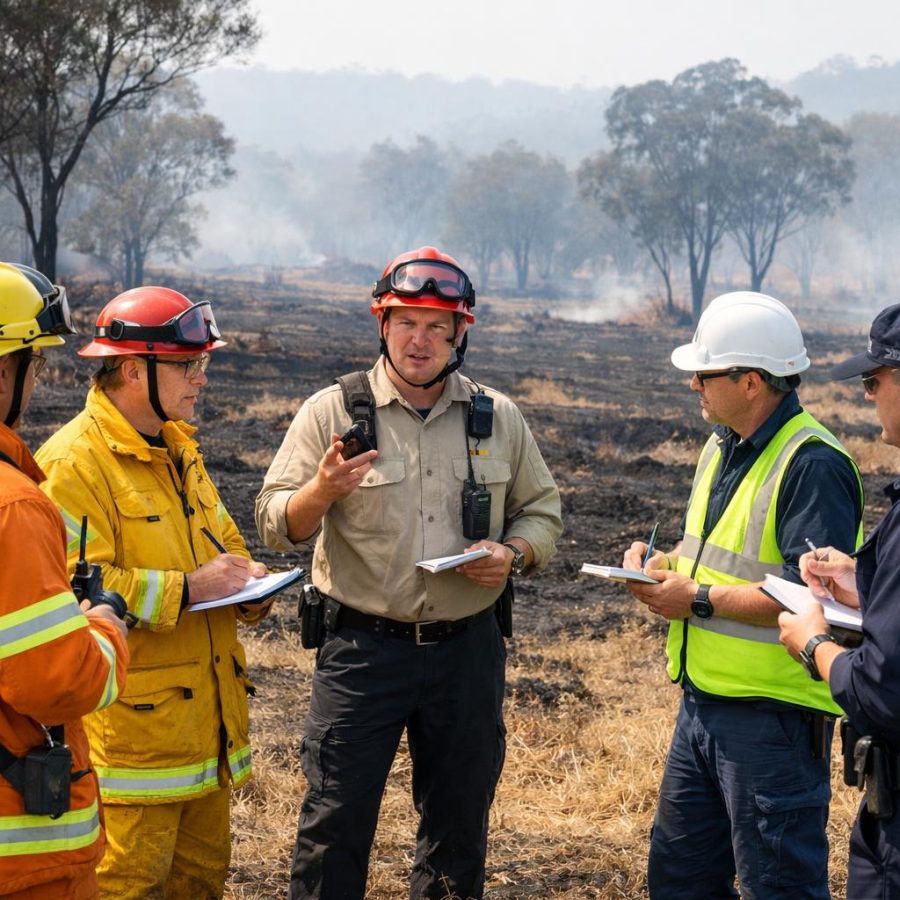
A team briefing is strongest when it answers three simple questions: What are we doing, what standard are we working to, and what do people need to know right now?
Provide up-to-date information, not outdated assumptions
Leadership communication must reflect current work expectations, not yesterday’s habits.
The unit specifically says team members must be provided with up-to-date information. That phrase matters. It reminds leaders that communication is not only about being clear. It is also about being current. Information that was accurate last month may be incomplete today. A routine that once worked well may have changed because of an organisational update, a revised process or a new reporting requirement.
In practical terms, this means leaders should not rely only on memory, habit or informal word-of-mouth. Before passing on direction, the leader should confirm the current objective and standard through proper organisational channels where required. This helps prevent confusion, mixed messages and unnecessary rework.
Public safety teams often rely on consistency, so even small changes need to be explained properly. When a leader passes on current information clearly, the team is more likely to trust that the direction is valid. When changes appear without context or seem inconsistent with earlier instructions, leaders may need to slow down slightly and explain what has changed and why it matters.
Providing up-to-date information also supports fairness. Team members should not be judged against a requirement they were never properly told about. If a standard has changed, the leader’s job includes making that change known in a practical and timely way.
Assuming the team already knows
Even experienced people can miss updates, interpret changes differently or continue old habits unless new information is clearly communicated.
State the current expectation clearly
If a process, form, priority or standard has changed, say so directly and explain what the team now needs to do.
Explain required standards in practical terms
Objectives tell the team what to achieve. Standards tell the team how well the work must be done.
A leader must communicate not only the objective, but also the required standard. That means the team needs to understand the level, quality, behaviour or compliance expectation attached to the work. This may include accuracy, timeliness, documentation quality, teamwork behaviour, safety expectations or adherence to organisational procedure.
Standards are important because they create consistency. Without clear standards, one person may complete a task quickly but incompletely, while another may overcomplicate it. A clear standard creates a shared measure. It supports accountability and helps the team understand how the organisation defines acceptable work.
Leaders should avoid vague statements such as “just do it properly” when more specific guidance is needed. A better approach is to explain the standard in practical language. For example, if a task must be completed by a certain time, recorded in a certain way or checked against a specific requirement, the leader should say so clearly. When behaviour standards matter, the leader should also make those visible in how the team communicates and works together.
This is especially helpful for newer members, but it also supports experienced personnel. Clear standards remove uncertainty. They also reduce the chance that people interpret instructions differently based on past habits or local assumptions.
Objective
What needs to be achieved by the team or individual.
Standard
The level, quality or required way the work must be completed.
Application
How the team turns the objective and standard into real work practice.
“Today’s objective is to complete the equipment readiness check by the end of shift. The required standard is that every item is checked against the current list, any issue is recorded properly and anything unclear is raised before sign-off.”
Monitor understanding and application
Leaders should not assume that because something was said, it was understood and applied properly.
PUATEA003 requires leaders to monitor team members’ understanding and application of work task objectives and organisational standards. This means communication is not complete at the moment the leader finishes speaking. The next step is to make sure the message has been understood and is being put into practice.
Monitoring understanding can be simple and practical. A leader may ask a team member to summarise the task, invite questions, observe early application of the process, review completed work or check whether people are using the current version of a form or routine. The purpose is not to catch people out. The purpose is to support correct application before small misunderstandings become larger problems.
Monitoring application is equally important. People may repeat instructions accurately but still apply them unevenly. A leader therefore needs to watch how the work is being carried out. If there is confusion, the leader can correct it early. If there is a strong example, the leader can reinforce it. If the task is drifting away from the required standard, the leader can step in before the problem grows.
This supports fairness and performance at the same time. When leaders monitor understanding, they create the chance to help people succeed. They also create a stronger basis for later feedback, because the leader has actively supported clarity rather than assuming knowledge and criticising after the fact.
Communicate the objective clearly
Explain the required standard
Check understanding early
Monitor application in practice
A leader does not only deliver a message. A leader checks that the message has become the work.
Model and promote organisational standards and values
Leaders must show the behaviour they expect, especially in relation to fairness, respect and workplace conduct.
The final performance criterion in Element 2 says that organisational standards and values relating to equal employment opportunity, antidiscrimination and workplace harassment are to be modelled and promoted to team members. This is a very important leadership responsibility. It means leaders are expected to do more than mention these standards. They must demonstrate and reinforce them through daily conduct.
Modelling means behaviour starts with the leader. A leader who speaks respectfully, treats people fairly, avoids bias, responds appropriately to poor conduct and supports a safe workplace sends a strong message about what is expected. Promotion means the leader actively reinforces those standards. This may happen through briefings, reminders, corrections, respectful workplace conversations and clear responses when standards are not met.
These standards are not separate from operational leadership. They are part of it. A team that tolerates disrespect, exclusion, discrimination or harassment is less healthy, less trusting and less effective. By contrast, a leader who promotes fair treatment and respectful conduct helps create a team environment where people can contribute, learn and work productively.
It is also important that these standards are not treated as abstract policy language only. Team members should understand that workplace values affect everyday behaviour, including the way people speak, make decisions, include others, respond to concerns and maintain professionalism under pressure.
Assuming values speak for themselves
If leaders do not model and reinforce organisational standards, team members may receive mixed messages about what behaviour is acceptable.
Make standards visible through conduct
Fair treatment, respectful communication and prompt action on poor behaviour show the team that workplace values are real expectations.
Scenario drill: a changed objective and a mixed team response
Use this scenario to apply communication, monitoring and values-based leadership together.
The updated reporting process
A team leader has been told that a reporting process has changed. The new form must now be used, and the standard for completion is stricter than before. During the briefing, one team member appears confident, another seems unsure, and a third makes a dismissive joke about a newer team member asking questions. The leader wants the team to adopt the new process properly and maintain professional workplace behaviour.
Which response best reflects Element 2 of PUATEA003?
The strongest response is the one that covers the full leadership task. It communicates the current objective, explains the standard, checks understanding, supports correct application and models organisational values through respectful workplace conduct. This is exactly the sort of practical communication responsibility described in PUATEA003.
Check your understanding
1. Team members should be given information about work task objectives and standards that is:
2. Monitoring understanding means:
3. Organisational standards and values relating to equal employment opportunity, antidiscrimination and workplace harassment should be:
4. A clear standard helps a team by:
Say it in one minute
Use this quick drill to summarise Part 3 aloud or in your own notes:
- Leaders must communicate clear work task objectives and required standards.
- The information provided must be up to date, not based on old assumptions.
- Standards tell the team how well the work must be done.
- Leaders should monitor understanding and application, not assume that speaking once is enough.
- Workplace values such as equal employment opportunity, antidiscrimination and respectful behaviour must be modelled and promoted by leaders.
FireRescue Training Hub
Access practical fire and emergency study support resources, downloads, checklists, audio guides, and member-only course content.
- Course library
- PDF downloads
- Audio guides
- Checklists
Study support only. Not accredited training or a replacement for workplace procedures.
About the author and safety review
Ken Walker
Former Station Officer and fire service educator
Former career firefighter with extensive career and volunteer fire service experience.
Qualifications: Associate Diploma of Applied Science in Fire Technology; Institute of Fire Engineers studies.
Author profilehttps://www.firerescue.com.au/about-us/