Fire & Rescue Insight
Key takeaways
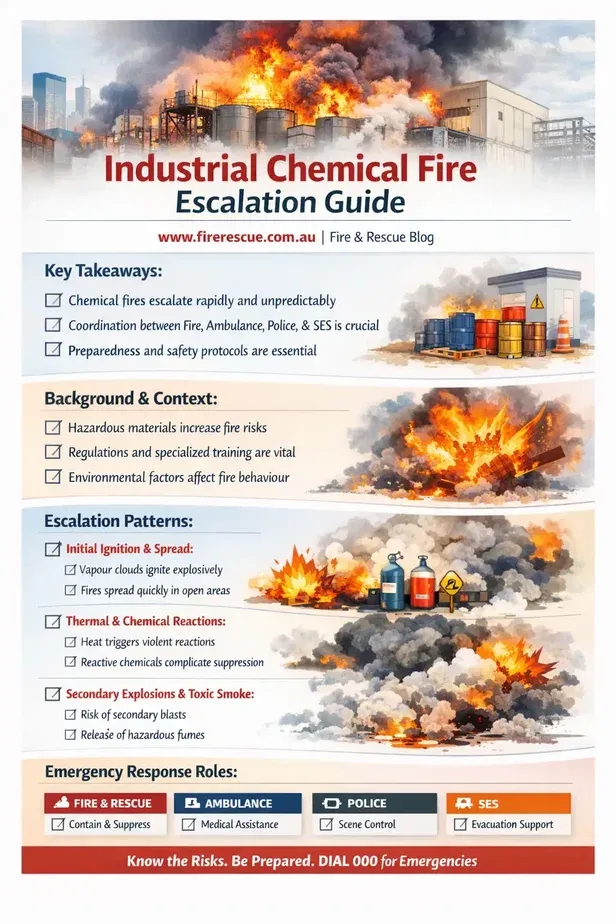
Industrial chemical fires are complex events that escalate rapidly due to the nature of the chemicals involved and the environment in which they occur. Understanding these escalation patterns is critical for effective emergency response and for minimizing risk to personnel and the surrounding community.
Emergency services in Australia have distinct roles during chemical fire incidents: Fire and Rescue manage containment and suppression, Ambulance services handle medical emergencies, Police control scene security and access, while the State Emergency Service (SES) may assist with evacuation and support operations.
Preparedness, including knowledge of chemical properties and fire behaviour, robust safety protocols, and coordinated multi-agency response, are essential to safely manage industrial chemical fire escalation and protect lives and assets.
Industrial Chemical Fire Escalation Patterns
A practical Australian guide covering ignition, escalation behaviour, toxic smoke risk, secondary events, emergency roles, and safer industrial response planning.
www.firerescue.com.au
What this guide covers
- Initial ignition and rapid spread
- Thermal and chemical reactions
- Secondary explosions and toxic smoke
- Australian emergency response roles
Why it matters
Industrial chemical fires can escalate fast. Clear planning, safer storage, staff training, and strong incident coordination help reduce harm to workers, responders, and nearby communities.
Good for
Fire and rescue readers, industrial safety teams, emergency planners, and anyone wanting a plain-English overview of chemical fire behaviour in an Australian context.
Clean, mobile-friendly promotion block for WPCoder. Light theme, subtle styling, and direct access to the guide PDF and preview image.
View the full guide
Industrial Chemical Fire Escalation Patterns
Background and context
- Industrial chemical fires differ significantly from conventional fires due to the diverse and often volatile nature of the substances involved. Facilities such as manufacturing plants, chemical processing centres, and storage warehouses may hold acids, solvents, flammable gases, and reactive materials that can exacerbate fire behaviour. The escalation patterns in these fires are influenced by factors including chemical reactivity, storage configuration, containment systems, and environmental conditions.
- In Australia, strict regulations govern the handling of hazardous chemicals, yet the potential for fire remains a critical safety concern. Rapid escalation can lead to secondary explosions, toxic smoke release, and large-scale environmental contamination. Awareness of these patterns underpins emergency planning, on-site training, and the deployment of specialised firefighting techniques and personal protective equipment (PPE).
- The complexity of chemical fire behaviour means that no two incidents are exactly alike. Factors such as the quantity of chemicals involved, the presence of ignition sources, and the design of fire suppression systems all contribute to how a fire may develop and escalate. Understanding these nuances allows emergency responders to anticipate potential hazards and tailor their approach accordingly.
- Moreover, environmental elements such as wind direction, ambient temperature, and humidity can influence the dispersion of flammable vapours and toxic gases, affecting both the fire’s behaviour and the safety of nearby populations. This highlights the importance of integrating meteorological data into emergency response planning and real-time incident management.
Understanding escalation patterns
Initial ignition and spread
- The first stage of an industrial chemical fire often involves ignition of flammable liquids or vapours. Vapour clouds formed from volatile substances can ignite explosively if exposed to a spark or heat source. Fires can spread rapidly when chemicals are stored in open containers or poorly ventilated areas. The presence of combustible packaging materials may further accelerate fire growth.
- In many cases, the ignition source might be electrical equipment malfunction, static discharge, or even human error during handling operations. Once ignited, the fire can quickly extend beyond its initial location, especially if containment measures fail or are absent. Understanding the dynamics of vapour cloud formation and ignition is crucial for developing effective prevention strategies.
Thermal and chemical reactions
As the fire develops, heat can trigger exothermic reactions within stored chemicals, causing self-heating and potential decomposition. This may produce flammable gases or vapours that expand the fire perimeter. Some chemicals can react violently when exposed to water or firefighting foams, complicating suppression efforts. Understanding these reactions is vital for selecting appropriate extinguishing agents.
For example, substances such as alkali metals or certain organic peroxides may react dangerously with water, releasing hydrogen gas or intensifying the fire. Firefighters must be aware of these risks to avoid inadvertently worsening the situation. Additionally, thermal decomposition can generate toxic by-products, increasing the hazard for emergency personnel and nearby communities.
Secondary events and escalation
Escalation may include secondary explosions caused by pressure buildup in tanks or containers, rupture of pipelines, or interaction of incompatible chemicals. The release of toxic smoke and irritant gases can pose serious health risks to responders and bystanders. Fire escalation can also be driven by structural collapse or spread to adjacent facilities if fire breaks and containment zones are insufficient.
Secondary explosions often occur when heat compromises the integrity of storage vessels, leading to rapid pressure release and blast effects. These events can cause significant damage to infrastructure and increase the danger to emergency crews. Furthermore, the mingling of chemicals during fire events can trigger unexpected hazardous reactions, necessitating careful risk assessment and monitoring throughout the incident.
In some cases, fire escalation may lead to prolonged incidents requiring extended firefighting operations, environmental remediation, and community health interventions. Understanding these patterns supports better resource allocation and longer-term recovery planning.
Emergency response considerations
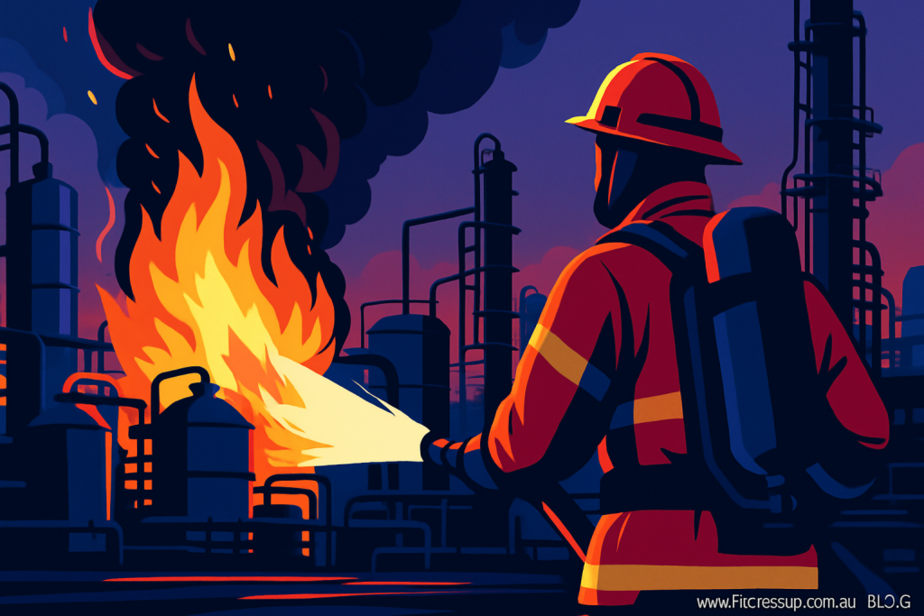
In Australia, the first point of contact for any industrial chemical fire is to call 000 immediately. Fire and Rescue NSW, or the relevant state fire service, will lead fire suppression and containment operations. The specialised training of fire crews in chemical hazards, use of breathing apparatus, and foam application is essential to control escalation and prevent spread.
Ambulance services provide critical medical support for any injured personnel, including treatment for burns, smoke inhalation, or chemical exposure. Police are tasked with securing the scene, managing traffic and crowd control, and assisting with evacuation orders if necessary. The SES may be called upon to support evacuation logistics and offer community assistance during extended incidents.
Inter-agency coordination is crucial. Incident commanders assess risks continuously and may establish exclusion zones to protect responders and the public. Communication with environmental protection authorities ensures monitoring and mitigation of toxic releases. Early identification of chemical types on site, through Safety Data Sheets (SDS) and site plans, supports tactical decision-making and appropriate resource deployment.
Effective emergency response also relies on the integration of technology such as thermal imaging cameras, drone reconnaissance, and real-time data sharing platforms. These tools enhance situational awareness and enable safer, more efficient firefighting operations. Equally important is ongoing training and simulation exercises that prepare responders for the unique challenges posed by chemical fires.
Public communication plays a vital role during incidents. Timely warnings, clear instructions, and updates help reduce panic and ensure compliance with safety measures. Establishing trust between emergency services and the community is essential for successful incident management and recovery.
Practical implications for industry and safety
- Industries handling hazardous chemicals must maintain rigorous safety management systems, including fire risk assessments tailored to the specific chemicals stored. Regular training and drills involving emergency services help ensure rapid and effective response to fires. Facilities should prioritise segregation of incompatible chemicals, use fire-resistant storage solutions, and maintain clear access routes for emergency vehicles.
- Installation of early detection systems, such as gas monitors and heat sensors, can provide critical lead time to respond before fires escalate. Emergency plans should clearly define roles, communication protocols, and evacuation procedures. Additionally, environmental controls such as bunding and spill containment reduce the risk of fire spread and contamination.
- The integration of advanced fire suppression technologies, including automated sprinkler systems and foam delivery mechanisms, further enhances protection measures. These systems must be regularly inspected and maintained to ensure functionality during emergencies. Additionally, adopting a culture of continuous improvement through incident reviews and lessons learned supports safer industrial operations.
- Worker safety is paramount; therefore, personal protective equipment (PPE) must be appropriate for chemical hazards present, and personnel should be trained in its correct use. Emergency evacuation drills should be conducted frequently, with clear signage and communication channels established to facilitate swift and safe egress.
Finally, collaboration between industry stakeholders, emergency services, regulators, and the community fosters a holistic approach to chemical fire risk management. Sharing knowledge, resources, and best practices contributes to resilience and reduces the likelihood and impact of industrial chemical fires across Australia.
Ultimately, a thorough understanding of industrial chemical fire escalation patterns enables safer workplace design, enhances firefighter safety, and protects communities. Stakeholders at all levels must collaborate to maintain a proactive stance towards chemical fire risks in Australia’s industrial landscape.
FireRescue Training Hub
Access practical fire and emergency study support resources, downloads, checklists, audio guides, and member-only course content.
- Course library
- PDF downloads
- Audio guides
- Checklists
Study support only. Not accredited training or a replacement for workplace procedures.
About the author and safety review
Ken Walker
Former Station Officer and fire service educator
Former career firefighter with extensive career and volunteer fire service experience.
Qualifications: Associate Diploma of Applied Science in Fire Technology; Institute of Fire Engineers studies.
Author profilehttps://www.firerescue.com.au/about-us/