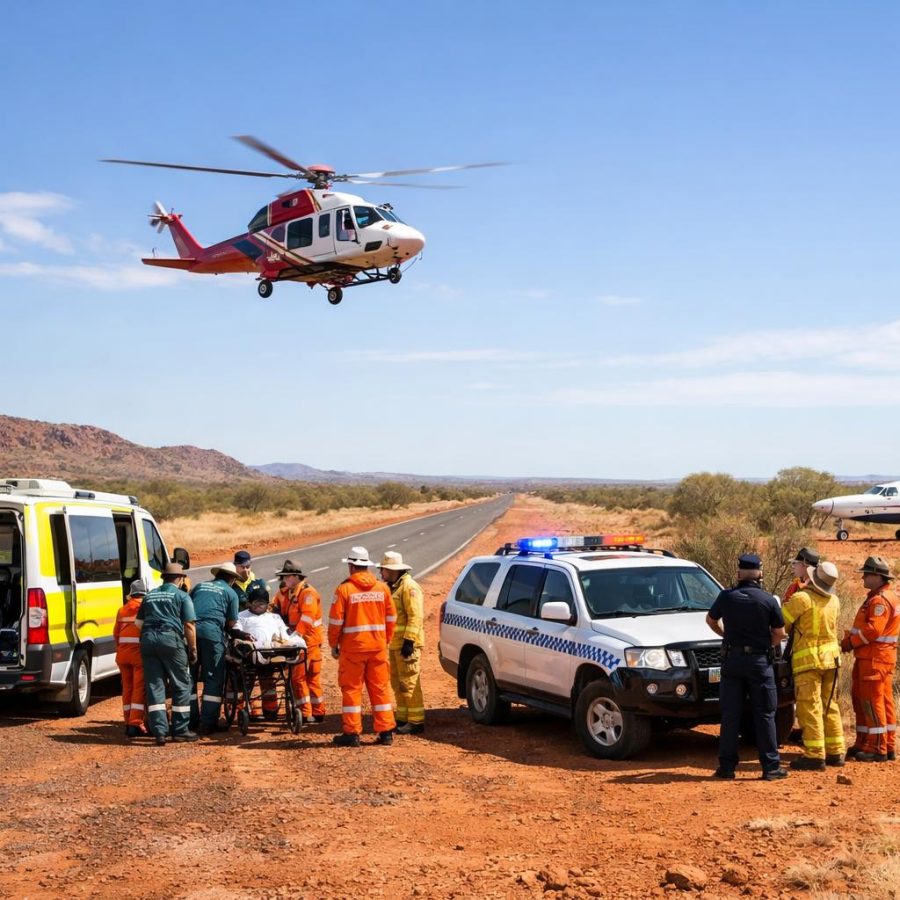
A Risk-Based Approach to Fire Truck Allocation, Rotation and Replacement
Managing a large fire service fleet is not just a matter of replacing trucks when they become old. In a system of about 100 brigades, the real task is to place the right appliance at the right brigade, rotate vehicles when workload changes, keep reserves dependable, and spread replacement spending across many years instead of facing a sudden budget shock.
Why fleet management must be a system, not a purchase list
In a large and mixed fire service fleet, appliance replacement is only one part of the job. Good fleet management asks a bigger question: what capability does each brigade need now, what capability will it need in the future, and which vehicle best meets that need at this stage of its life?
That shift in thinking matters because a brigade’s role is rarely fixed. A station that once handled mostly rural grass fires may later sit on the edge of urban expansion. A highway brigade may see more rescue work as traffic grows. A bushfire-interface brigade may experience longer and more complex incidents as development moves closer to vegetation. If fleet planning only follows age, the service can easily end up with the wrong appliances in the wrong places.
For that reason, fleet management should be treated as a long-term capability system. It should cover allocation, rotation, reserve management, refurbishment, replacement timing, budget forecasts and local risk changes. The goal is not to give every brigade the newest truck. The goal is to give each brigade the right truck for its risk and workload, while keeping the whole system affordable and reliable.
Interactive Resources
Explore the Fire Fleet Management Model
Explore the fictional Orange Land fire fleet management model.
Use the interactive dashboard or download the complete Excel
demonstration workbook.
Interactive Dashboard
Fire Fleet Lifecycle Manager
Explore the Orange Land fleet using the interactive
Fire Fleet Lifecycle Manager. Review brigades,
appliances, fleet health, lifecycle status and
regional risk information.
- 100 fictional fire brigades
- 175 demonstration fire appliances
- Fleet health and lifecycle information
- Regional and brigade risk profiles
- Replacement and rotation planning
Open Fleet Dashboard
→
Excel Demonstration
Orange Land Fleet Workbook v2.0
Download the complete Orange Land demonstration
workbook. It includes appliance records, brigade
profiles, maintenance history, lifecycle planning,
budgets and fleet simulations.
- Complete appliance register
- 20–25 year lifecycle model
- Fleet health scoring
- Budget and replacement planning
- Future fleet simulation
Download Excel Workbook
↓
Demonstration data only
Orange Land, its brigades, vehicles, risks, costs and
operational information are fictional and are provided
solely to demonstrate the fleet-management framework.
Explore the Fire Fleet Management Model
Explore the fictional Orange Land fire fleet management model. Use the interactive dashboard or download the complete Excel demonstration workbook.
Fire Fleet Lifecycle Manager
Explore the Orange Land fleet using the interactive Fire Fleet Lifecycle Manager. Review brigades, appliances, fleet health, lifecycle status and regional risk information.
- 100 fictional fire brigades
- 175 demonstration fire appliances
- Fleet health and lifecycle information
- Regional and brigade risk profiles
- Replacement and rotation planning
Orange Land Fleet Workbook v2.0
Download the complete Orange Land demonstration workbook. It includes appliance records, brigade profiles, maintenance history, lifecycle planning, budgets and fleet simulations.
- Complete appliance register
- 20–25 year lifecycle model
- Fleet health scoring
- Budget and replacement planning
- Future fleet simulation
Orange Land, its brigades, vehicles, risks, costs and operational information are fictional and are provided solely to demonstrate the fleet-management framework.
Orange Land Fire & Rescue: a fictional example for Australian-style planning
To make the concepts easier to follow, this article uses a fictional service called Orange Land Fire & Rescue. Orange Land operates about 100 brigades across urban, rural, bushfire-interface, industrial, highway and remote areas. It also maintains a mixed fleet of rural tankers, urban tankers, light urban pumpers, heavy urban pumpers and specialist appliances such as rescue, HazMat, aerial, command and bulk-water units.
Orange Land is not a real organisation. It is simply a practical model designed to resemble Australian operating conditions. The example is useful because many services face the same planning pressures:
- wide distances between brigades
- different risk profiles across districts
- variable access to neighbouring support
- multiple appliance types with different workloads
- budget limits that force staged replacement
- the need to keep reserves available for breakdowns, servicing and major incidents
In a system like this, a district manager cannot sensibly decide appliance placement by looking only at calendar age. A 22-year-old tanker in a lightly used rural brigade may still be fit for service, while a 10-year-old appliance in a very busy urban brigade may already be under significant wear. The Orange Land model shows why the fleet must be managed as a whole network, not as isolated vehicles.
Risk-based brigade classification: one brigade can belong to several categories
A common mistake in fleet planning is to classify a brigade using only one label. In practice, brigades usually carry several operational characteristics at once. A brigade may be primarily rural, but also sit on a bushfire interface, cover a major highway, and support a nearby industrial area. That combination changes the appliance requirement.
Orange Land would therefore classify brigades using multiple characteristics rather than a single type. The categories might include:
- Rural — long response distances, water supply limitations and broad area coverage
- Urban — higher turnout frequency, more structure fires, rescue support and tighter access
- Bushfire-interface — exposure to vegetation fires plus life and property protection near urban edges
- Industrial/highway — higher consequence incidents, hazardous loads, heavy vehicle rescue or special risks
- Specialist — brigades with rescue, HazMat, aerial, bulk-water or command responsibilities
This approach matters because risk-based allocation should reflect more than a simple map location. The service should consider:
- actual annual turnout numbers
- activity category, such as very high, high, medium, low or very low
- local fire and emergency risk
- incident complexity and likely duration
- population growth and development pressure
- industrial, transport or interface risk
- specialist responsibilities
- neighbouring brigade coverage
- minimum local capability
- future risk as a secondary consideration
Neighbouring brigades are important, but they cannot be assumed to always be free. They may already be committed to other incidents, training, false alarms or prolonged operations. A brigade that appears well covered on paper may still need a higher minimum local capability in practice.
For that reason, each brigade should be compared against a recommended appliance mix rather than a generic minimum. The planner can then compare the current appliance mix, the recommended mix and the resulting capability gap. Significant gaps deserve senior review, because they may indicate a local risk that is not being matched by the fleet.
Risk-based classification should be used to guide planning, not to lock brigades into fixed labels forever. As the district changes, the classification should change as well.
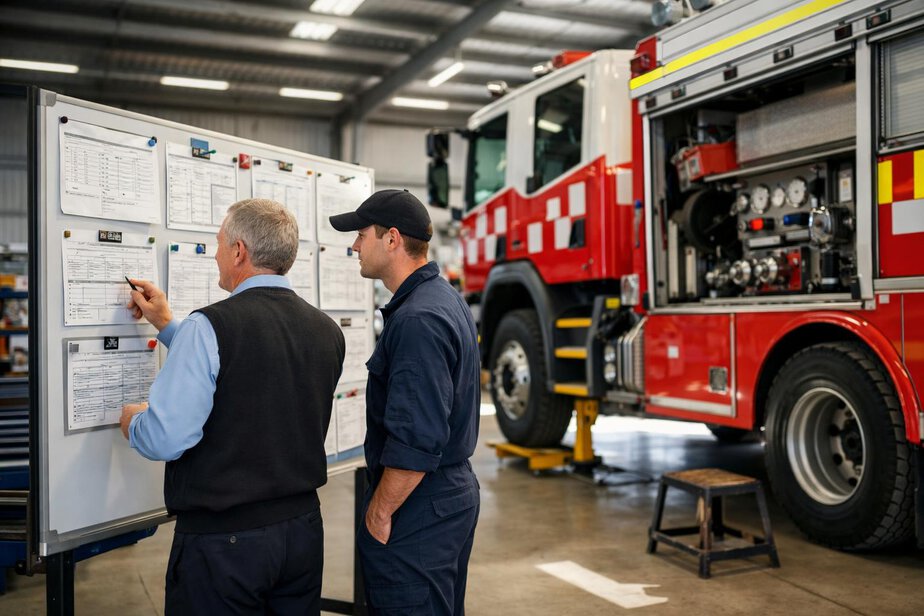
Choosing the right appliance mix for each brigade
Once brigade risk is understood, the next step is to match that risk to appliance capability. Orange Land’s mixed fleet might include rural tankers, urban tankers, light urban pumpers, heavy urban pumpers and specialist units such as rescue, HazMat, aerial, command and bulk-water appliances. Not every brigade needs every type, but every brigade does need a dependable minimum level of capability.
A rural brigade may be best served by a tanker that can cope with limited reticulated water, rougher access and longer response distances. A dense urban brigade may need a pumper with stronger pumping capacity, equipment for structural fire attack and rescue support, and a layout that suits frequent multi-crew operations. A bushfire-interface brigade may need a tanker or pumper-tanker arrangement that can perform in both vegetation and urban protection roles.
Specialist appliances should be assigned with even more care. A rescue appliance should sit where rescue demand is real and support times matter. A HazMat unit should be available to cover industrial, freight or transport hazards. Aerial appliances may need to be positioned to balance coverage, road access and turntable operational limitations. Command vehicles should support district-level incident coordination. Bulk-water appliances can be strategically useful where sustained water movement is a recurring problem.
Standardisation where practical
Strong fleet standardisation is usually helpful where it can be achieved without compromising local needs. Similar appliance layouts, controls, equipment locations and operating systems can simplify training, maintenance, parts supply and inter-brigade transfers. Standardisation also makes it easier to move appliances between brigades, because crews already understand the general layout.
That said, standardisation should not become inflexible. Local terrain, station design, specialist work, road network limits and operating environment can justify differences. The aim is not identical appliances everywhere. The aim is consistent, predictable and maintainable capability.
| Brigade profile | Likely appliance priority | Planning focus |
|---|---|---|
| Very high-activity urban | Heavy or light urban pumper | Fast turnouts, repeated use, rescue support, robust maintenance planning |
| Medium rural-interface | Rural tanker or tanker-pumper | Water supply, vegetation protection, mixed road access, neighbour support limits |
| Low-activity rural | Suitable transferred tanker | Reliable capability without forcing a new appliance if not needed |
| Specialist district role | Rescue, HazMat, aerial, command or bulk-water unit | Function-specific fit, regional support, lifecycle and training needs |
The practical question is always the same: does the appliance match the brigade’s actual role, not just its historical description?
A 20–25 year lifecycle with rotation, not just replacement
In a long-term fleet model, age still matters, but it should be part of a broader lifecycle plan. A sensible planning framework is to begin replacement planning around 20 years, expect a normal maximum service age of around 25 years, and make earlier decisions when condition or workload demand it. Specialist vehicles may need separate assessment because their operating pattern can be quite different from that of general-purpose appliances.
Under the Orange Land model, a new appliance would generally be allocated first to a high-activity brigade. That is logical because the newest appliance is usually the most reliable, least tired and easiest to support. It should start life where operational demand is highest and where its capability will be used most fully.
After roughly 5 to 10 years, the appliance should be reviewed. If it is still mechanically sound, operationally suitable and compatible with the brigade’s role, it may then be transferred to a lower-activity brigade. In other words, the lifecycle may look like this:
New appliance → high-activity brigade → workload and mid-life review → lower-activity brigade → final service → retirement
This approach lets the organisation extract more value from each vehicle while keeping the best equipment in the highest-demand locations. It also avoids the problem of sending brand-new trucks to brigades that may use them relatively lightly while a busier brigade continues to operate a more tired vehicle.
Low-activity brigades should not automatically receive a brand-new appliance simply because their current truck has reached a nominal replacement age. If a well-maintained transferred appliance still meets the brigade’s risk and capability needs, it may be a better use of public money. The receiving brigade must still get a mechanically reliable and operationally suitable vehicle, but it does not always need the newest one.
Workload-based mid-life reviews: judge the vehicle, not just the calendar
Mid-life review should be driven by workload, not by a fixed age alone. Two appliances of the same age may be at very different stages of life depending on kilometres travelled, pump hours, incident load and maintenance history. A busy urban pumper may be worn in a way that a lightly used rural tanker is not, even if both are the same age.
A proper mid-life review should consider:
- kilometres travelled
- pump operating hours
- incident workload
- routine service history
- breakdown frequency
- repair history
- mechanical condition
- corrosion or structural concerns
- operational suitability
- changes in brigade risk
Senior mechanics and experienced operational firefighting leaders should conduct major lifecycle assessments together. That combination is important. Mechanics understand mechanical condition, repair trends and likely future costs. Firefighting leaders understand whether the appliance still suits the incident types, crew flow, equipment needs and operational environment of the brigade.
Possible review outcomes include:
- continue in current service
- upgrade or refurbish
- transfer to a lower-activity brigade
- move into another suitable role, such as reserve
- retire early
This is where good judgement matters. A vehicle with low kilometres but recurring corrosion, equipment issues or service interruptions may be a poor candidate for extended frontline use. Another vehicle may be older but still healthy enough to keep working in a lower-demand role. The review should therefore combine evidence and professional judgement.
Age gives a starting point for planning, but workload and condition tell you whether the vehicle is really ready for another chapter.
Regional reserve fleets and the role of dependable backup
Reserve appliances are a major part of a resilient fleet, especially across a large area with 100 brigades. A reserve strategy should not rely on a single central pool alone. Instead, reserves should be based regionally so they can support nearby brigades quickly and reduce transport delays.
Reserve numbers should reflect regional risk, the number of brigades, appliance workload, likely maintenance demand and surge requirements. A busy region with several high-turnout brigades may need more reserve depth than a quieter area. Likewise, regions with long distances or difficult access may need reserves that can be deployed without large delay.
A reserve appliance should preferably remain in the earlier part of its service life so it is dependable when called upon to replace an unavailable frontline appliance. A reserve unit that is too old or too worn does not solve the problem; it merely shifts it. At the right point in its lifecycle, perhaps around 5 to 10 years depending on workload and condition, a reserve vehicle can move into a suitable brigade and complete the remainder of its operational life.
This means reserve management is not a dead end. It is a stage in a broader lifecycle plan. A reserve appliance can be a strategic buffer, a temporary replacement during major repairs, or a transition vehicle before final retirement. The value comes from keeping the reserve pool fit for purpose rather than letting it age into weakness.
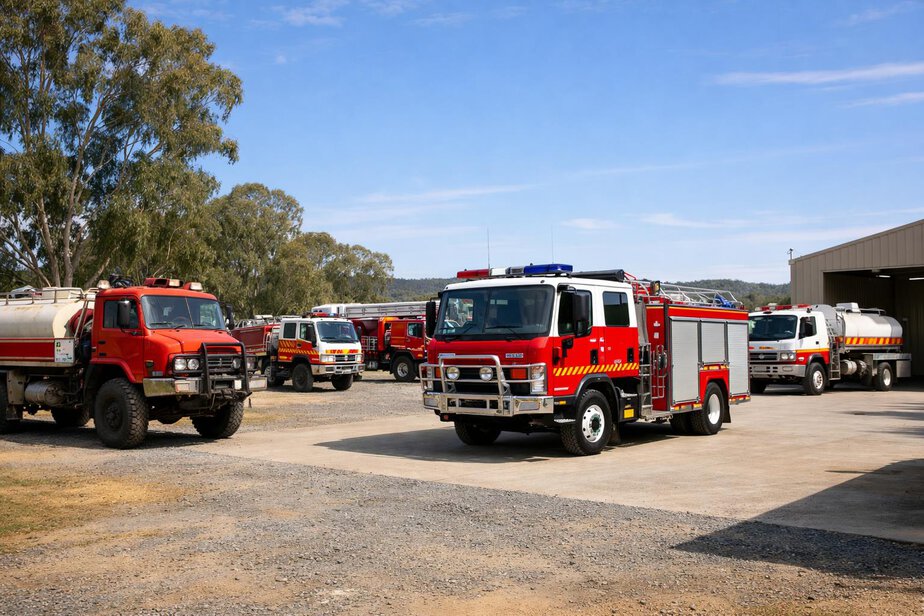
Fleet health scoring, replacement priorities and traffic-light warnings
With around 100 brigades and multiple appliance types, senior leaders need a simple way to see where attention is needed. A Fleet Health Score out of 100 can provide that overview. It should not replace professional judgement, but it can help rank vehicles and reveal emerging risks.
A practical score could combine age, mechanical condition, servicing history, breakdown history, fleet gaps, reserve coverage and replacement backlog. The point is not to create a perfect mathematical answer. The point is to give managers a consistent indicator that supports decision-making.
| Colour | Meaning | Management response |
|---|---|---|
| Green | Healthy | Continue planned monitoring and routine maintenance |
| Amber | Review or watch | Check workload, service history and future role; prepare options |
| Red | Urgent attention | Escalate for replacement, transfer, repair or risk mitigation |
The system can also produce automatic replacement recommendations and explain why they were made. For example, it might advise:
Plan replacement in 2028 because the appliance is 22 years old, has high repair history, operates in a high-workload brigade and has exceeded its normal mid-life workload.
That kind of note is useful because it gives decision-makers a clear starting point. Senior managers should still be able to override a recommendation, but the reason for doing so should be recorded. That keeps the system transparent and helps protect institutional memory when personnel change.
Fleet health scoring can also highlight capability gaps. A region may show healthy vehicles on paper but still lack enough reserve cover, or it may have good reserve depth but an ageing frontline pumper profile. The score should therefore be seen as a management prompt, not a substitute for analysis.
Annual whole-of-fleet review, long-term budgeting and avoiding the replacement cliff
A fleet program of this scale should be formally reviewed every year. The annual review should examine age profile, condition, workload, replacement priorities, transfers, reserves, capability gaps, future risks and expected expenditure. It should also compare the current fleet against the planned fleet so leaders can see whether the service is moving toward or away from its target structure.
This annual review is essential for avoiding the dreaded replacement cliff — the situation where too many appliances become due at once because the organisation delayed action for too long. If that happens, purchasing pressure spikes, budgets become unstable and the service may be forced into reactive decisions.
Instead, the fleet program should be introduced progressively across the whole lifecycle. Replacements should be spread over time so purchasing becomes a predictable annual program. For a mixed fleet of around 175 appliances on a 25-year lifecycle, the long-run average may eventually be about seven replacements per year, although actual annual demand will vary by appliance type, condition, cost and workload. The key point is not the exact number. The key point is smoothing the demand curve.
Budget planning should therefore include:
- estimated replacement cost by appliance
- annual capital budget
- planned replacements
- budget variance
- five-year and 10-year forecasts
- consequences of delaying replacements
Simulation is especially helpful. Senior managers should be able to test scenarios such as replacing five, seven or ten appliances per year. Those simulations can show the effect on age profile, reserve depth, risk and future capital pressure. If a service delays too long, it may face a period where several expensive units all need attention together, which can compromise operational capability and force difficult trade-offs.
In a well-run system, the annual review becomes part of normal governance rather than an emergency response to aging assets. The service can then plan staffing, procurement, maintenance and regional transfer decisions with much more confidence.
Governance, records and practical decision-making controls
Strong governance is vital when fleet decisions affect public safety and major public spending. A useful access structure could include:
- Guest — public or read-only information
- Fleet Manager — operational records
- Senior Manager — approvals, budgets, simulations and lifecycle decisions
- IT Administrator — security, users, settings, backups and audit systems
Important decisions such as transfers, replacement overrides and lifecycle changes should be recorded in an audit log. That log should show what was decided, who approved it and why. This matters because fleet decisions often carry long timeframes. A decision made today may not show its full effects for several years.
Good records also help with handover between staff. If a fleet manager retires or a district changes leadership, the organisation should still be able to see why a vehicle was retained, moved or replaced. That protects continuity and makes later reviews much easier.
Equally important is the separation of public and authorised actions. Brigade leaders may provide valuable operational input, but they should not be expected to independently manage capital budgets or override fleet engineering advice without the proper approval path. Likewise, mechanics should provide technical evidence, but the final fleet decision should sit within a clear governance structure that balances operational need, safety, cost and long-term strategy.
Practical management principles for a 100-brigade fleet
Orange Land’s fictional example shows that fleet management works best when it follows a few steady principles rather than a single fixed rule. The first principle is to match appliance capability to actual risk, not just to station history. The second is to keep the newest and most reliable appliances in the highest-workload brigades. The third is to review heavily used appliances on workload, condition and service history rather than age alone.
The fourth principle is to use transfers positively. A transferred appliance is not automatically second-rate if it is mechanically sound and still fits the receiving brigade’s risk. The fifth principle is to keep reserve appliances regional, dependable and appropriately staged in their lifecycle. The sixth is to run annual whole-of-fleet reviews so that leaders always know the age profile, condition, gaps and future cost pressure.
Several other habits also make the system stronger:
- keep appliance layouts and controls as standard as practical
- document exceptions where local risk requires a different configuration
- track kilometres, pump hours, repairs and breakdowns consistently
- review regional reserve demand before the frontline fleet becomes stressed
- use long-range forecasts to prevent a replacement cliff
- record all major lifecycle and transfer decisions in an audit trail
- treat operational leaders and mechanics as partners in lifecycle assessment
In the end, the objective is simple. A fire service fleet should support safe, reliable and cost-aware operations across a broad and changing risk landscape. That means placing the right appliance at the right brigade, at the right stage of its lifecycle, while keeping enough reserve depth and budget predictability to serve the whole system over decades.
The most effective fleet programs do not chase the newest truck for every station. They build a disciplined cycle of allocation, review, transfer, reserve use and replacement so the service can keep responding when the community needs it most. Before publication or local application, verify the facts, assumptions and procedures against your organisation’s current policies, engineering advice and local decision-making requirements.
FireRescue Training Hub
Access practical fire and emergency study support resources, downloads, checklists, audio guides, and member-only course content.
- Course library
- PDF downloads
- Audio guides
- Checklists
Study support only. Not accredited training or a replacement for workplace procedures.
About the author and safety review
Ken Walker
Former Station Officer and fire service educator
Former career firefighter with extensive career and volunteer fire service experience.
Qualifications: Associate Diploma of Applied Science in Fire Technology; Institute of Fire Engineers studies.
Author profilehttps://www.firerescue.com.au/about-us/