
October 25, 2026
Who Is in Charge at an Emergency? How Incident Control Works in Australia
FireRescue Training Hub · Australian emergency services explained
Who Is in Charge at an Emergency? How Incident Control Works in Australia
What an Incident Controller does, who has authority, and why clear decisions matter from the first call to the final handover.
Quick answer: At an Australian emergency, the Incident Controller is responsible for the overall management of the response, within the authority of the relevant organisation and jurisdiction. The role is supported by crew leaders, other agencies and a shared incident-management system. Not every emergency has the same control arrangements.
Key takeaways
- Control of the overall incident is not the same as command within each emergency-service agency.
- The authorised Incident Controller sets priorities and coordinates the response.
- AIIMS 2025 provides a shared, scalable management approach and formally includes safety as a principle.
- Level 1 incidents can be managed with local or initial response resources; they are not automatically low risk.
- For the public, staying safe and following official advice matters more than knowing the rank of the person in charge.
The first few minutes: one incident, many moving parts
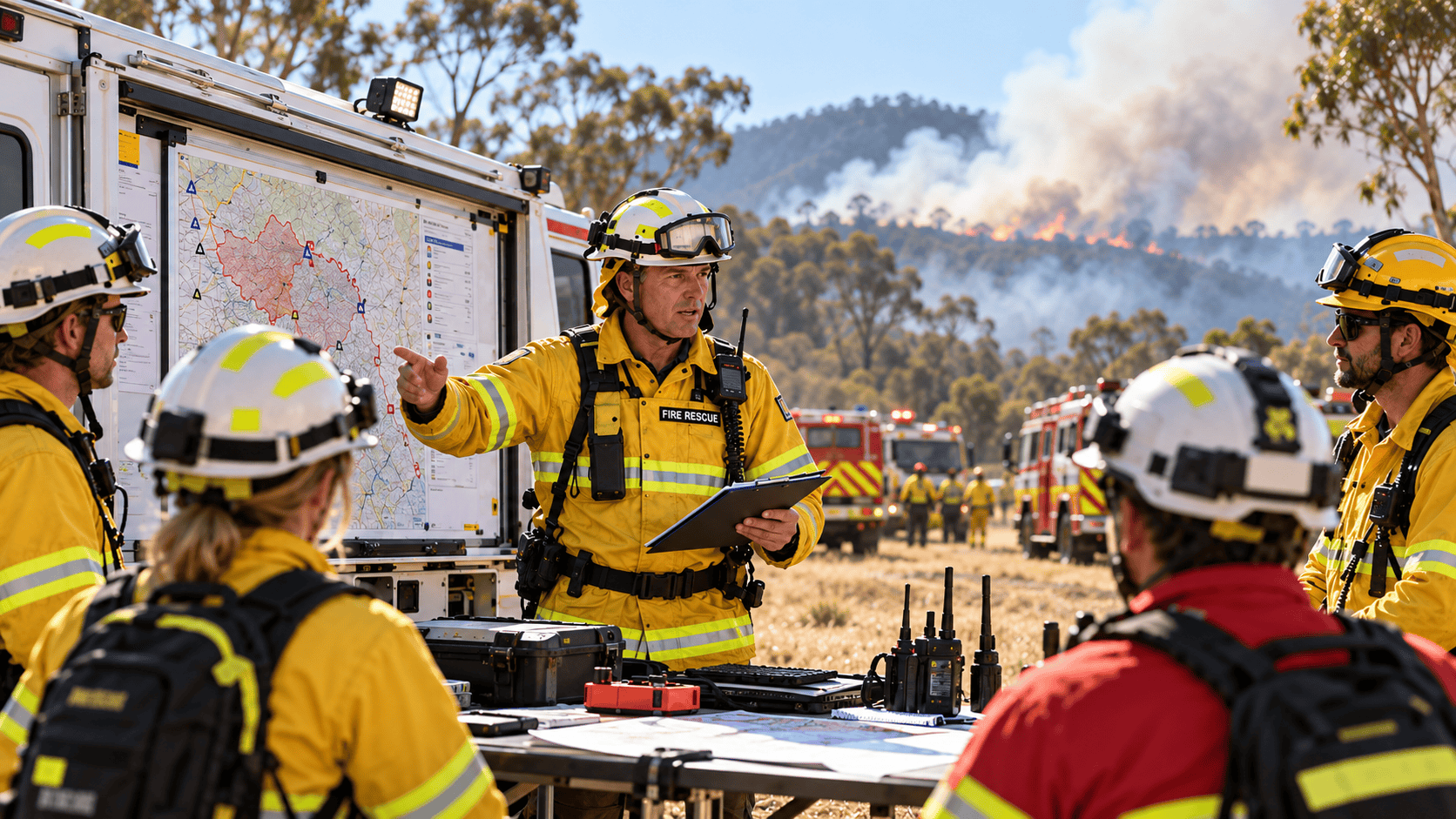
Picture a weekday afternoon in a regional Australian town. Smoke is coming from a small workshop. A neighbouring business calls Triple Zero, someone starts moving workers away from the building and a fire crew receives the job. There may be a person unaccounted for. The wind is pushing smoke across the road.
Before anyone gets close to the affected building, several things need to happen. The right resources must be sent. Responders need a reliable address and an understanding of the initial hazards. The crew must travel safely, arrive in a suitable position and establish who is responsible for controlling the incident.
This is an illustrative scenario, not a report of a real event. But it shows why the most important question at an emergency is not always “Where is the fire?” Sometimes it is: Who is making the decisions, and does everyone know?
Who is in charge at an Australian emergency?
At a responding emergency, the person with responsibility for the overall management of incident-control activities is generally called the Incident Controller. The role involves making or approving objectives, setting priorities, coordinating resources, managing changing risks and maintaining an understanding of what is happening across the incident.
That does not mean the Incident Controller personally directs every hose, vehicle or task. Crew leaders and supervisors carry out their own responsibilities. It means there is an identified point of accountability for the incident as a whole.
The exact appointment depends on legislation, incident type, agency arrangements and jurisdiction. A uniform, rank or being first to arrive does not give someone unlimited authority at every kind of emergency. In the Australian Public Safety Training Package, the Control a Level 1 incident unit specifically links the role to appointment by the organisation with legislative responsibility and to its policies and procedures.
Who decides which agency has control?
Different emergencies can involve different responsible agencies. A structure fire, bushfire, traffic incident, hazardous-material release, flood or other emergency can raise different statutory responsibilities and operating arrangements. The agency with the relevant legislative or agreed responsibility is often called the control authority or, in some systems, the lead or combat agency.
Other organisations may have essential roles without taking overall control. Police may manage traffic and other police functions; ambulance personnel manage clinical care; utilities may isolate services; local government and other organisations may assist. Exactly how these roles are arranged depends on the incident and jurisdiction.
This is why the response needs an agreed control arrangement. A member of the public should not assume that the organisation with the largest number of vehicles at a scene must be the one controlling the whole emergency.
Control, command and coordination are different
These words sound similar, but they do different work. Control is the overall direction of incident activities. Command is the authority an organisation exercises over its own personnel and resources. Coordination helps organisations, services and resources work together towards a common response.
Imagine fire crews, police and ambulance teams working at the same location. Each service maintains its professional responsibilities and chain of command. Incident control provides the wider priorities and arrangements that allow their efforts to fit together rather than conflict.
None of these functions should be treated as a reason to cross into another service’s specialist decision-making. An Incident Controller is expected to obtain advice and use qualified people for the decisions that require particular expertise.
What does an Incident Controller actually do?
The role is more than making radio calls. The controller needs to understand the problem, make sensible decisions with imperfect information, and check whether those decisions are having the intended effect. Typical responsibilities include confirming the control arrangement, communicating priorities, organising the response, maintaining records and recognising when extra help is needed.
There is an important human side too. Responders need understandable instructions, reasonable supervision, suitable protective arrangements and attention to welfare. Community members may need reliable information and protection from hazards created by the incident.
The incident can change faster than the initial plan. A skilled controller does not cling to an early assumption just because it appeared in the first report. New observations should influence the assessment, objectives, resources and safety measures.
Arrival: the first useful report
Let’s return to our fictional workshop. The first crew approaches from a safe route and observes the smoke, access points, people outside, nearby buildings and potential exposures. The initial information passed from the caller may be incomplete or partly wrong. There could be gas cylinders, stored chemicals or electrical equipment that was not mentioned.
Agency procedures determine how the crew formally reports arrival and establishes control. A brief initial situation report helps other responders understand the location, what is happening, immediate threats, actions already under way and whether more resources are required.
One Australian example is the NSW Rural Fire Service guidance for initial incident control. It describes the first arriving officer’s duties and an established process for control handover. That is useful context, not a universal procedure that should be copied into every Australian agency. Responders must follow their own organisation’s authorised arrangements.
A size-up starts with people and hazards
An initial assessment or size-up is the disciplined effort to work out what is occurring, what could happen next and what can be done safely. It does not end after the first look. The team keeps reassessing as observations, reports and conditions change.
In our example, the crew needs to clarify whether anybody remains inside, whether smoke or fire threatens neighbouring occupancies, and whether the building or stored materials create hazards beyond an ordinary workshop fire. Road traffic, bystanders, wind direction and the availability of water can all matter.
Responders do not have to know every answer before protecting people from an obvious immediate danger. But actions must remain within their training, equipment, authorisation and safe operational limits. Uncertainty itself should be reported, not hidden beneath confident language.
From observations to incident objectives
Objectives describe the outcomes the response is trying to achieve. They need to be understandable, realistic and consistent with safety and organisational requirements. For a small fire, an objective may concern life safety, preventing the incident from spreading or keeping the public away from a hazardous area.
An objective is not the same as a tactic. “Protect nearby occupants” describes a desired outcome. A specific crew assignment, route or suppression action is a way the organisation might achieve that outcome. This distinction helps an Incident Controller adapt the method without losing sight of the reason for the response.
Priorities should be communicated so all participating personnel understand what matters now. If circumstances change, objectives and tasks may need to be reviewed, with the changes passed to the people affected.
What is an Incident Action Plan?
An Incident Action Plan, usually shortened to IAP, brings together the response objectives, strategies, tasks, resources and relevant safety and communication arrangements. Its detail and format depend on the incident and the organisation’s procedures. Smaller incidents need an appropriately scaled plan; bigger or more demanding incidents may require a more developed management structure and documentation.
The national Level 1 incident unit includes developing and implementing an IAP. Its assessment evidence also refers to a written incident action plan. That matters for formal assessment: a general conversation about “having a plan” is not by itself evidence that all requirements have been met.
For the public, the important idea is simple. Firefighters and other responders are not meant to improvise independently in different directions. Their work needs agreed objectives, assigned responsibilities, clear communication and regular review.
How do crews keep a shared picture of the emergency?
Incident information arrives from many places: dispatch messages, arriving crews, people who have escaped, specialist advisers, observations from other agencies and changes in weather or site conditions. Some information is verified. Some is only a report. The difference is worth keeping clear.
Shared situational awareness means responders are working from a sufficiently common, current understanding of the incident. It depends on concise reports, listening, confirmation where needed and a way of recording significant decisions or changes.
At the workshop, one crew might discover that the neighbouring tenancy shares a roof space. Another may report that the person thought to be missing has already left safely. Both findings could change priorities. They are useful only if they reach the right people and are acted on.
Why communication and reporting lines matter
A busy incident can generate a lot of radio traffic and face-to-face instructions. Without clear reporting arrangements, two teams might be told to do conflicting things or assume somebody else has dealt with a task.
AIIMS is designed to support a scalable management structure with clear responsibilities. A small incident may need only a compact arrangement; as complexity increases, additional supervisory or functional roles can be introduced. The point is to keep the response manageable, not to create paperwork or positions for their own sake.
Good instructions say what is needed, who is responsible, what relevant hazards are known and how to report progress or a change. Crew leaders should be able to raise new risks promptly. An early warning about a worsening situation is valuable information, not an interruption.
AIIMS 2025: the system working behind the scenes
Australia’s common incident-management doctrine is the Australasian Inter-service Incident Management System (AIIMS), maintained by AFAC. The 2025 edition is the latest, replacing the 2017 edition. It provides a shared approach for agencies that need to manage emergencies together.
AIIMS is designed to be flexible and scalable. It supports management by objectives, clear authority and responsibilities, workable supervision, functional management and information flow. Importantly, the 2025 edition formally makes safety a principle, strengthening its place in incident-management decisions.
AIIMS does not erase legislative responsibilities or replace an agency’s procedures. Nor does every small incident need a full Incident Management Team. If you want the detailed system structure, see FireRescue’s AIIMS 2025 guide; this article focuses on what incident control looks like to people watching an everyday response.
What is a Level 1 incident?
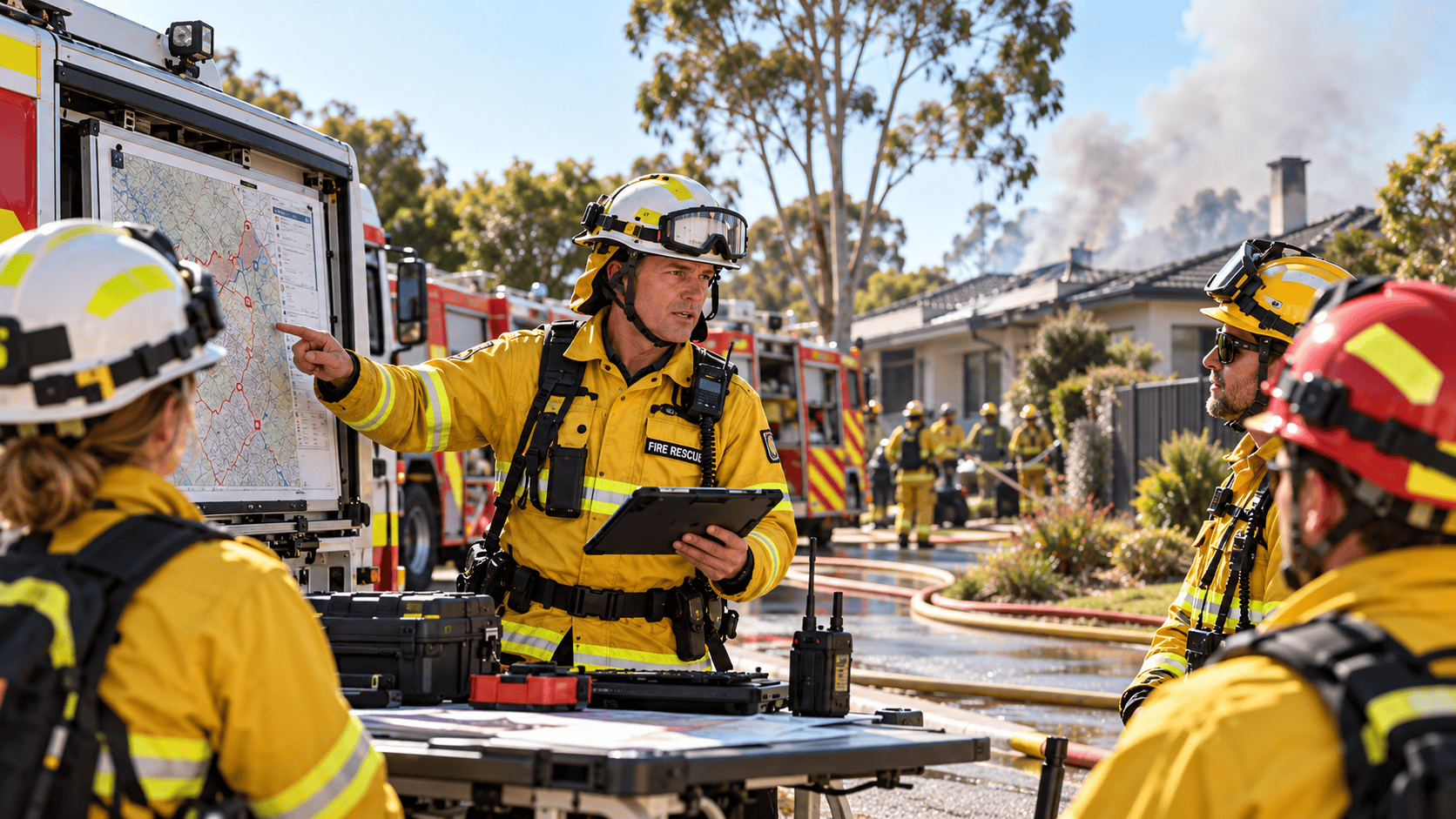
In the Australian unit PUAOPE012 — Control a Level 1 incident, a Level 1 incident is characterised by being manageable using local or initial response resources only. That is about the resources and management demands of the event, not simply the size of the smoke plume or the number of people nearby.
A small incident still needs competent control. It can involve a difficult hazard, a changing scene and meaningful decisions about safety. Equally, a call that appeared routine might grow beyond initial expectations.
The Level 1 description belongs to an incident-management framework. It should not be confused with a public warning level or treated as reassurance that conditions are harmless.
When does a small incident need to escalate?
The controller continually asks whether the available people, equipment, expertise and control structure remain suitable. A spreading incident, a serious unresolved hazard, multiple affected sites or increasing demands on supervision could justify requesting further resources or changing the management arrangements.
Escalation should be based on the actual or reasonably anticipated complexity, not delayed merely to keep the incident labelled “Level 1”. Conversely, bringing in help does not mean the original crew has failed. Recognising limits early can protect responders and the community.
For a real-world illustration of one agency’s approach, NSW RFS doctrine describes situations in which incidents may require resources beyond the initial response or additional management structure. Specific thresholds, appointments and handover procedures still depend on the relevant authority.
What happens when other emergency services arrive?
At the workshop, ambulance personnel may attend to assess people affected by smoke, police may assist with traffic or public access, and electricity or gas providers may be asked to deal with their infrastructure. Each brings its own expertise and legal duties.
The control arrangements should make clear how these services exchange information and coordinate their work. The Incident Controller needs to know what others are doing and what decisions could affect the wider incident. Equally, supporting services need to know the agreed priorities and where relevant hazards exist.
The presence of several agencies does not automatically mean they all share identical powers. Good cooperation relies on respecting each organisation’s role while maintaining an integrated response.
Who issues warnings and tells the community what to do?
Incident information for the public needs to come through the responsible authorities and their authorised arrangements. Crews on scene may need to communicate immediate safety directions, but formal public warnings and wider messaging follow relevant agency processes.
The Australian Warning System uses three nationally recognised levels: Advice, Watch and Act and Emergency Warning. These are about the potential or actual threat to people and the actions they should take. They are not the same as Level 1, 2 or 3 incident management classifications.
A warning is a snapshot of conditions and may change quickly. People should follow the wording and instructions in current official messages, rather than guessing what a particular incident-management label means for their own safety.
What should the public do at an incident scene?
If you discover a serious emergency, move somewhere safe and call Triple Zero (000) for police, fire or ambulance as appropriate. Give an accurate location and tell the operator what you can safely see. Follow their instructions and stay on the line when asked.
When emergency crews arrive, leave room for appliances and other responding vehicles. Keep clear of cordons, damaged structures, smoke, fallen lines and other hazards. Do not enter a dangerous area to take photographs or check whether a business or property has survived.
If you have information that could help—such as a person last seen in the building or the location of a known hazardous material—give it to emergency personnel from a safe place. Avoid spreading unverified rumours online. Use your state or territory’s official warnings and trusted emergency broadcasts for wider updates.
When is an incident actually finished?
An emergency does not end just because the visible flames are gone or the fire appliances begin to move. Before formally concluding operations, responders may need to confirm hazards are controlled to an acceptable level, outstanding responsibilities are understood, records are completed and the next responsible parties have been informed.
Post-response work can include equipment cleaning and replenishment, crew welfare checks, debriefing, reporting and arranging follow-up action. These are recognised parts of the Level 1 incident unit, not optional extras to think about weeks later.
A building can remain unsafe for occupancy after firefighting operations conclude. Re-entry, utilities, contamination, structural assessment and investigative requirements may need separate decisions or professional advice. Members of the public should wait for the relevant authority’s instructions.
Professional perspective: what good control looks like
For learners interested in the operational side, it helps to think of incident control as a sequence of decisions that keeps repeating: understand, prioritise, direct, check and adapt. The sequence is a learning aid, not a substitute for official AIIMS doctrine or agency procedures.
Clear control becomes especially visible when the original information is wrong. The early crew might hear “everyone is out”, then receive a credible report of somebody missing. Or a minor external fire may begin affecting an adjoining building. Good leadership allows those reports to change the plan rather than forcing the scene to fit an earlier assumption.
The official unit also expects decisions to be recorded, hazards and risks managed, personnel supervised, stakeholder communications addressed and a higher level of management considered when appropriate. Knowledge is useful; operational authority, capability and assessment are separate matters.
What workplaces and community groups can learn
Businesses, community facilities and volunteer organisations cannot appoint themselves as the statutory Incident Controller for a public emergency. They can, however, prepare to support responders by having clear internal responsibilities, accurate site information and people who understand how to raise the alarm and move others to safety.
Useful preparation includes knowing the site address and access points, keeping emergency plans current, identifying hazardous processes and essential service locations, and making suitable information available to arriving crews. Staff should know who meets responders from a safe location and who can answer questions about the building or workplace.
The limits matter. A workplace emergency warden, manager or first aider should not treat an internal emergency role as permission to enter a dangerous area or direct emergency-service operations. Follow your workplace’s lawful procedures and the instructions of responding authorities.
Frequently asked questions
Is the first firefighter at the scene always in charge?
Not automatically across Australia. Some agency procedures give the first authorised arriving officer initial control, with a defined handover process. Legislative responsibility, agency policy and the incident type determine the applicable arrangement.
Is a Level 1 incident the same as an Advice warning?
No. An incident level concerns the resources and management complexity of the response. Advice is a public warning level under the Australian Warning System.
Does the Incident Controller personally supervise every firefighter?
No. Roles may be delegated and crew supervision occurs through the relevant chain of command. Overall incident control is different from managing every individual task.
Can an online course qualify someone to control an incident?
No. Online study can build understanding. Appointment, organisational approval, required qualifications and practical assessment must be considered separately. A FireRescue course completion certificate is not national accreditation or operational authorisation.
Where to learn more about Australian incident management
For the deeper doctrine, start with the AFAC AIIMS overview and the national PUAOPE012 unit requirements. They explain the system and the formal knowledge and performance expectations, rather than describing a single agency’s daily procedures.
For supporting examples, the NSW RFS Incident Controller guideline provides a published agency approach to initial control and handover. Our existing urban and rural firefighting comparison shows why tactics and resources differ, even when the underlying need for coordination is similar.
Explore structured study support
If you’re interested in incident leadership, crew safety or firefighting, the FireRescue Training Hub offers structured online study resources, with free and members-only options. You can also browse the current course directory to see what is available.
These are non-accredited learning resources. Availability varies by course; operational authorisation and workplace assessment are separate.
Conclusion and practical next steps
So, who is in charge at an emergency? In Australia, an authorised Incident Controller provides overall direction under the relevant legislative and organisational arrangements. Other responding services and crew leaders retain their own responsibilities while working towards a coordinated outcome.
The lesson for the public is to call for help early, give useful information, stay clear of the incident and follow official advice. For workplaces, it is to have clear contacts, current emergency information and a practical way to support responders. For professional learners, it is to understand that good control depends on safety, communication, shared awareness and the willingness to adapt.
Before an emergency happens, check your workplace or household plan, confirm which official warning sources apply where you live, and learn the basics of who holds authority when different agencies arrive. Those small preparations make the larger emergency response easier to understand.
Official sources and further verification
- AFAC — Australasian Inter-service Incident Management System (2025 edition).
- AFAC — AIIMS Principles 2025 update and safety principle.
- Training.gov.au — PUAOPE012 Control a Level 1 incident.
- NSW Rural Fire Service — Incident Controller function (agency-specific guidance).
- NSW Rural Fire Service — Approach and size-up (agency-specific guidance).
- Australian Institute for Disaster Resilience — Australian Warning System.
- Australian Government — Triple Zero (000).
Sources checked 25 October 2026. Agency policies, appointments and public warnings must be checked against current local requirements.
Corrections and field experience: Have a source-backed correction or useful community or fire-service experience that would improve this guide? Contact FireRescue. Clearly identify personal observations so they are not confused with official policy.