T-REX 800kg Electric Hoist Review & Guide (12V 360° Crane)
Excerpt: A practical Australian review of the T-REX 800kg Electric Hoist—a 12V, 360° vehicle-mounted crane for lifting engines, pumps, sandbags, and heavy kit. Learn how it works, where it shines, safety must‑knows, maintenance, and smart buying advice.
Last updated:
Overview
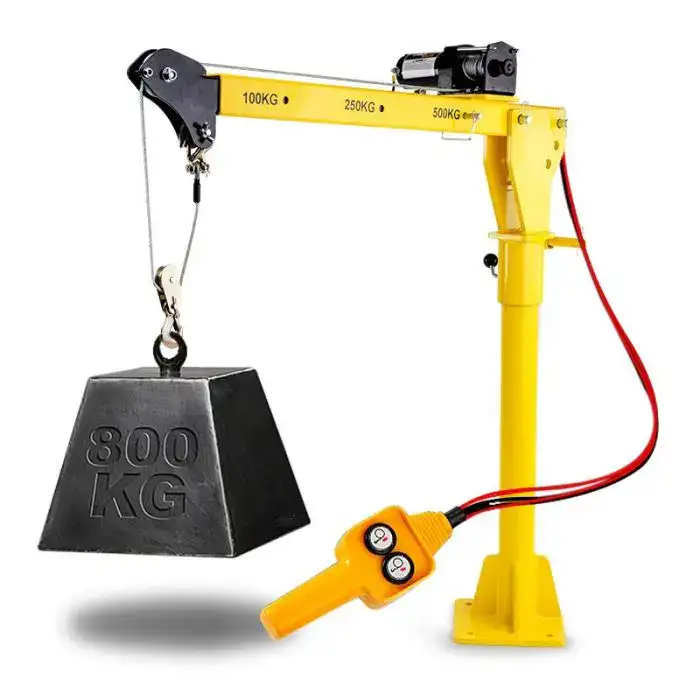
The T-REX 800kg Electric Hoist is a compact, vehicle‑mounted 12V crane designed for lifting and positioning heavy loads in the field. Commonly fitted to utes and service vehicles, it can rotate through 360° to move engines, pumps, generators, sandbags, and tool chests safely onto trays or the ground. Its appeal is portability: carry the crane to where work is, rather than bringing every load to a workshop gantry.
For firefighters and emergency crews, a reliable hoist reduces manual handling injuries while speeding up tasks like positioning portable firefighting pumps at creeks, lifting flood barriers, or loading chainsaws and salvage equipment after storms. Members of the public use similar cranes for maintenance, farm work, boating, and engine swaps. The secret is using rated gear and an anchor point that meets or exceeds the stated Safe Working Load (SWL).
This guide explains how the unit works, best‑practice setup, safety considerations, and how it compares to alternatives like workshop engine cranes. We also include maintenance steps to extend life and a buyer’s checklist to avoid common pitfalls.
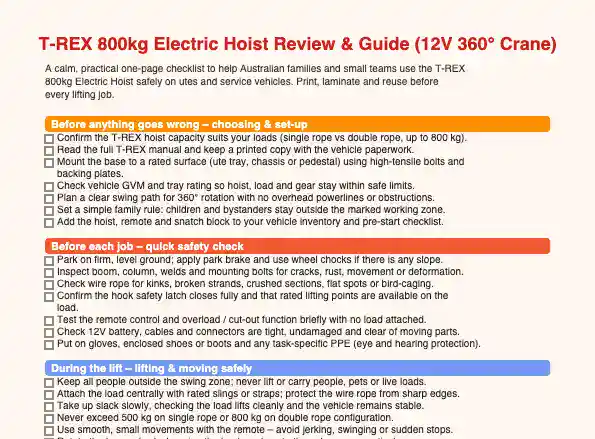
Download teh Checklist:
Key Features
How It Works
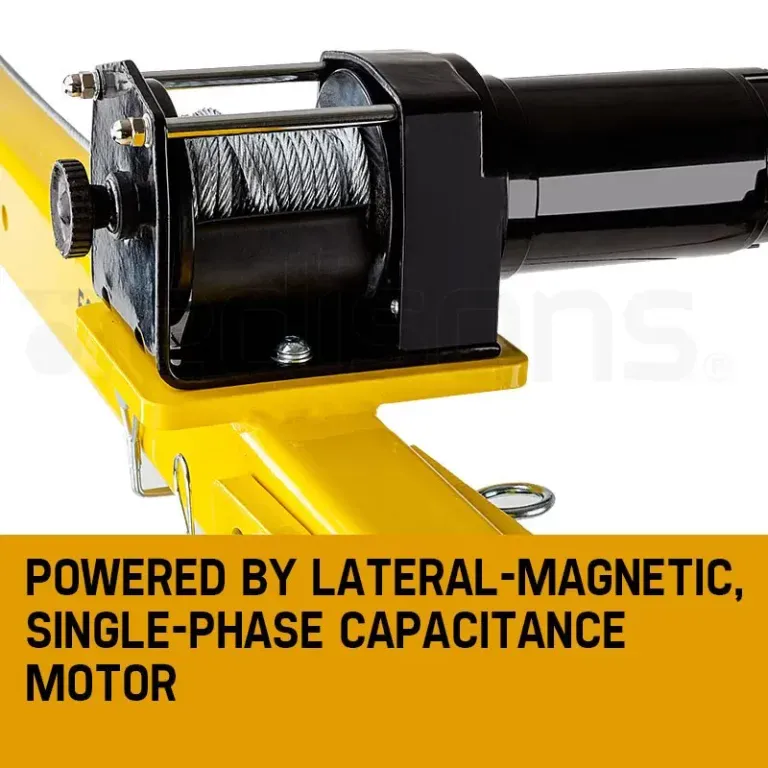
The T-REX 800kg Electric Hoist uses a 12V winch motor to drive a wire rope (or chain, depending on kit) over a boom. The mast rotates manually for positioning. A wired hand control typically manages raise/lower; some kits add an emergency stop. Power is usually via heavy‑gauge leads direct to the battery with an inline fuse or breaker.
- Mount the base to a reinforced point (tray or chassis receiver) using high‑tensile hardware.
- Connect the fused 12V supply and test “up/down” without load.
- Attach rated sling/chain to the load’s lifting points; keep the hook’s latch fully closed.
- Lift a few centimetres to confirm balance, then raise steadily. Use a tag line to control swing.
- Slew the mast and lower into final position. Never place any part of your body under a suspended load.
Why Choose the T-REX 800kg Electric Hoist?
Key advantages for emergency work and general use include:
- Injury prevention: Reduces high‑risk manual handling, especially when loading pumps, generators, and sandbags at awkward heights.
- Rapid deployment: Vehicle‑powered and ready to go—ideal in remote firegrounds and storm clean‑ups.
- Precision placement: 360° slewing and slow‑speed lowering help position delicate equipment safely.
- Space‑efficient: Mounts to a ute/truck; frees floor space compared to workshop cranes.
- Cost‑effective: Lower cost than permanent gantries; shares across crews by moving between vehicles.

Limitations & Safety Considerations
User Scenarios
Maintenance & Care Guide
- Inspect rope/chain for kinks, flats, corrosion, or stretch.
- Check hook latch closes fully; no cracks/deformation.
- Test up/down no‑load; verify e‑stop (if fitted).
- Confirm base bolts and pins are tight; no mast play.
- Wipe down; dry moisture to prevent rust.
- Rewind rope evenly; avoid over‑spooling.
- Disconnect controller; stow to prevent damage.
- Lubricate per manual; check bearings and sheaves.
- Torque critical fasteners; inspect mounting plate.
- Load test with a known weight under controlled conditions.
- Battery health check and fuse inspection.
- Keep the boom short for heavy lifts—protects rope and base.
- Use only rated shackles and slings with clear tags.
- Replace rope/chain at the first sign of crushed strands.
- Store the controller in a dry pouch; avoid UV exposure.
- Record inspections in a simple log (date, defect, action).
Comparison Table
| Model | Best For | Pros | Cons |
|---|---|---|---|
| T-REX 800kg Electric Hoist (12V) | Field lifting from a ute/truck; rapid deployment | Portable, 360° slewing, no mains power needed | Intermittent duty; mounting must be engineered |
| Hydraulic Engine Crane 1T (Workshop) | Garage engine swaps, flat floors | High lift capacity; no vehicle mods | Bulky; not practical on rough terrain or remote jobs |
| Compact 12V Ute Crane 500kg | Light/medium loads with minimal tray space | Smaller, lighter, easier to install | Lower capacity; may lack reach vs bigger booms |
FAQs
Where to Buy (Australia)
- Edisons — often stocks T‑REX branded hoists and accessories.
- Outback Equipment — lifting accessories, recovery gear.
Links & Manuals
- Product/Manual downloads (check your model): Edisons
- Safe Work Australia guidance on manual tasks and lifting: safeworkaustralia.gov.au
- WorkSafe Victoria—vehicle loading and lifting advice: worksafe.vic.gov.au
- Standards Australia (e.g., AS 1418 Cranes, hoists and winches; AS/NZS 4024 Safety of machinery): standards.org.au
- Emergency (Police/Fire/Ambulance): 000
- SES (Storm/Flood help): 132 500
- Poisons Information: 13 11 26
Create a SWMS/JSA for field lifts, specify exclusion zones, tag‑line control, dual‑battery/fusing requirements, and inspection intervals. Keep a laminated load chart at the crane and record operator training.
Credits & Review Notes
This guide synthesises common specifications and safe‑work practices for 12V vehicle‑mounted hoists. Always check your exact model’s rating plate, load chart, and manual—variants differ in boom length, rope type, controller, and duty cycle. Field procedures herein reflect Australian conditions and terminology.
Disclaimer: Always follow safety protocols and training when using equipment.