
October 28, 2026
What Firefighters Assess Before Entering a Burning Building
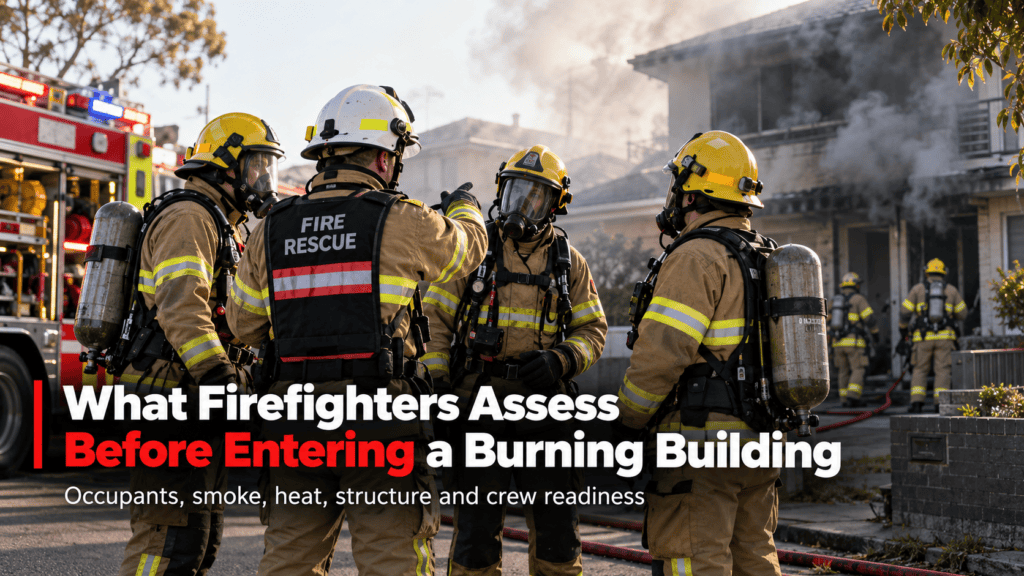
FIREGROUND SAFETY · AUSTRALIA
Before firefighters enter, there is a safety decision to make.
Before any interior firefighting decision, crews must weigh life safety, changing fire behaviour, structural risks and their own readiness. Here is what happens behind the scenes.
Australian fire safety guide · Scheduled 1 November 2026 · FireRescue Training Hub
At a glance
- Life safety and occupant information help shape priorities.
- Smoke, heat, fire development and structural condition can change rapidly.
- Breathing apparatus and protective clothing do not remove every hazard.
- Safe decisions rely on trained crews, communication and continual reassessment.
The first minutes: arriving is not the same as entering
Picture a familiar street in regional Australia. A neighbour has called Triple Zero. Smoke is rising above a house, people are gathering at the front fence and the first fire appliance pulls up. From the outside, it might look as though the crew has just one job: get through the door and put the fire out.
But there is a serious decision to make before any firefighter enters. The crew needs to understand what is happening, what is likely to happen next, who may still be inside, and whether an internal operation can be carried out within an acceptable level of risk. Firefighters may work on a number of tasks at once, and the decision is revisited as new information arrives.
This is not hesitation. It is disciplined fireground assessment, often called a size-up. The public sees the house. The trained crew is trying to understand the fire, the structure, the people and the changing conditions together.
What does a fireground size-up actually mean?
A size-up is a continuing process of gathering information, recognising hazards, weighing options and communicating a workable plan. It begins with the dispatch message and observations on approach. It continues after arrival, after the first actions are taken, and whenever conditions change.
A trained officer might receive an initial report of smoke from a bedroom, then discover that flames are affecting the roof space. That new observation matters because it changes the possible extent of fire, potential stability of parts of the building and the resources required. Similarly, a reliable report that someone is still inside affects the urgency and priorities, but does not eliminate the danger to rescuers.
The exact method, command arrangements and operational limits come from the relevant fire service. This article explains the considerations, not a procedure for readers to attempt building entry.
1. Occupants: who is out, missing or possibly trapped?
Life safety is central to the first assessment. Crews seek to establish whether everyone has escaped, whether a person was last seen inside and whether that information has been confirmed. A neighbour might say someone usually lives upstairs. A parent may report a child missing. These reports must be treated seriously, but firefighters also need to distinguish what a witness knows from what they assume.
Information about mobility needs, children, unfamiliar visitors and likely sleeping locations may help the Incident Controller decide what resources and priorities are appropriate. It is also important to know which occupants have already reached a safe location; incomplete headcounts can lead to unnecessary uncertainty.
For the public: move away from the building, tell emergency crews immediately if someone may be missing, and give the last known location if you know it. Do not go back inside to check. The Country Fire Authority’s advice is to get out, stay out and call Triple Zero (000).
2. Building layout, access and hidden spaces
The outside appearance of a building rarely tells the full story. A single-storey home might have an occupied extension, a concealed roof cavity, a garage connected to living spaces or a converted room at the back. Apartments and mixed-use buildings create different access, evacuation and compartmentation issues.
Responders consider known floor plans, number of levels, entrances, exits, stairways, doorways, attached structures and possible obstructions. They also need to understand the limits of that information. Renovations, blocked corridors and changes in use can make an apparently simple layout more complicated.
Fire doors and fire-resistant construction can help limit spread when intact and used correctly, but a crew must not assume those protections are functioning. For a public explanation of why closed doors matter, see our Fire Doors in Apartments guide.
3. Structural condition: what can the building still support?
Fire can weaken structural components, and the amount of damage is not always visible from the street. Roof framing, floors, walls, supporting connections and areas already damaged by heat or water may present a danger. Building materials and construction methods influence how a fire may spread and how different components respond.
Cracks, deformation, sagging, falling material or other indications of distress may be significant, but there is no simple visual checklist that can guarantee structural safety. Firefighters combine observations with available building information, their training and the judgement of the incident command team. They may need specialist advice or a change in operations.
In August 2026, Fire Rescue Victoria reported withdrawing firefighters from a Yarraville factory because of structural-integrity concerns. The external attack continued. It is a useful, documented reminder that a decision suitable five minutes ago may no longer be suitable now.
4. Smoke: information, danger and uncertainty
Smoke is not just something that hides the fire. It can contain toxic combustion products, hot gases and fine particles that threaten life and health. The way smoke moves may help experienced firefighters understand changes in the fire, available openings and possible fire spread.
Crews observe where smoke is coming from, how it is moving and whether conditions are changing. Smoke visible from roof spaces, concealed areas or several sides of a building may indicate a more complex incident than the original report suggested. However, smoke appearance alone cannot safely tell a crew exactly how hot a room is or whether entry is acceptable.
Modern research stresses that air movement and ventilation can influence fire development. Opening a door or creating an additional opening may change the flow of air and combustion gases, sometimes worsening conditions if the action is not coordinated with suppression. See the Fire Safety Research Institute’s structural fire dynamics material.
5. Heat: more than the temperature you can feel
High temperatures can affect firefighters, occupants, protective equipment and the building itself. Radiant heat can make an exposed position dangerous even where there are no visible flames immediately nearby. Inside a structure, heating of surrounding surfaces and hot gas layers can create a rapidly changing environment.
Firefighters interpret heat conditions alongside smoke movement, visible fire, building construction and other observations. They do not rely on a single sensation or device. Protective clothing helps reduce exposure, but it does not remove the risk of burns or heat stress.
A thermal imaging camera can be valuable for trained personnel, yet it is a supporting tool rather than proof of safety. Images can be affected by what the camera is detecting and by the limitations of its view. The crew still needs situational awareness, communication and a safe operational plan.
6. Fire development: how quickly could conditions change?
A compartment fire changes as fuel is consumed, heat accumulates and air becomes available. Fires may be fuel-limited or ventilation-limited at different stages. Changes to openings can influence the supply of oxygen and where hot gases flow. Firefighters therefore consider not only the fire they can see, but also the potential for it to grow or spread into other spaces.
Terms such as flashover and backdraft describe different hazardous fire phenomena; they should not be treated as interchangeable. Both are part of formal fire behaviour education, not cues for members of the public to diagnose a burning building from outside.
The critical idea is that fire behaviour is dynamic. A building fire can develop while people are speaking, while a line is being prepared or while information is being passed to the incident controller. A decision must reflect current conditions rather than the first report alone.
7. Doors, windows and ventilation: the air supply matters
Doors and windows influence airflow. When a compartment fire is ventilation-limited, introducing air can alter fire behaviour. The direction and extent of smoke movement also depend on openings, temperature differences, wind and the internal layout.
That is why firefighters treat ventilation as part of the wider incident strategy, coordinated by authorised personnel. It is not automatically helpful to smash a window or throw open a door to ‘let smoke out’. Such actions can create new flow paths that carry heat and gases into other spaces.
The Fire Safety Research Institute’s research on additional flow paths illustrates why ventilation decisions must be considered alongside suppression and occupant safety. For homeowners, the best advice remains much simpler: follow your escape plan, close doors behind you if safe, get outside and stay outside.
9. Crew readiness: having firefighters is not the same as having a safe crew
Before a hazardous task begins, the command team needs to understand what personnel and resources are actually available. Crew numbers alone tell only part of the story. Firefighters need appropriate training, supervision, suitable personal protective equipment, communications and a defined role for the conditions they may encounter.
Training, experience and organisational procedures influence what work a crew may undertake. A small first-arriving crew may be able to establish control, gather information, support evacuation and take other authorised actions while more resources are requested. It must not be assumed that immediate interior entry is always the correct or possible first action.
Good supervision includes ensuring personnel understand their assignments, limitations and reporting arrangements. It also means recognising fatigue, heat strain and other welfare concerns. The aim is effective work within a safe, accountable system—not simply doing the most visible thing first.
10. Breathing apparatus: essential protection, not a guarantee
Structural-fire smoke can create an atmosphere that is dangerous or impossible to breathe. Firefighters may require self-contained breathing apparatus (BA) for interior structural firefighting and other conditions involving smoke, heat, toxic products or low oxygen.
Breathing apparatus supplies air from a cylinder, but its safe use depends on specific training, equipment checks, team procedures, communications and supervisory controls. Wearing BA does not make a weakened floor strong, eliminate extreme heat or remove the risk of disorientation.
Fire and Rescue NSW’s equipment guidance explains the respiratory protection role of breathing apparatus. Australia’s Respond to Urban Fire unit also makes clear that this work is performed as part of a team under direct supervision and includes a relevant BA prerequisite for formal fire-sector issuance.
11. Communications: everyone needs the same changing picture
A sensible decision loses value if the people carrying it out do not know the plan. On a fireground, crews need clear directions and a reliable means of reporting new hazards, progress, difficulties or changing conditions. Information from one side of a building may be important to personnel working elsewhere.
Firefighters and supervisors maintain communications using the arrangements required by their organisation. A crew report about increased smoke, deteriorating stability or an unaccounted-for occupant may affect the whole operation. Information must reach the right person in time to be useful.
The public can help by speaking to an available firefighter or designated officer from a safe location, giving concise facts rather than guesses, and following directions. Avoid crowding entry points, approaching working hose lines or interfering with emergency vehicles.
12. Balancing rescue needs against firefighter risk
One of the hardest parts of structural firefighting is weighing the urgency of helping occupants against the real dangers of a deteriorating building. Command decisions take account of the available evidence about people, fire conditions, building stability, resources and the realistic benefits of possible operations.
There is no universal rule that a specific amount of smoke or a particular flame pattern always means ‘go in’ or ‘stay out’. A safe decision relies on trained judgement and organisational procedures applied to the whole situation.
This is also why defensive firefighting is not simply ‘doing less’. If interior operations would expose crews to unacceptable hazards, an incident controller may choose exterior operations, exposure protection and other measures that can still deliver important safety outcomes. The strategy may change as more information arrives.
13. Why a crew may stop, withdraw or change strategy
Firefighter safety depends on the willingness to reassess. A crew may begin with one plan, then discover that conditions have worsened, the structure is unstable, the fire has extended further than expected or available resources no longer match the task. Changing direction can be the correct professional decision.
Fire Rescue Victoria documented this at the Yarraville factory fire: firefighters using breathing apparatus entered, but withdrew because of concerns about structural integrity; aerial appliances then attacked the fire from above. That report is not a template for every incident. It demonstrates that assessment continued after operations started.
When crews change tactics, communication and accountability remain essential. The public should not interpret a temporary withdrawal or exterior position as firefighters abandoning the incident. Often, it is how the service manages the risk while continuing to protect people and nearby property.
14. The Incident Controller and the wider decision-making team
A building-fire response operates within the jurisdiction’s incident-management and command arrangements. The Incident Controller, or officer exercising the applicable command responsibility, must have an accurate picture of the situation and understand what personnel are doing. Decisions may involve several crew leaders, specialist advisers and other agencies.
Information about occupant locations, firefighting progress, utilities, exposures and building conditions needs to be brought together rather than kept in separate pockets. A shared picture supports safer allocation of work, appropriate resource requests and timely changes to the plan.
Not every house fire has a large command post, nor does every incident need the same structure. Incident management should be scaled to complexity and undertaken by properly authorised personnel. The important point for readers is that firefighters are part of a coordinated response rather than acting independently.
15. What happens when the first crew needs more resources?
The first response may not be enough for the conditions found on arrival. A reported kitchen fire can turn out to involve a roof space; a small shop may be attached to several occupied premises. The incident controller may need additional firefighters, specialist equipment, other emergency services or advice from people with particular expertise.
Requesting resources early can support crew safety and protection of the public. It does not necessarily mean the original response was inadequate; it may simply reflect improved information about the incident.
Factors affecting resource needs include the number and location of occupants, access difficulties, water availability, hazards, building size, adjacent exposures and the likelihood that the incident will grow. The exact dispatch and escalation arrangements differ between Australian jurisdictions and agencies.
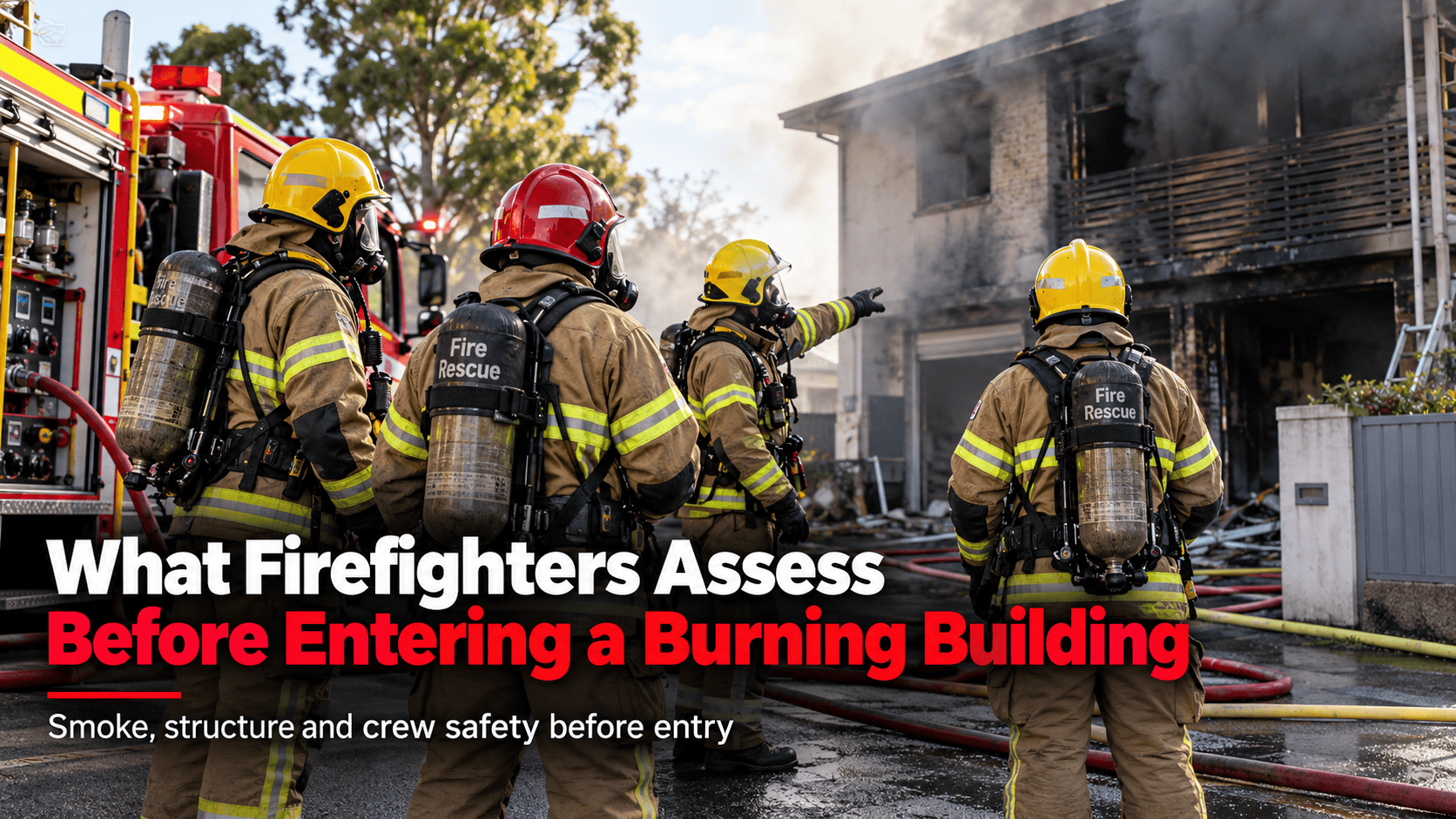
16. A fictional arrival: watching the assessment develop
Illustrative example, not a report of a real incident: Two appliances arrive at a suburban home after reports of smoke from the back rooms. A family member says everyone is outside, but then remembers a visiting relative might have gone upstairs. The officer asks for that information to be checked while the crew continues assessing from safe positions.
Smoke is visible beneath the eaves. A neighbour reports a possible gas cylinder stored at the rear. One firefighter provides an update about the building’s side access; another reports that the roofline looks different from the street view. None of these observations alone provides a complete answer.
The officer combines information about occupants, hazards, construction, fire conditions, crew resources and supervision before authorising tasks under the service’s procedures. As conditions change, the assessment changes too. That is the thread linking every topic in this article: there is no one-time safety decision that lasts for the entire fire.
17. How residents and witnesses can help the crews
When an emergency vehicle arrives, a resident may feel pressure to explain everything at once. The best information is short, factual and relevant. Tell crews the address and what you observed, whether you know anyone is missing, where they were last seen and whether you know of unusual risks such as gas bottles or stored chemicals.
Be clear about uncertainty. “I haven’t seen my neighbour come out” is different from “My neighbour is definitely inside.” Both matter, but they mean different things to the incident controller.
After giving the information, move to the safe area directed by emergency services. Keep driveways and access clear. Do not push past cordons, open doors or windows for firefighters, or re-enter to rescue possessions or animals. Follow any smoke or community advice issued for the area.
18. Preparation at home makes the fireground safer
Households can make a real difference before a fire ever starts. Working smoke alarms, a practised escape plan and clear exits help people leave earlier. A planned outdoor meeting point makes it easier to establish who has reached safety. Families should include children, visitors and people who may need assistance.
Closed doors can help limit smoke movement during escape when it is safe to close them, and the location of keys, exits and stairs matters. In an apartment building, follow the building’s emergency arrangements and relevant official advice.
The Country Fire Authority and Fire and Rescue NSW both emphasise getting out, staying out and calling Triple Zero. A family outside at the agreed meeting place is one less uncertainty for arriving firefighters.
19. For aspiring firefighters: what this teaches about the job
New recruits and interested volunteers sometimes picture firefighting as a sequence of physical skills: wear protective clothing, carry equipment and advance toward the fire. Those skills matter, but safe operational work also depends on judgement, observation, teamwork and the ability to report what is changing.
The Australian unit Respond to Urban Fire describes supervised team responsibilities involving safe entry, search and rescue, firefighting operations and reactions to changing fire behaviour. It is a useful reference for understanding the scope of structured training; it does not mean the general public can learn to enter a burning building from reading an article.
Formal competence requires the appropriate training and assessment arrangements. In the workplace, follow your organisation’s current procedures, supervision and authorised roles. Treat online resources as preparation for asking better questions, not as substitutes for supervised drills or operational instruction.
20. Five common misconceptions about fireground entry
- “The crew always goes straight in.” Entry depends on the assessed conditions, objectives, resources and authorised plan.
- “No flames means little danger.” Concealed fire, hot gases, smoke and structural weakness may still be present.
- “A breathing apparatus set makes it safe.” BA addresses respiratory hazards; it does not remove other risks.
- “Breaking windows lets the danger out.” Uncoordinated ventilation can change fire behaviour and spread.
- “Withdrawing means giving up.” A change to exterior operations may be the safer and more appropriate strategy.
Each of these misunderstandings overlooks the same fact: firefighting is a coordinated, evolving risk-management task. Good decisions are made from current information, not assumptions about what firefighters ought to look like on television.
21. Frequently asked questions
Do firefighters always search a burning house?
Crews consider the available information about occupants, conditions and operational feasibility. Search decisions are made by trained, authorised firefighters within their service’s procedures.
Can firefighters tell if a building is safe by looking at it?
No single outside observation guarantees structural safety. Crews consider the whole incident and reassess as information changes.
Why are firefighters wearing breathing apparatus outside?
Smoke and other respiratory hazards can exist outside a building too. BA use follows risk assessment and the fire service’s procedures.
Why might firefighters fight a fire from outside?
Extreme conditions, possible collapse or other hazards may make interior work inappropriate. Exterior operations can support life safety and protect exposures.
What should I tell the first fire crew?
Give clear facts about possible occupants, their last known locations and unusual hazards. Remain in a safe area and do not go back inside.
22. Final takeaway: assessment never really stops
Before a firefighter crosses a doorway, the important questions go far beyond whether fire is visible. People, building condition, smoke, heat, fire development, ventilation, crew readiness, breathing apparatus, communication and resource limits all influence the decision.
Those questions do not end once work begins. Firefighters and their supervisors continue to review conditions, sometimes changing the plan entirely. A disciplined decision to wait, withdraw or work from outside can be as professional as a carefully authorised interior operation.
For households, the most useful contribution is to prepare early: keep alarms working, practise escape, account for everyone and give responders accurate information. For aspiring firefighters, the lesson is that observation, reporting and crew safety are as important as any tool carried on the appliance.
Official sources and further reading
Sources selected for safety guidance, the Australian unit framework, operational examples and fire dynamics research. Official procedures and incident details should be checked again when reviewing this article.
- PUAFIR203 — Respond to Urban Fire, Release 1 (Australian Government training register)
- CFA — What to do if your house catches fire
- CFA — Home fire evacuation plan
- Fire and Rescue NSW — Uniforms and equipment (breathing apparatus)
- Fire Safety Research Institute — Structural Fire Dynamics
- Fire Safety Research Institute — Ventilation and additional flow paths
- Fire Rescue Victoria — Firefighters battle Yarraville factory fire, August 2026
- Fire and Rescue NSW — Home escape plans